35 CONCEPTS SEATTLE → WASHINGTON D.C. MAY–JUN 2026

ROOTS ON THE ROAD

35 t-shirt concepts for the transcontinental bike ride. Look through, pick the ones that speak to you, mark anything you want refined.

THE BRIEF

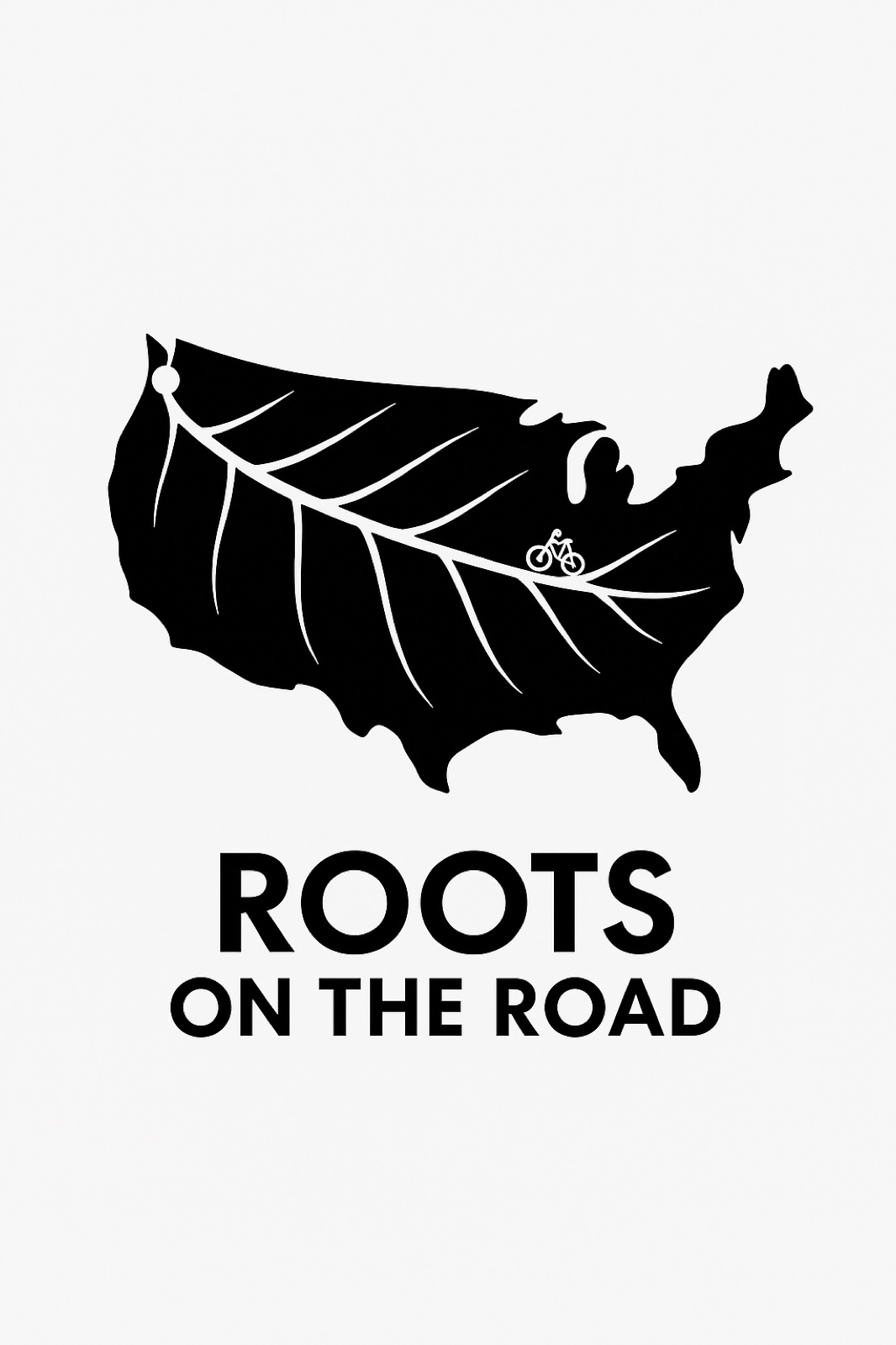
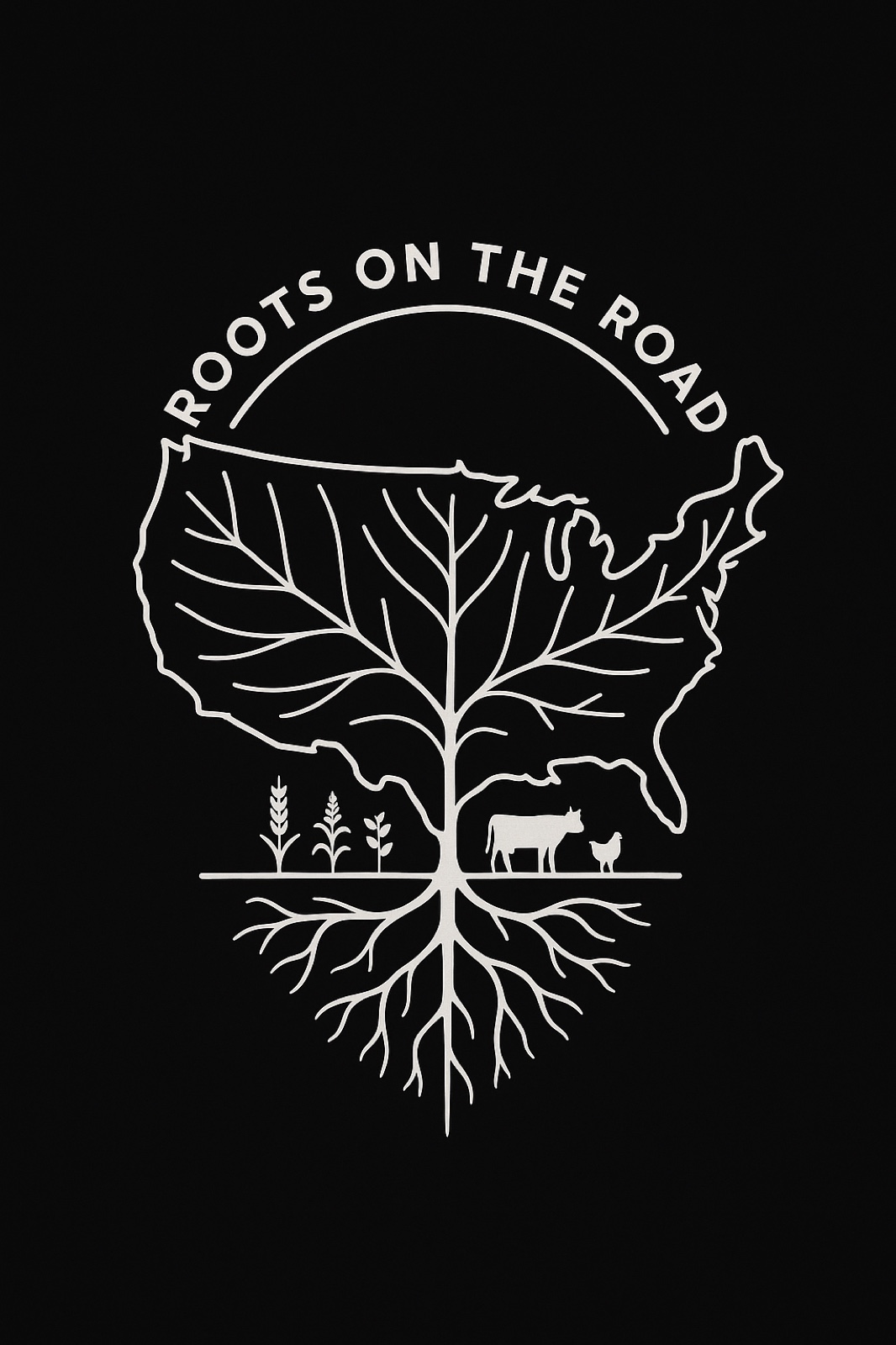
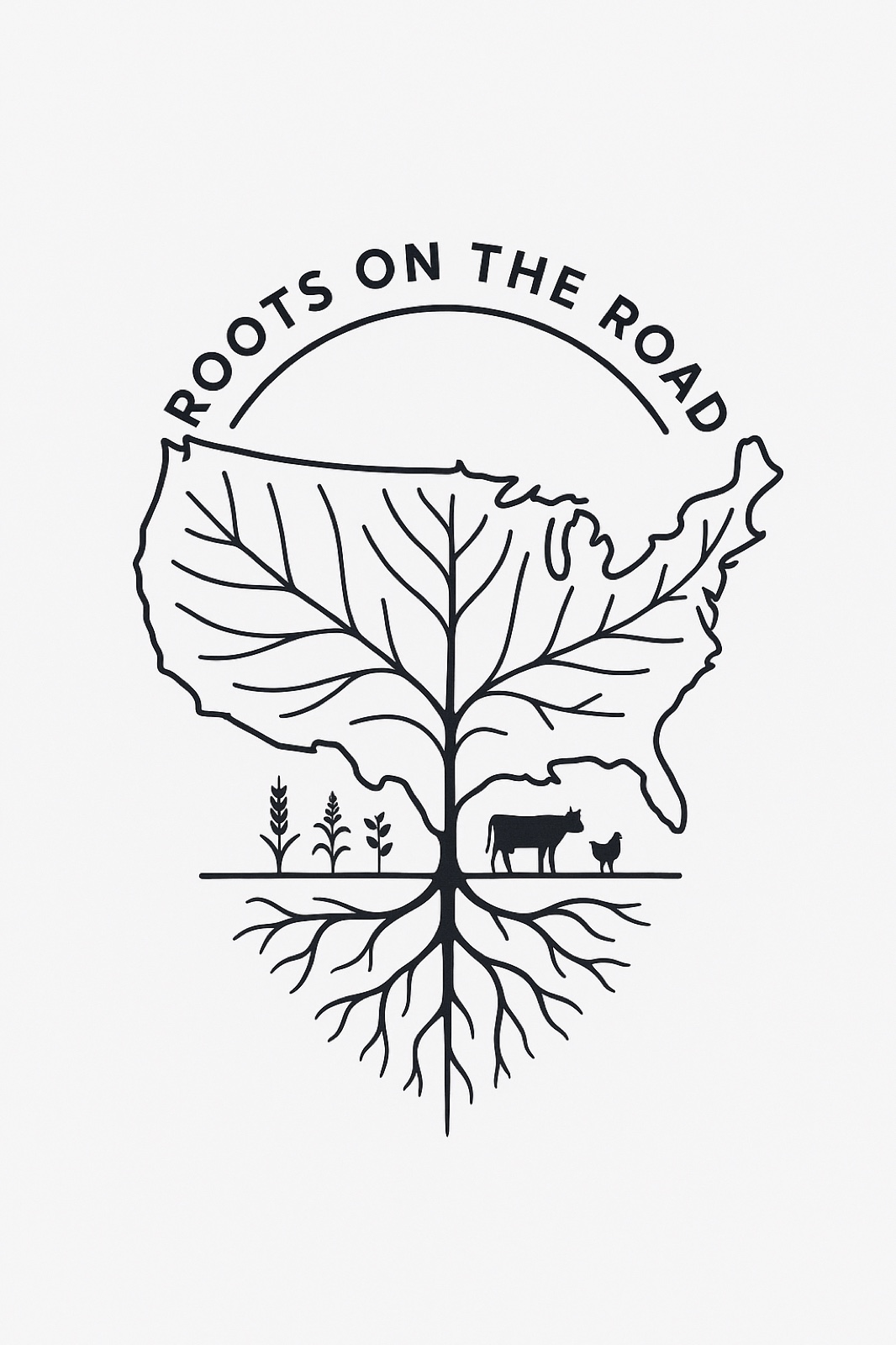
Creating a design for a t-shirt for a group of college students biking across the US to raise awareness for sustainable farming. The front will have a small logo with their name of the group — Roots on the Road. The back will have an outline map of the US with the southern border:

  1. Forming roots
  2. Forming plants that are farmed (wheat, soy, corn) and cows/chickens with the roots of the plants moving down
  3. Normal border

Additionally, the words Roots on the Road to be written across the northern tier of the US along a route from Seattle to Washington DC.

The designs will be printed on a green shirt with the design being white outline.

The ON BLACK previews below show how white ink will look on a dark (green) shirt. ON WHITE is the inverted reference.

Closest to the Brief

These eight map most directly to the ask — front wordmark with bike-wheel O's, the circular badge, and back designs featuring the US outline + route + crop roots.

11 Front — Small Logo

13

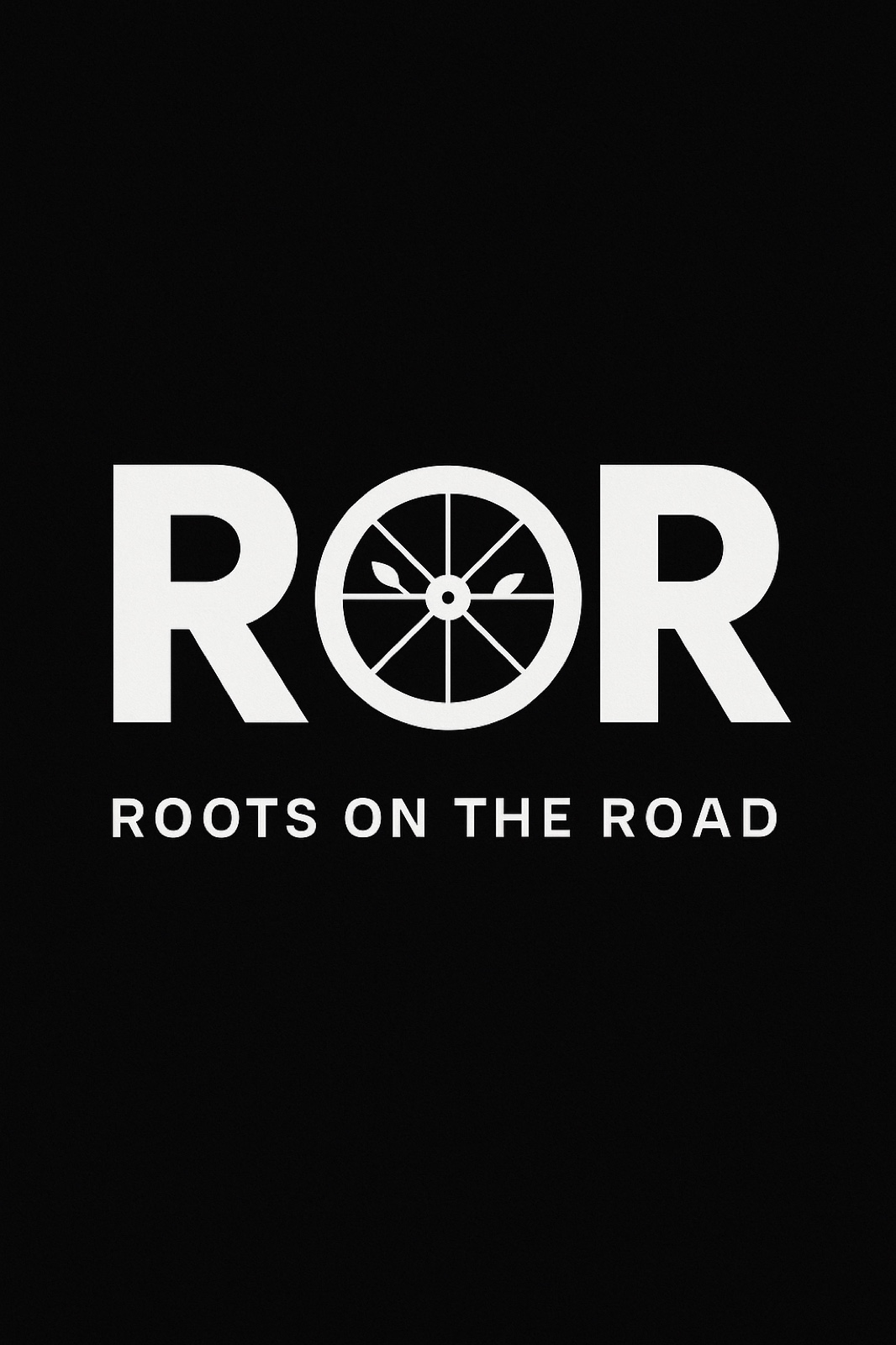
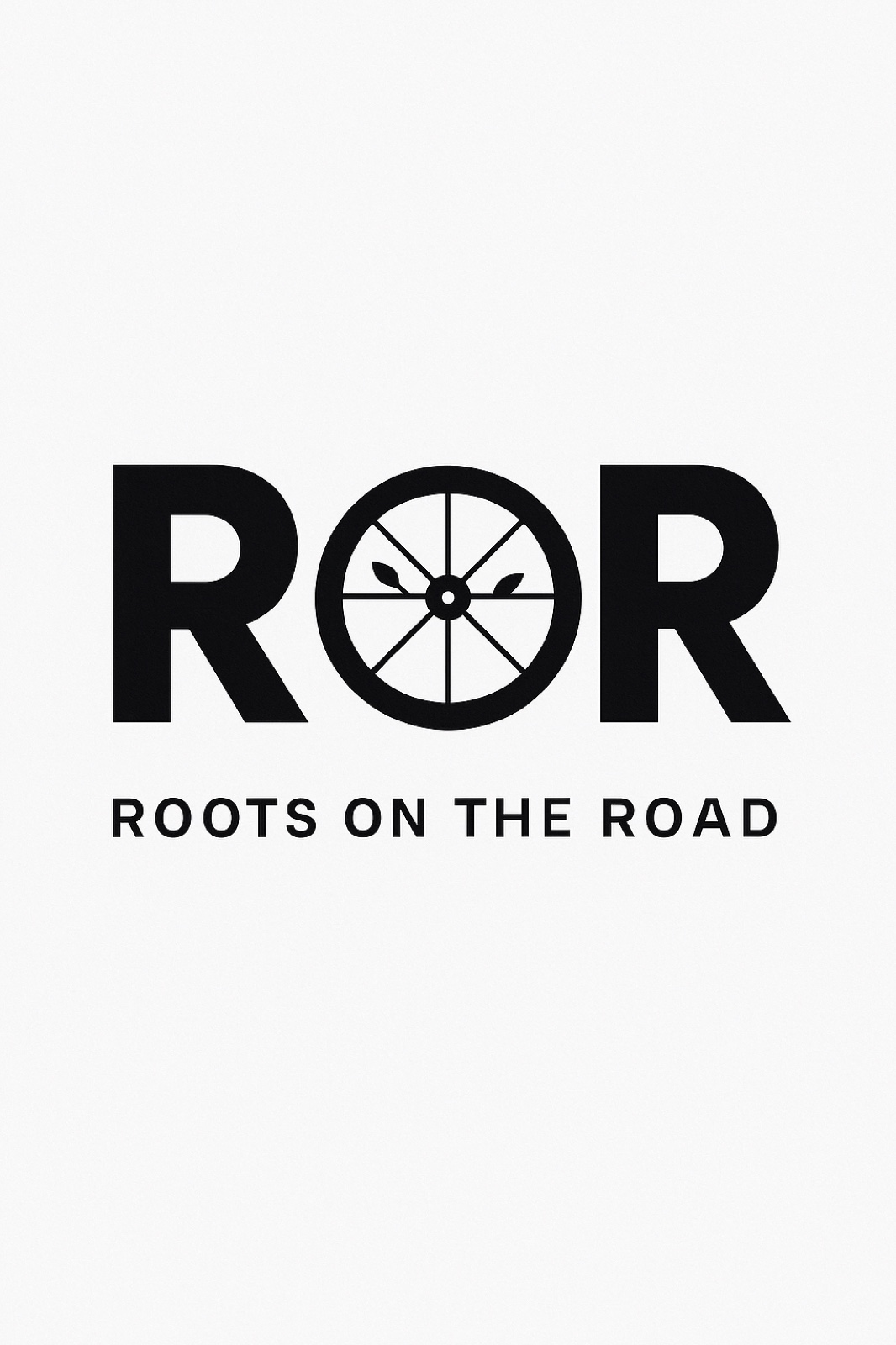
Monogram

Monogram on black
ON BLACK
Monogram on white
ON WHITE
PROMPT
A single iconic typographic monogram, centered on a solid pure black background. Square or near-square composition. The monogram fills roughly 60% of the canvas, generously surrounded by black negative space.

Subject: a Paul-Rand-style typographic mark in pure flat solid white. Three uppercase letters set tightly side-by-side as a three-character monogram: R · O · R (for "Roots On the Road"). The R's are set in a heavy modernist geometric sans-serif (Futura Bold, ITC Avant Garde, or similar), as solid white shapes. The central O is replaced entirely by a stylized bicycle wheel viewed dead-on — the O literally IS a bike wheel. The wheel is rendered as a perfect white ring (matching the visual weight of the R's strokes) with a small set of clean white spokes converging to a central white hub. Optional: two of the spokes can subtly suggest tiny leaves at their tips, as a quiet visual rhyme.

The three letters R-O-R sit on a shared baseline, perfectly aligned, the bike-wheel-O the same height as the R's. The whole mark must read instantly as both a wordmark monogram AND as a bicycle.

Below the monogram, with generous spacing, a single line of small mono caps centered: "ROOTS ON THE ROAD." That is the only secondary type on the entire image.

Strict design constraints: pure flat solid white vector shapes on solid pure black background. NO outlines, NO gradients, NO color, NO photographic elements, NO additional decoration, NO hatching, NO drop shadows. Every shape is a clean filled silhouette. The mark must be reproducible at any scale from sticker to billboard. Aesthetic references: Paul Rand's Eye-Bee-M poster, IBM logo, ABC logo, Westinghouse logo, NeXT logo; Saul Bass identity work; Massimo Vignelli's Bloomingdale's "BIG BROWN BAG"; contemporary Pentagram. Witty visual pun. Modernist. Iconic.
A single iconic typographic monogram, centered on a solid pure black background. Square or near-square composition. The monogram fills roughly 60% of the canvas, generously surrounded by black negative space.
17

Lauren Wordmark

Lauren Wordmark on black
ON BLACK
Lauren Wordmark on white
ON WHITE
PROMPT
A single iconic typographic wordmark, centered on a solid pure black background. Square composition. The wordmark fills roughly 75% of the canvas, generously surrounded by black negative space.
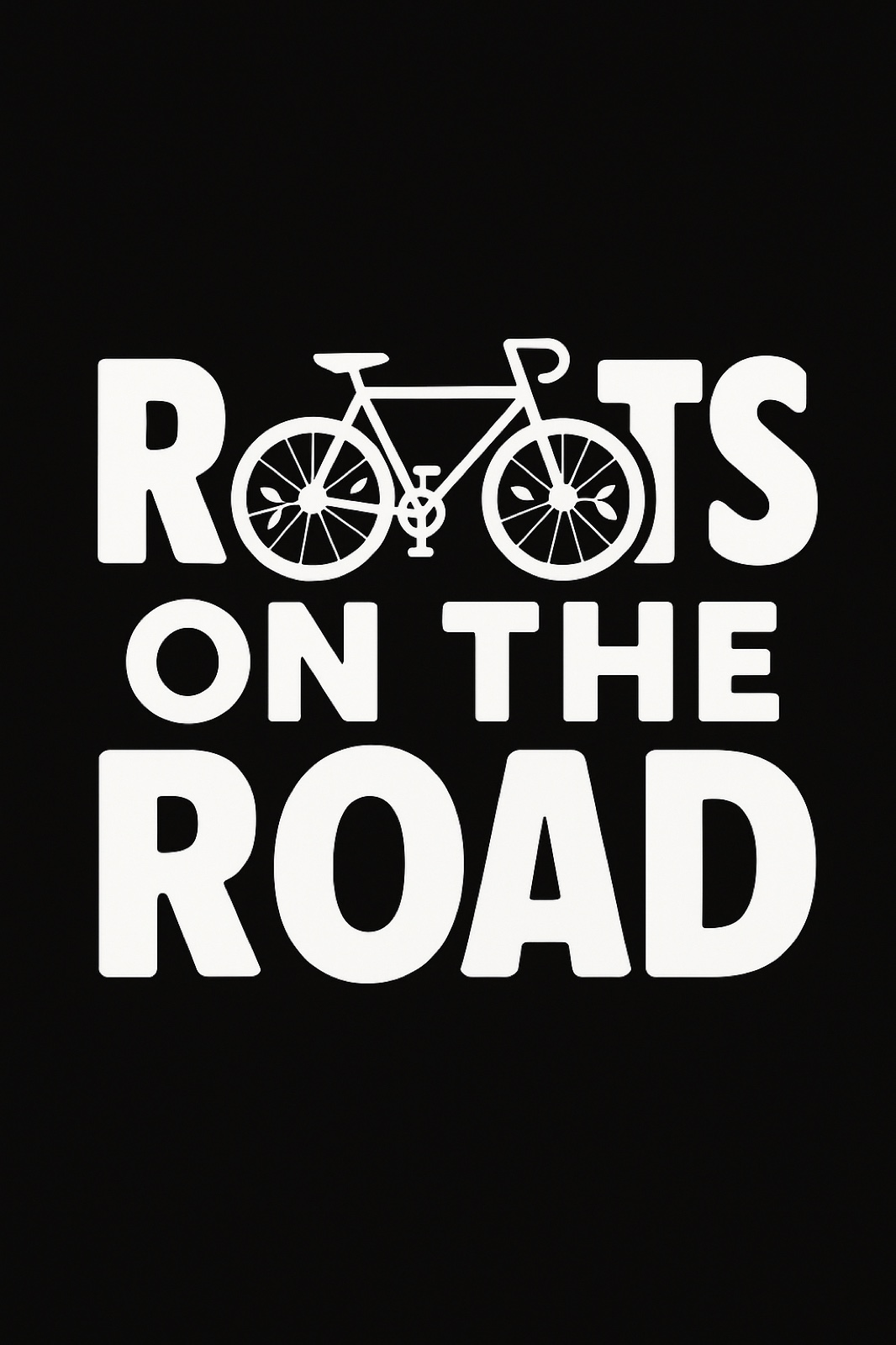
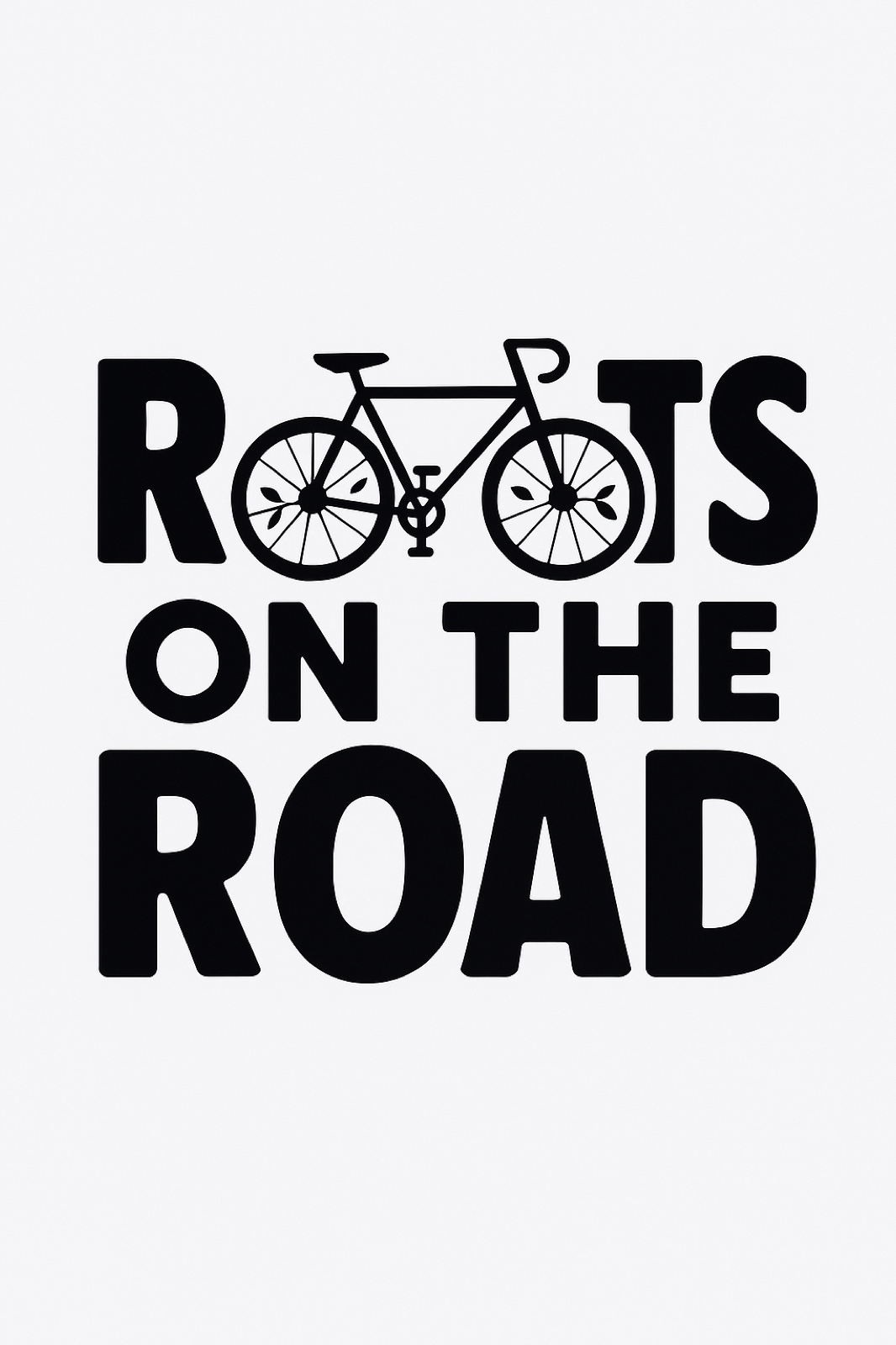
Subject: a refined, professionally-executed reinterpretation of a hand-drawn wordmark concept. Three lines of type, all in solid white, all caps:

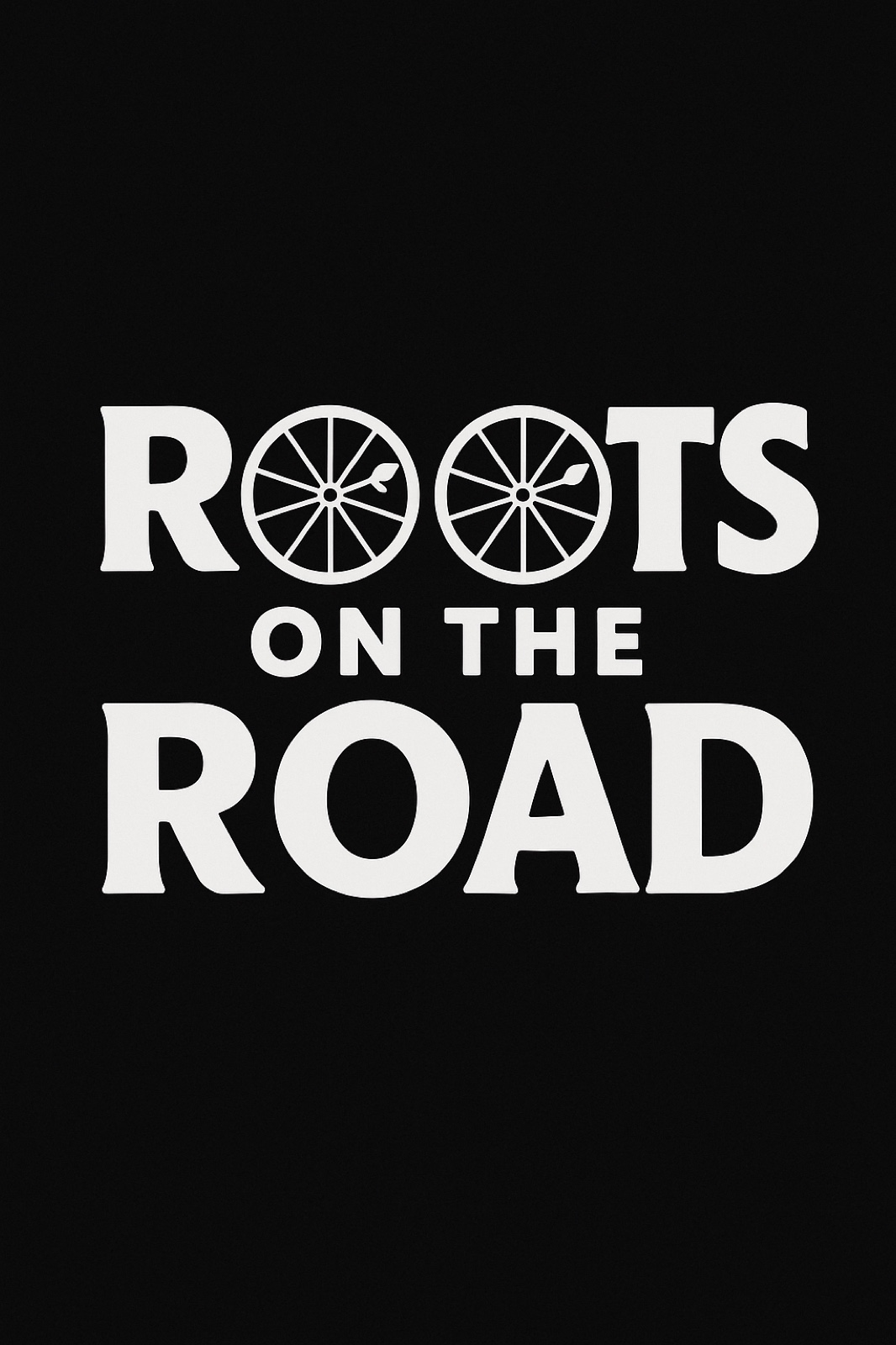
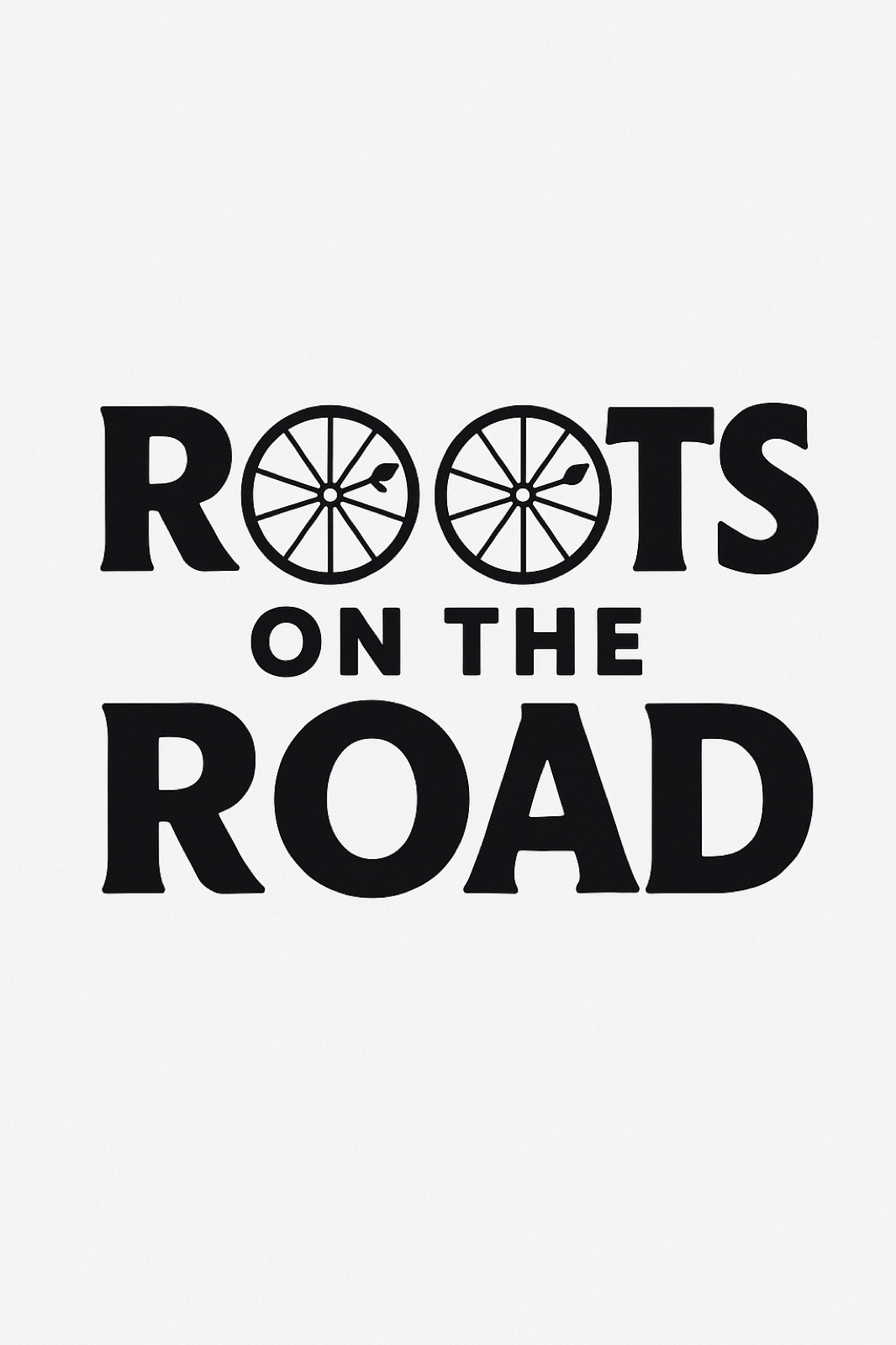
Line 1 (largest, top): "R [bike-wheel] [bike-wheel] T S" — the word "ROOTS" where both O's are replaced by stylized bicycle wheels viewed dead-on. The wheels are perfect white circles with thin clean spokes radiating from a small white hub, and from the tips of two of the spokes on each wheel, tiny stylized leaves emerge (one leaf upper-right, one leaf lower-left). The wheels match the cap-height and stroke-weight of the surrounding R, T, S letters perfectly.

Line 2 (smaller, middle): "ON THE" — set centered.

Line 3 (large, bottom): "ROAD" — set centered, matching the size and weight of "ROOTS."

Typography: a confident chunky modernist sans-serif, somewhere between Cooper Black-meets-Futura — soft, friendly, but disciplined. NOT a default system font. The letterforms have personality but stay geometric. All three lines feel like one unified family.

Strict design constraints: pure flat solid white vector shapes on solid pure black background. NO outlines, NO gradients, NO color, NO photographic elements, NO additional decoration, NO drop shadows, NO additional text. The wheels and the letters are the entire mark. Aesthetic references: Paul Rand's Cummins logo, Herb Lubalin's typographic plays, the original Whole Foods wordmark, contemporary independent farm and brewery branding done by Pentagram or Hoodzpah. Reductive. Witty. The wheels-as-O's pun does all the work.
A single iconic typographic wordmark, centered on a solid pure black background. Square composition. The wordmark fills roughly 75% of the canvas, generously surrounded by black negative space.
18

Lauren Badge

Lauren Badge on black
ON BLACK
Lauren Badge on white
ON WHITE
PROMPT
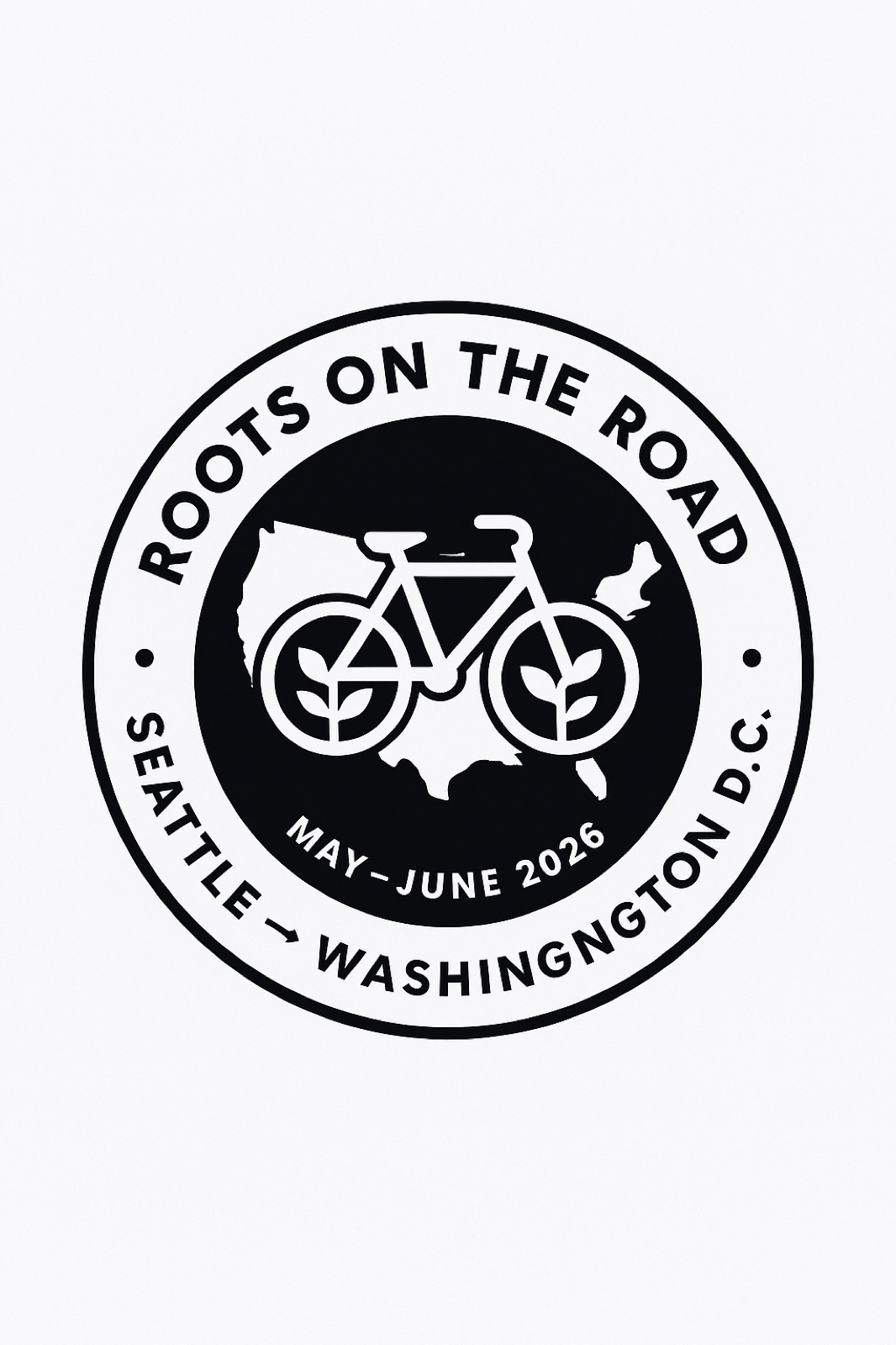
A single iconic circular badge mark, centered on a solid pure black background. Square composition. The badge fills roughly 80% of the canvas, generously surrounded by black negative space.

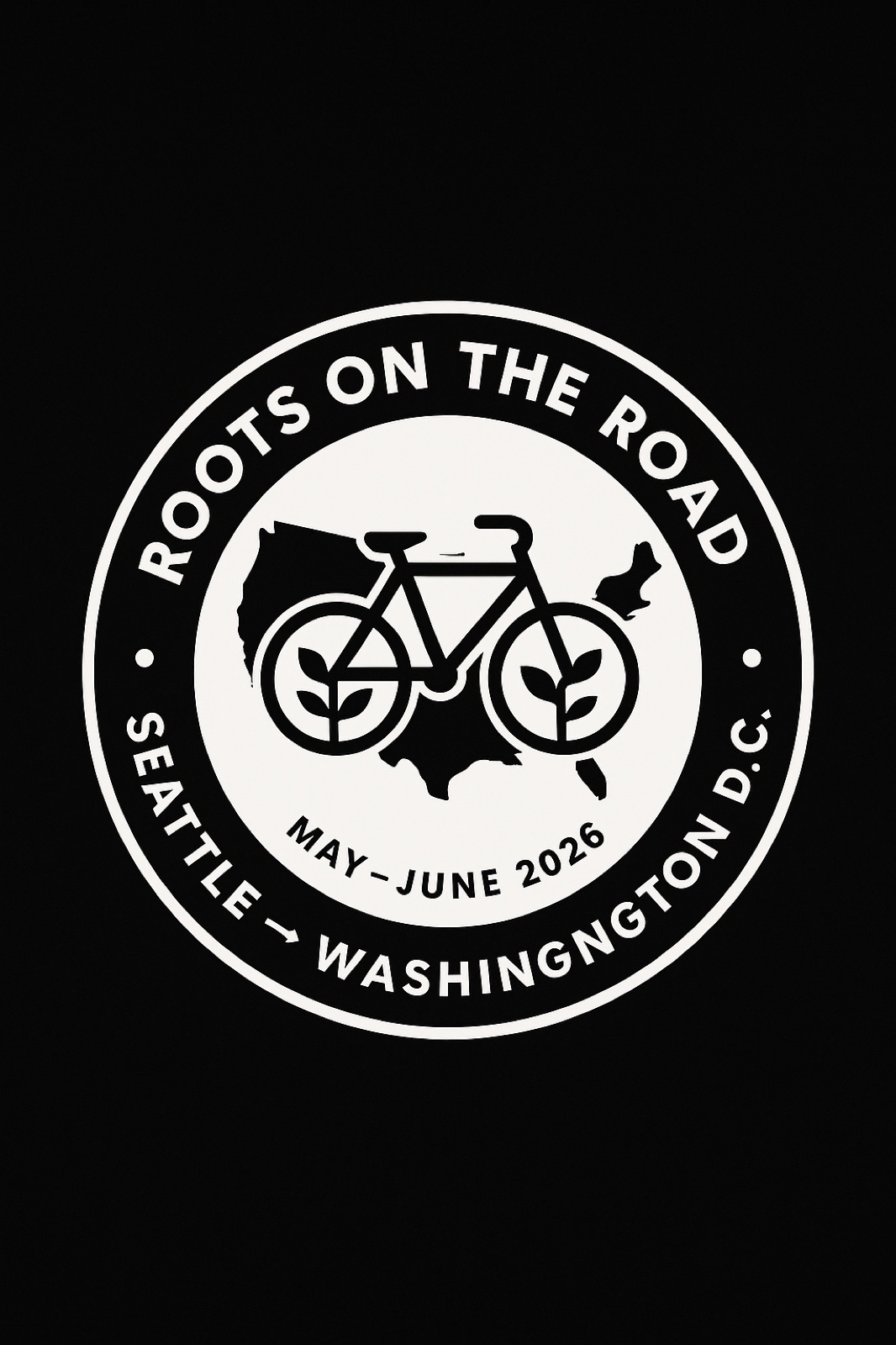
Subject: a clean modernist circular emblem rendered entirely in flat solid white vector shapes. The composition has three concentric layers:

OUTER RING — A thin clean white circle outline forms the badge's perimeter. Just inside it, white type set on the curve: along the upper arc, "ROOTS ON THE ROAD" in confident geometric sans-serif caps. Along the lower arc, "SEATTLE → WASHINGTON D.C." curving the opposite way. Two small white dots or asterisks on the left and right of the circle separate the upper and lower text.

CENTER — A solid white silhouette of the contiguous United States fills the inner circle, occupying roughly 60% of the badge's interior. The country is rendered as a flat solid white shape with NO state borders.

OVERLAY — A single black bicycle silhouette is positioned over the center of the white US shape, drawn in confident geometric vector style (clean circles for wheels, triangulated frame, simple handlebars). The bike's two wheels are NOT solid black — instead, each wheel contains a stylized leafy plant motif (a small stem with two opening leaves) rendered in white, so the leaves read as the bike's wheels. The bike's body is solid black, cut cleanly out of the white US silhouette.

Beneath the lower curved type, inside the circle, a small line of caps: "MAY – JUNE 2026."

Typography: confident geometric sans-serif (Futura Bold, Akzidenz-Grotesk, or similar) for all type. The curved type follows the circle smoothly with even letter-spacing.

Strict design constraints: pure flat shapes only — solid white where specified, solid black where specified. NO gradients, NO outlines beyond the perimeter ring, NO photographic elements, NO additional decoration, NO drop shadows. Aesthetic references: National Park Service emblems, Sierra Club badge, the New England Trail seal, contemporary Pentagram environmental identity work, Paul Rand's UPS shield. This is a higher-craft, more disciplined execution of an existing student-drawn circular badge concept.
A single iconic circular badge mark, centered on a solid pure black background. Square composition. The badge fills roughly 80% of the canvas, generously surrounded by black negative space.
19

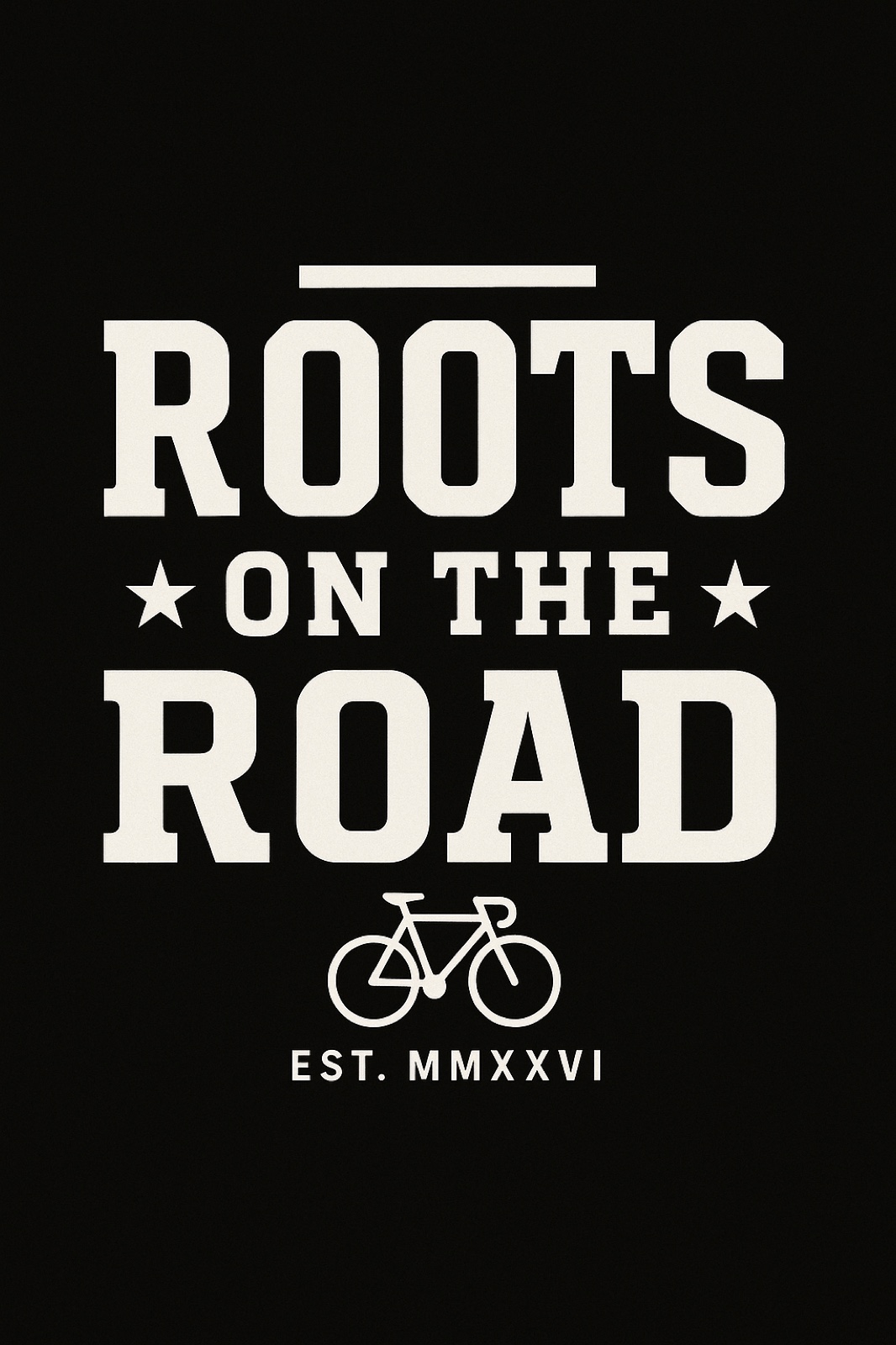
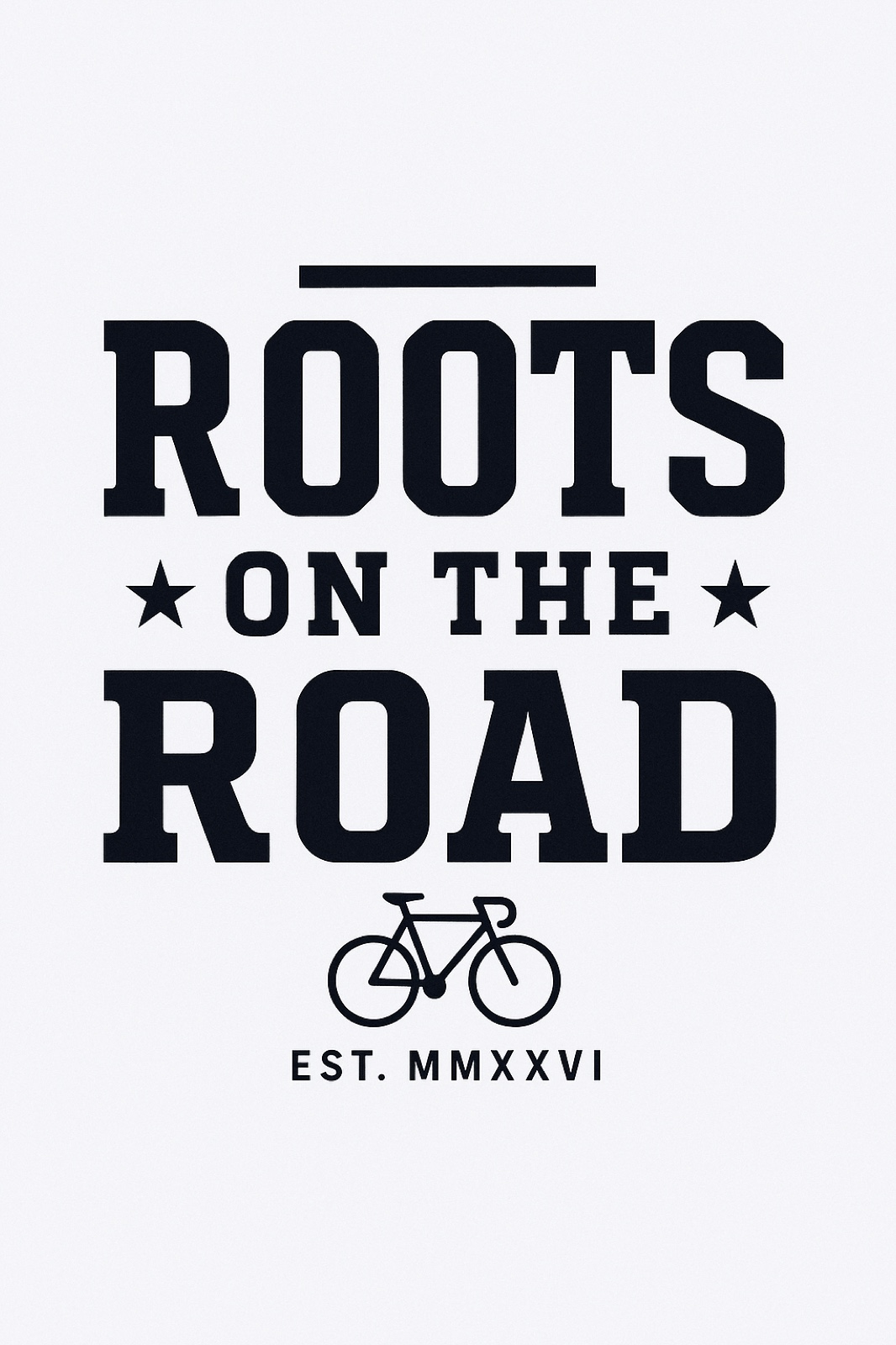
Athletic Slab

Athletic Slab on black
ON BLACK
Athletic Slab on white
ON WHITE
PROMPT
A single iconic athletic-jersey-style typographic mark, centered on a solid pure black background. Square composition. The mark fills roughly 80% of the canvas, generously surrounded by black negative space.

Subject: a vintage collegiate cycling jersey wordmark, rendered entirely in flat solid white vector shapes.

Composition, top to bottom:
1. A small white horizontal bar.
2. The word "ROOTS" set in heavy slab-serif caps (think Rockwell Bold, Clarendon, or the lettering on a 1920s baseball jersey), large and condensed, all white.
3. A thin horizontal white rule across the full width of the type.
4. The phrase "ON THE" set smaller in the same slab-serif caps, centered, with a small five-pointed white star on each side flanking the words.
5. Another thin horizontal white rule.
6. The word "ROAD" set in matching heavy slab-serif caps, large and condensed.
7. Beneath, a single small white bicycle silhouette in confident geometric style, centered, scale roughly 25% of the type's cap-height.
8. Tiny caps below the bike: "EST. MMXXVI" (Roman numerals for 2026).

Typography: classic American slab-serif athletic lettering, with confident bracketed serifs. Letter-spacing tight. Strong weight. The whole composition reads like a varsity jersey or vintage cycling team logo from a small American college town.

Strict design constraints: pure flat solid white vector shapes on solid pure black background. NO outlines that aren't filled, NO gradients, NO color, NO photographic elements, NO drop shadows, NO additional decoration beyond what is specified. Aesthetic references: Rapha cycling jersey graphics, Brooks England saddle branding, Pendleton wool labels, vintage American baseball script, the United States Bicycle Route System wordmark, mid-century Hatch Show Print posters in their cleaner moments. Athletic. Classic. Confident.
A single iconic athletic-jersey-style typographic mark, centered on a solid pure black background. Square composition. The mark fills roughly 80% of the canvas, generously surrounded by black negative space.
20

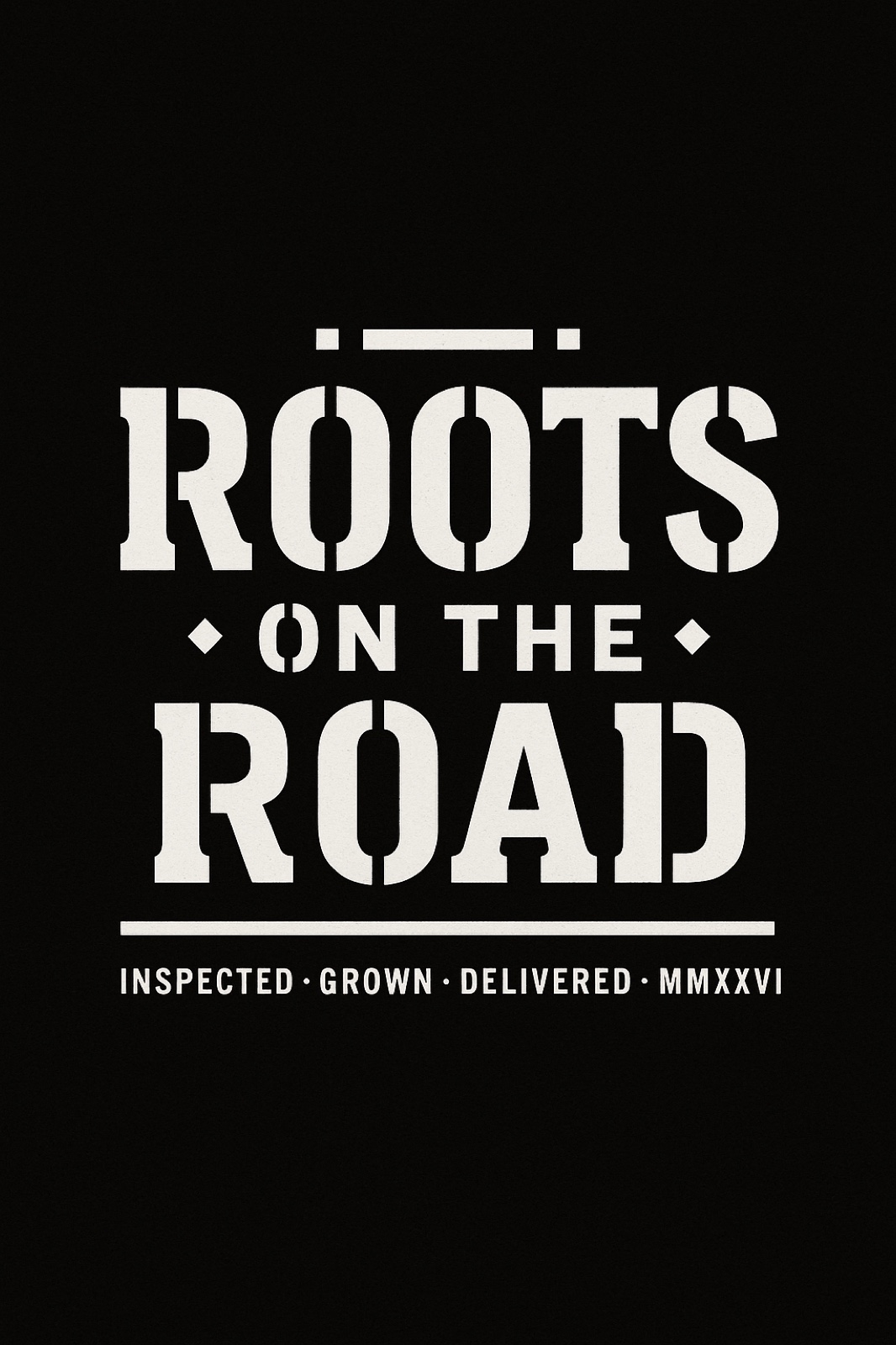
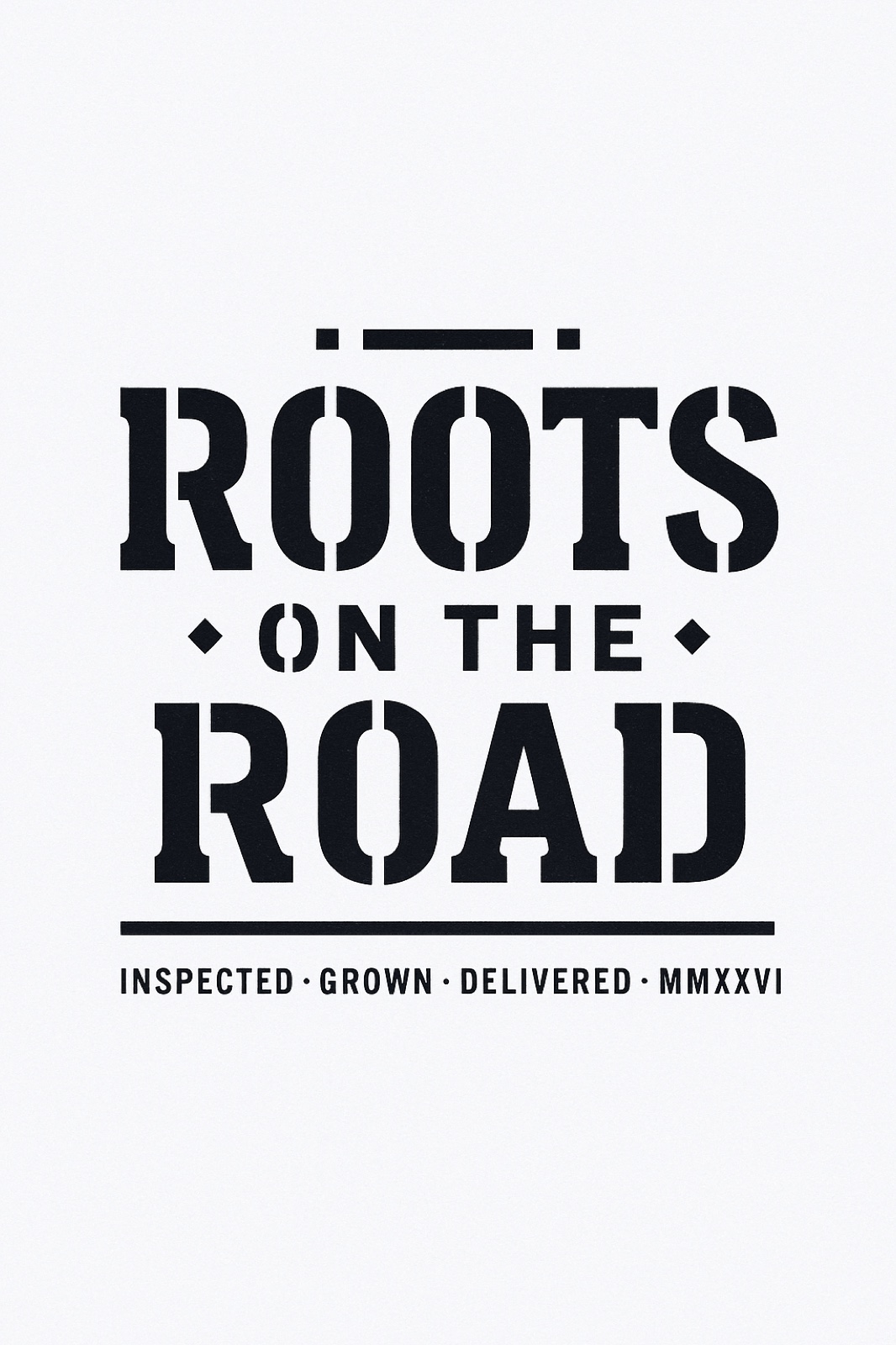
Stencil USDA

Stencil USDA on black
ON BLACK
Stencil USDA on white
ON WHITE
PROMPT
A single iconic stencil-typography mark, centered on a solid pure black background. Square composition. The mark fills roughly 75% of the canvas, generously surrounded by black negative space.

Subject: an industrial-agricultural stencil wordmark, rendered entirely in flat solid white vector shapes, evoking the visual language of feed sacks, grain elevators, USDA crate stamps, and military stencil signage.

Composition, top to bottom:
1. A small horizontal white rule, with two tiny white squares flanking it.
2. The word "ROOTS" in classic stencil caps (the letters have characteristic stencil "bridges" — small black gaps interrupting the strokes of the letters where a stencil would require). Heavy weight, slightly condensed.
3. The phrase "·  ON THE  ·" in smaller stencil caps, centered, with two small white diamonds flanking.
4. The word "ROAD" in matching large stencil caps.
5. Below, a single thin horizontal white rule spanning the full width.
6. Beneath the rule, in tiny stencil caps: "INSPECTED · GROWN · DELIVERED · MMXXVI"

Typography: authentic stencil letterforms with proper bridges, like Allotrope Stencil, Stencil Std, or the lettering on actual USDA inspection stamps and military crates. The stencil bridges should be visible and consistent across all letters.

Strict design constraints: pure flat solid white vector shapes on solid pure black background. NO outlines that aren't filled, NO gradients, NO color, NO photographic elements, NO drop shadows, NO additional decoration beyond what is specified. Aesthetic references: actual USDA-graded crate stamps, WPA poster type, military supply stencils, Levi's red-tab industrial graphics, the Carhartt wordmark heritage, the visual language of grain bags and apple crates from the 1940s. Industrial. Honest. Agricultural-American.
A single iconic stencil-typography mark, centered on a solid pure black background. Square composition. The mark fills roughly 75% of the canvas, generously surrounded by black negative space.
21

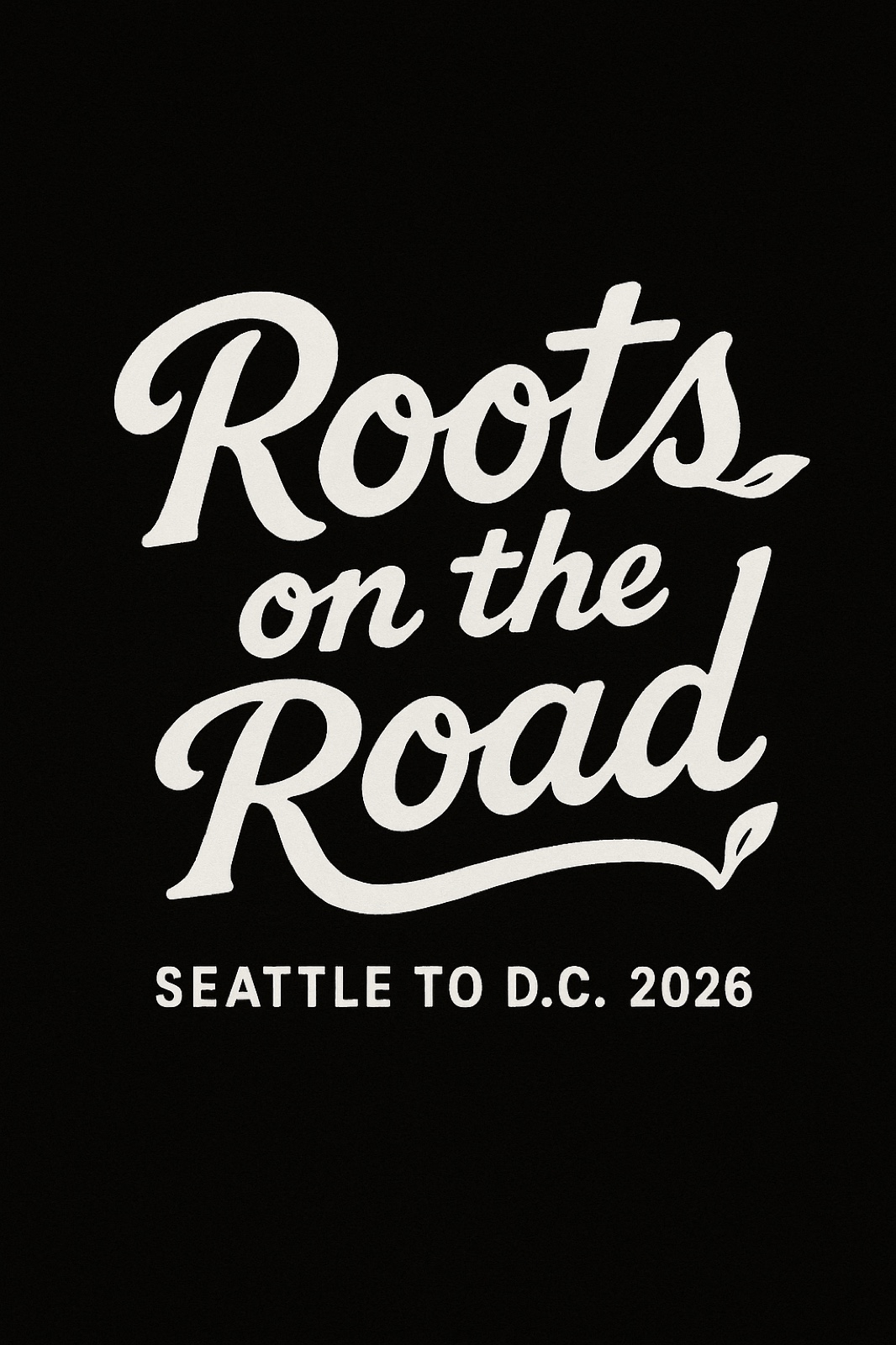
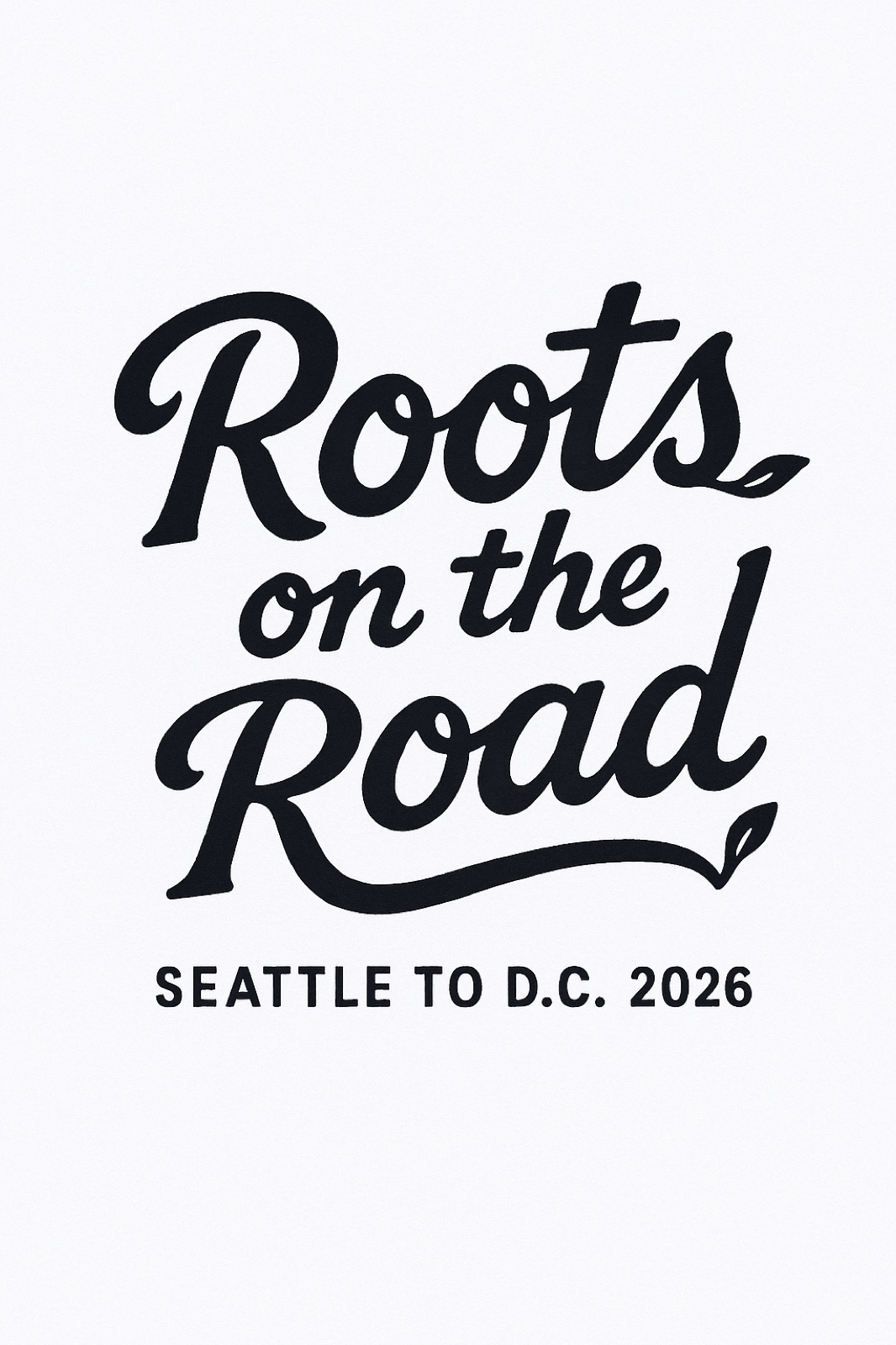
Folk Script

Folk Script on black
ON BLACK
Folk Script on white
ON WHITE
PROMPT
A single iconic hand-lettered script wordmark, centered on a solid pure black background. Square composition. The mark fills roughly 80% of the canvas, generously surrounded by black negative space.

Subject: an organic hand-lettered farm-folk wordmark, rendered entirely in flat solid white vector shapes, evoking the visual language of the Whole Earth Catalog, hand-painted barn signs, Stewart Brand's California counterculture publications, and small-farm produce-stand signage.

Composition: the words "Roots on the Road" set in three lines of expressive hand-lettered script — NOT a digital script font, but the look of a confident sign-painter's brush. Mix of upper and lowercase, each letter slightly imperfect but the whole composition disciplined. The "R" of Roots and the "R" of Road have small flourishes — a tiny leaf or tendril sprouting from one terminal of each. The "oo" of Roots can subtly suggest two small wheels or two small seeds, but stays first and foremost as letterforms.

Layout: "Roots" on line one, large. "on the" on line two, smaller and slightly tilted. "Road" on line three, large, with a confident underline-flourish curving beneath that ends in a tiny sprouting leaf at its rightmost point.

Beneath the wordmark, with generous space, a single small line of plain caps in a contrasting clean sans-serif (Futura or similar): "SEATTLE TO D.C. · 2026"

Typography: the script lettering should feel hand-painted, with slight variations in stroke weight that suggest a real brush. Confident, not amateur. The contrasting bottom caps line provides typographic counterpoint.

Strict design constraints: pure flat solid white vector shapes on solid pure black background. NO outlines that aren't filled, NO gradients, NO color, NO photographic elements, NO drop shadows, NO additional decoration. Aesthetic references: Whole Earth Catalog covers, hand-painted barn quilts and farm-stand signage, the original Ben & Jerry's wordmark, Linda McCartney Foods packaging, contemporary craft-farm branding by studios like Hoodzpah and Commoner Inc. Hand-touched. Earnest. Folk-modern.
A single iconic hand-lettered script wordmark, centered on a solid pure black background. Square composition. The mark fills roughly 80% of the canvas, generously surrounded by black negative space.
22

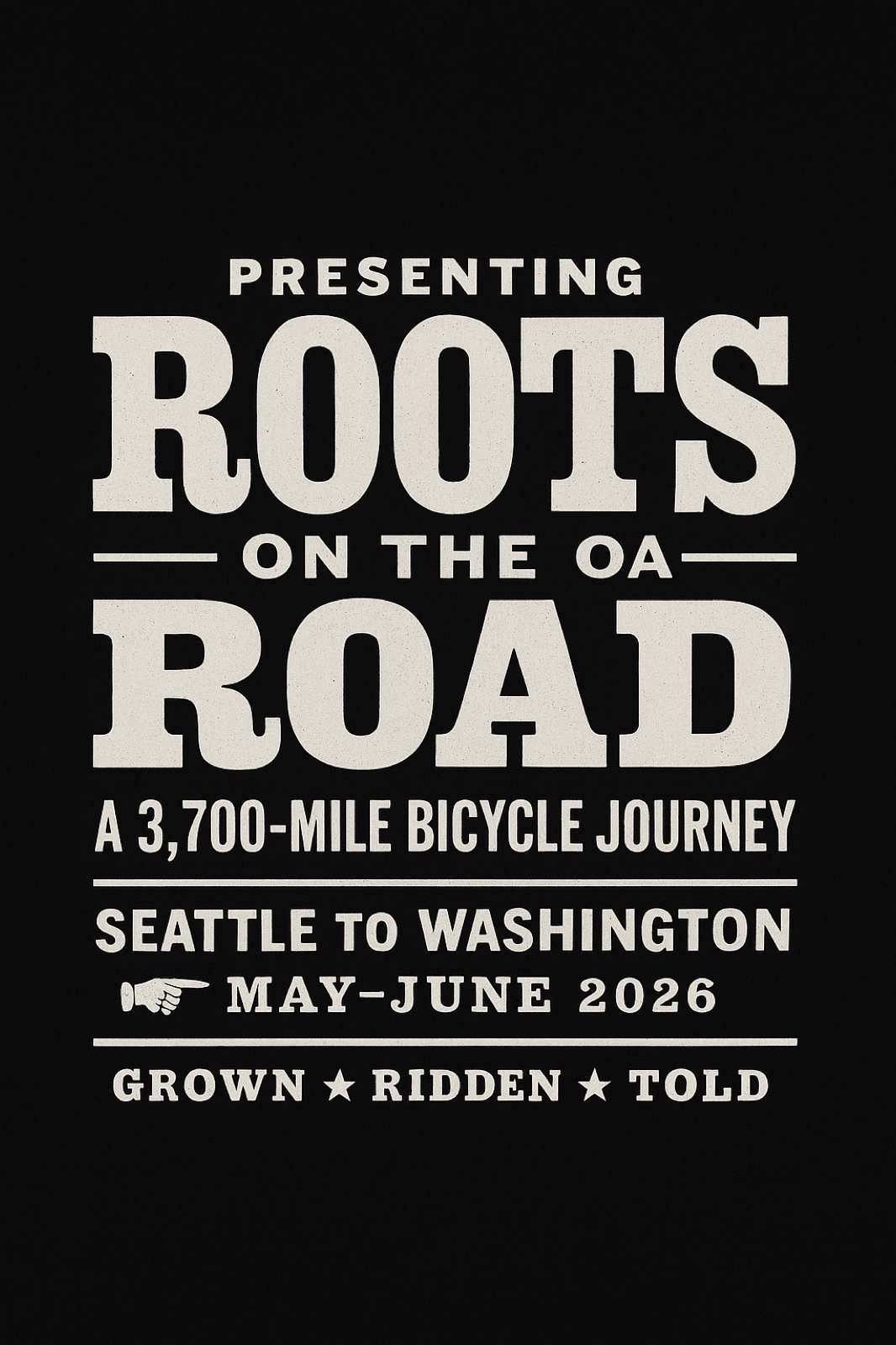
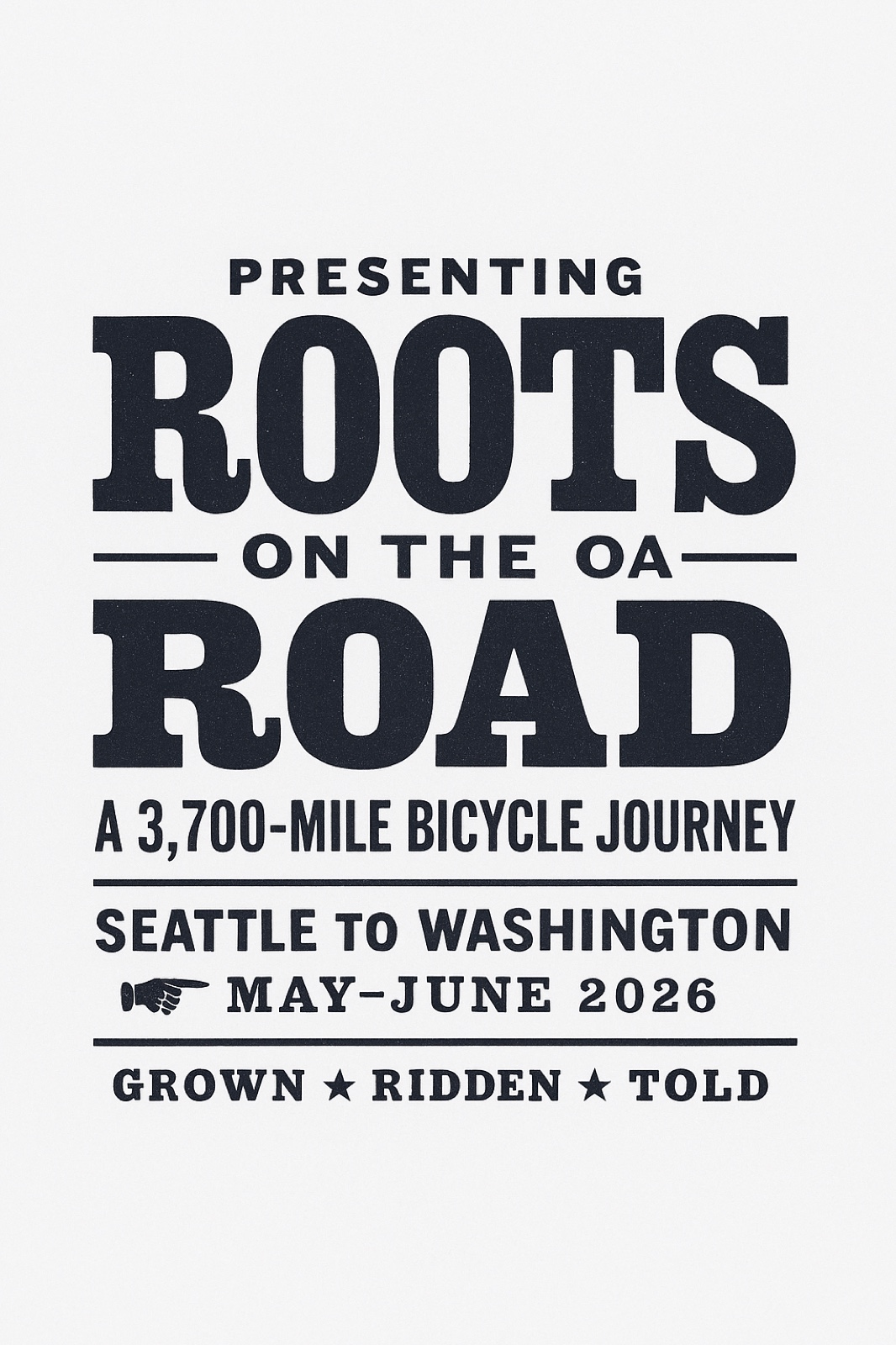
Wood Type

Wood Type on black
ON BLACK
Wood Type on white
ON WHITE
PROMPT
A single iconic Hatch-Show-Print-style wood-type poster mark, centered on a solid pure black background. Square composition. The mark fills roughly 85% of the canvas, with generous black margin.

Subject: a 19th-century American letterpress playbill wordmark, rendered entirely in flat solid white vector shapes, evoking the visual language of Hatch Show Print (Nashville), traveling-circus broadsides, gold-rush mining camp notices, and frontier-town newspaper headlines.

Composition, top to bottom, each line a different display weight and width:

1. Tiny white caps: "PRESENTING"
2. The word "ROOTS" set HUGE in chunky condensed wood-type caps with bracketed slab serifs (Clarendon Black or French Clarendon style). Spans the full width.
3. Tiny white caps centered between thin double rules: "·  ON THE  ·"
4. The word "ROAD" set HUGE in a CONTRASTING wood-type style — extended Egyptian slab caps, wider and chunkier than ROOTS, in a different display weight. Spans the full width.
5. A double horizontal white rule.
6. Smaller caps: "A 3,700-MILE BICYCLE JOURNEY"
7. A single small white pointing-finger (manicule) ☞ icon, followed by: "SEATTLE TO WASHINGTON · MAY-JUNE 2026"
8. Bottom: a single thin rule, then "GROWN ★ RIDDEN ★ TOLD" in tiny caps.

Typography: authentic 19th-century wood-type variety — each line uses a DIFFERENT display face from the wood-type tradition: Clarendon, Egyptian Extended, Tuscan, Antique Tuscan. The variety of typefaces is the point. All caps. All chunky. Mix of condensed and extended. NO modern sans-serifs.

Strict design constraints: pure flat solid white vector shapes on solid pure black background. NO outlines that aren't filled, NO gradients, NO color, NO photographic elements, NO drop shadows. The composition should feel like an actual broadside poster from 1880, executed with authentic typographic craft. Aesthetic references: Hatch Show Print Nashville, Globe Poster Baltimore, Tribune Showprint, P.T. Barnum circus broadsides, gold-rush mining notices. Loud. Crafted. Unmistakably American.
A single iconic Hatch-Show-Print-style wood-type poster mark, centered on a solid pure black background. Square composition. The mark fills roughly 85% of the canvas, with generous black margin.
23

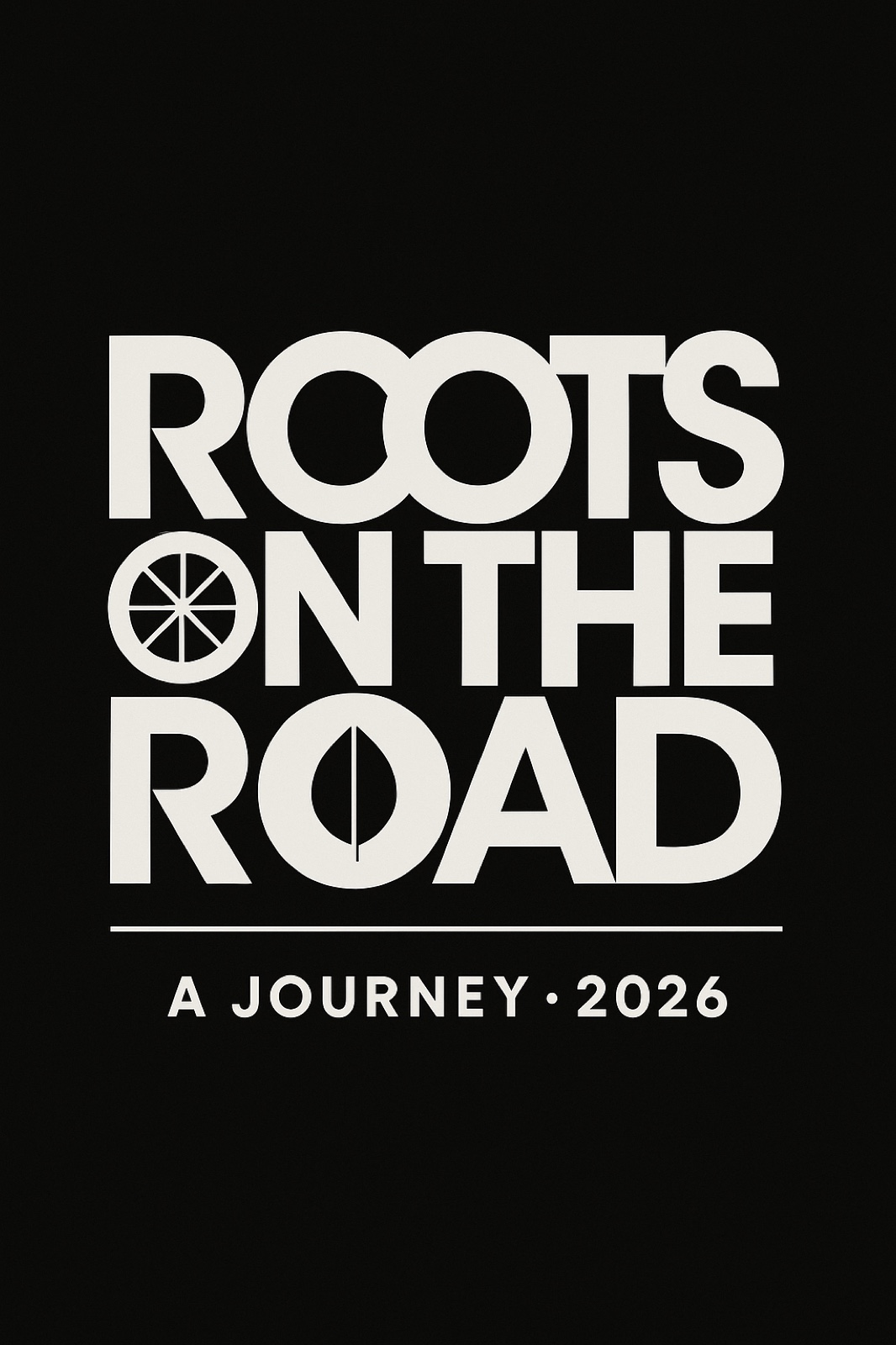
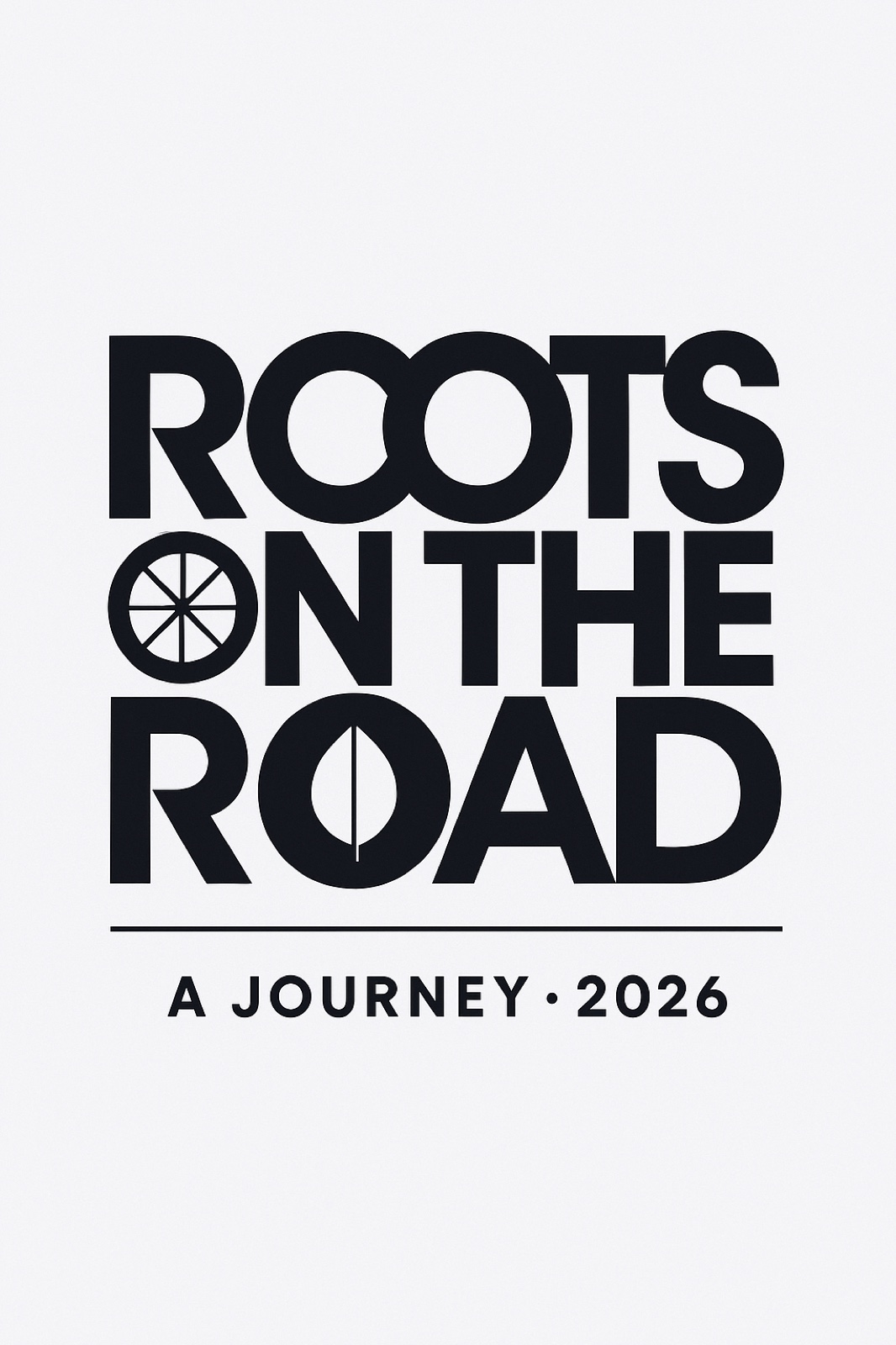
Avant Garde

Avant Garde on black
ON BLACK
Avant Garde on white
ON WHITE
PROMPT
A single iconic Lubalin-style typographic logotype, centered on a solid pure black background. Square composition. The logotype fills roughly 70% of the canvas, generously surrounded by black negative space.

Subject: a sophisticated 1970s editorial-graphic-design typographic mark, rendered entirely in flat solid white vector shapes, evoking the visual language of Herb Lubalin's ITC Avant Garde Gothic typography, U&lc magazine, Push Pin Studios at its most refined, and the original Mother Earth News and Coevolution Quarterly mastheads.

Composition: the words "ROOTS ON THE ROAD" set as ONE tightly-locked geometric-sans logotype, all caps, with intentional Lubalin-style ligatures, overlaps, and letter modifications:

— The two O's in "ROOTS" share a single bowl: the second O grows out of the first like a Venn diagram overlap, and inside the conjoined O-O shape sits a small minimalist bicycle wheel pictogram (just a circle with a clean cross of spokes).
— The O of "ON" tucks intimately beside the N.
— The O in "ROAD" is replaced by a stylized leaf — a perfect oval with a single vein, sitting at the same cap height.
— The R's have characteristic ITC Avant Garde geometric construction (perfect circles for the bowls, straight legs).
— Letter spacing is extremely tight throughout, letters nearly touching, with intentional kerning quirks.

The whole logotype reads as one compressed unit, three to four lines tall maximum. May be set on two lines: "ROOTS ON" / "THE ROAD" with the type interlocked.

Beneath, with generous space, a single thin horizontal white rule, and below that: "A JOURNEY · 2026" in small letterspaced caps.

Typography: ITC Avant Garde Gothic Bold/Demi as the base, with custom ligature modifications. Geometric. Tight. Sophisticated.

Strict design constraints: pure flat solid white vector shapes on solid pure black background. NO outlines that aren't filled, NO gradients, NO color, NO photographic elements, NO drop shadows, NO additional decoration beyond what is specified. Aesthetic references: Herb Lubalin's masterworks (Avant Garde magazine masthead, Mother & Child logo, Families magazine), Tom Carnase letterforms, U&lc magazine covers, original Push Pin Studios identities. Refined. Tight. Editorial-craft.
A single iconic Lubalin-style typographic logotype, centered on a solid pure black background. Square composition. The logotype fills roughly 70% of the canvas, generously surrounded by black negative space.
24

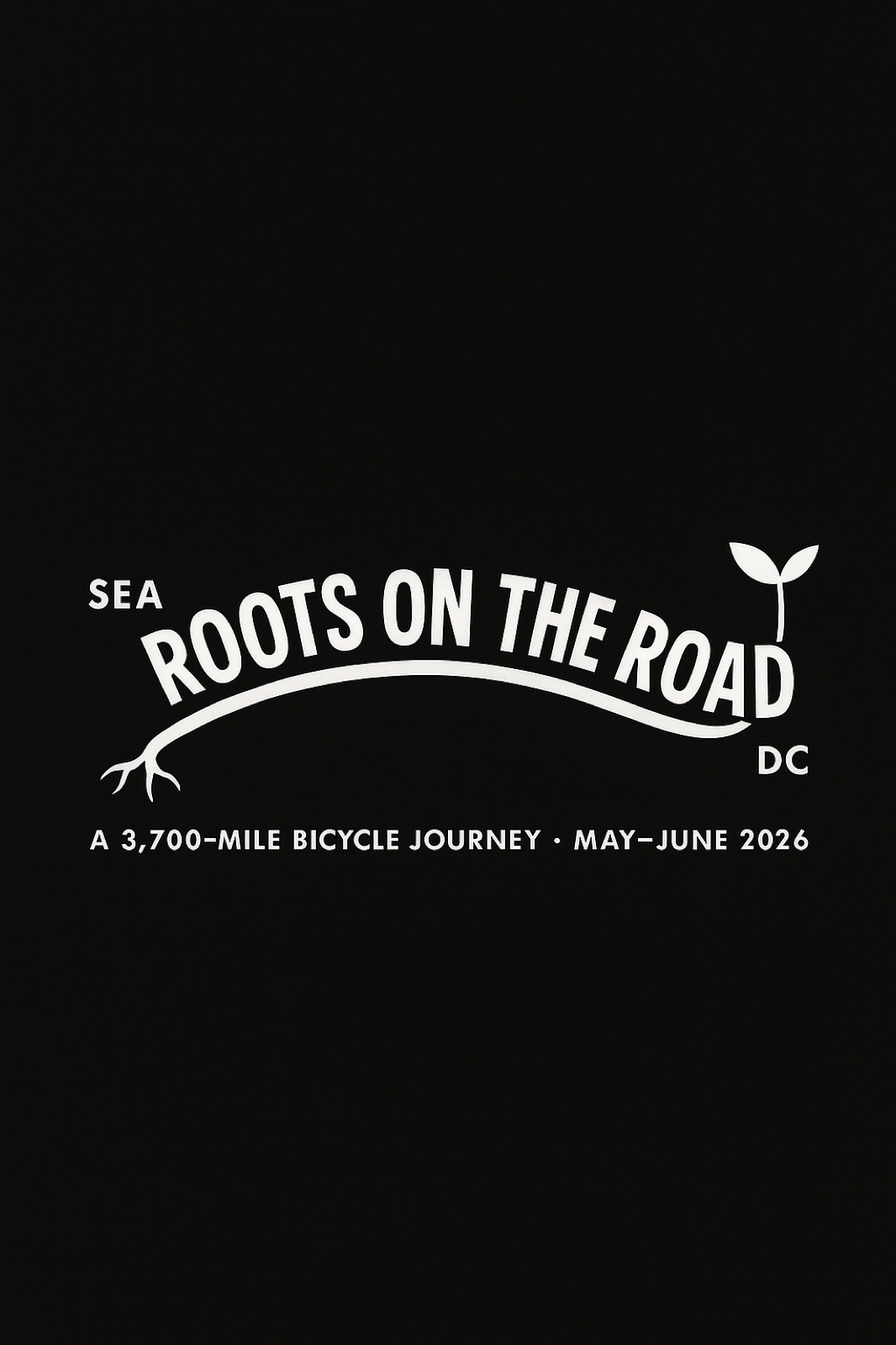
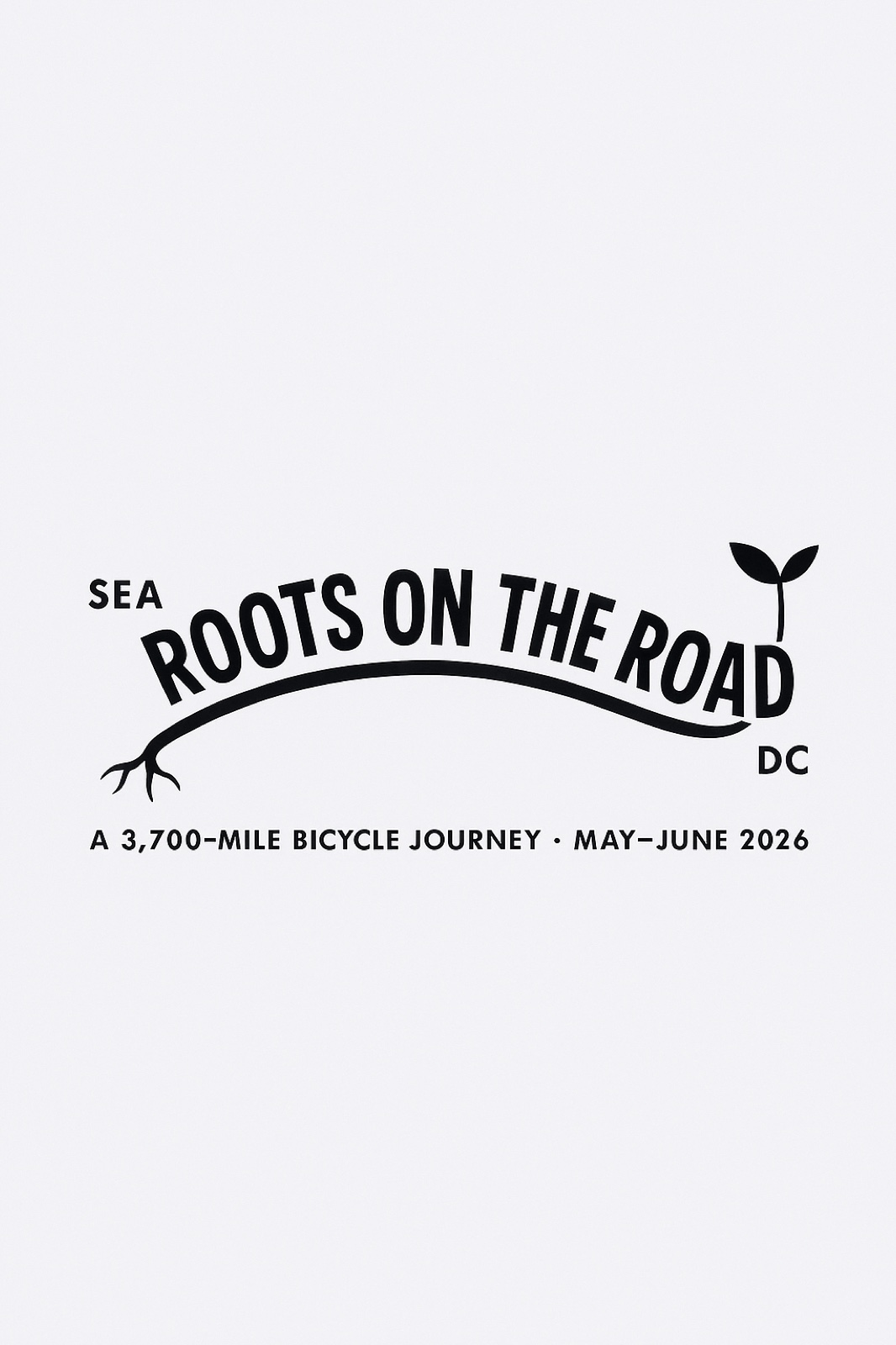
Type as Trail

Type as Trail on black
ON BLACK
Type as Trail on white
ON WHITE
PROMPT
A single iconic type-as-path mark, on a solid pure black background. Horizontal-leaning composition. The mark spans roughly 90% of the canvas width, with generous black margin above and below.

Subject: the words "ROOTS ON THE ROAD" set ON a curving white path that sweeps across the canvas from left to right — the type IS the trail. Rendered entirely in flat solid white vector shapes.

Composition: a single confident curving white line travels from the upper-left of the canvas down across the middle and up to the upper-right, suggesting the arc of the Great American Rail Trail from Seattle to Washington D.C. The line has gentle organic curves — not a straight path. On the left end, the line begins as a small downward root with two tendrils. On the right end, the line opens into a small sprout with two leaves.

Set ON this curving line, following its arc precisely, the words "ROOTS ON THE ROAD" appear in confident geometric sans-serif caps (Futura Bold or similar), with each letter sitting on the curve and rotating to follow the path's angle. The letters are solid white, the line passes through the baseline of the letters. The text is sized so that "ROOTS ON THE ROAD" exactly fills the journey from west to east.

Above the curving line on the far left: tiny white caps "SEA" with a small dot.
Above the curving line on the far right: tiny white caps "DC" with a small dot.

Beneath the entire composition, centered and well below, a single small line of caps: "A 3,700-MILE BICYCLE JOURNEY · MAY–JUNE 2026"

Typography: confident geometric sans-serif (Futura Bold, Trade Gothic Bold, or similar). The trail-set type is the entire concept.

Strict design constraints: pure flat solid white vector shapes on solid pure black background. NO outlines that aren't filled, NO gradients, NO color, NO photographic elements, NO US map outline, NO state borders, NO drop shadows, NO additional decoration. The single curving line + the type sitting on it + the root/sprout terminations are the whole image. Aesthetic references: Massimo Vignelli's New York City Subway diagram, Saul Bass's title-sequence linework, Paul Rand's logo gestures, Ed Fella's path-set type experiments, contemporary Pentagram wayfinding work. Singular gesture. Type-as-image. Confident.
A single iconic type-as-path mark, on a solid pure black background. Horizontal-leaning composition. The mark spans roughly 90% of the canvas width, with generous black margin above and below.
25

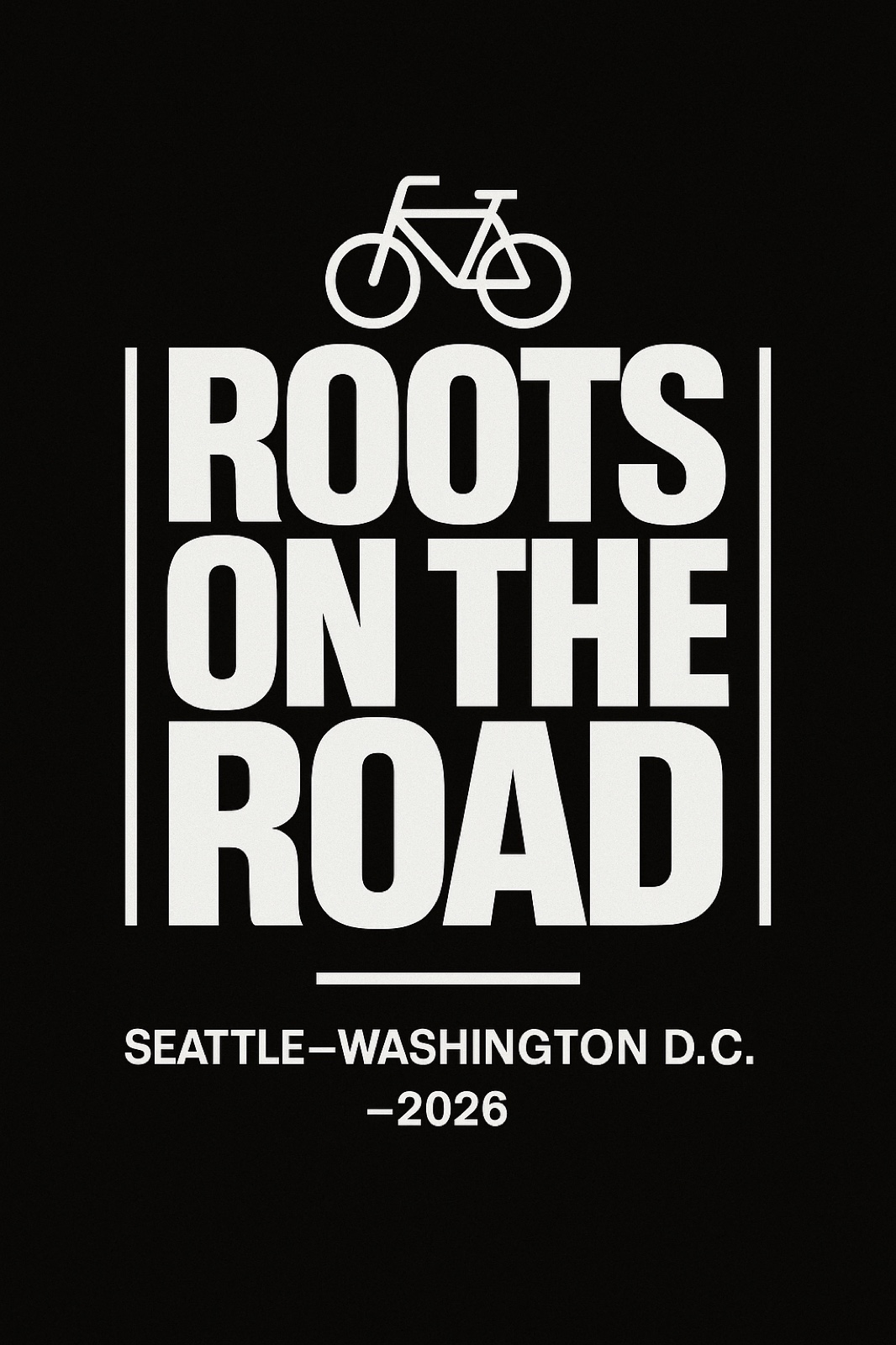
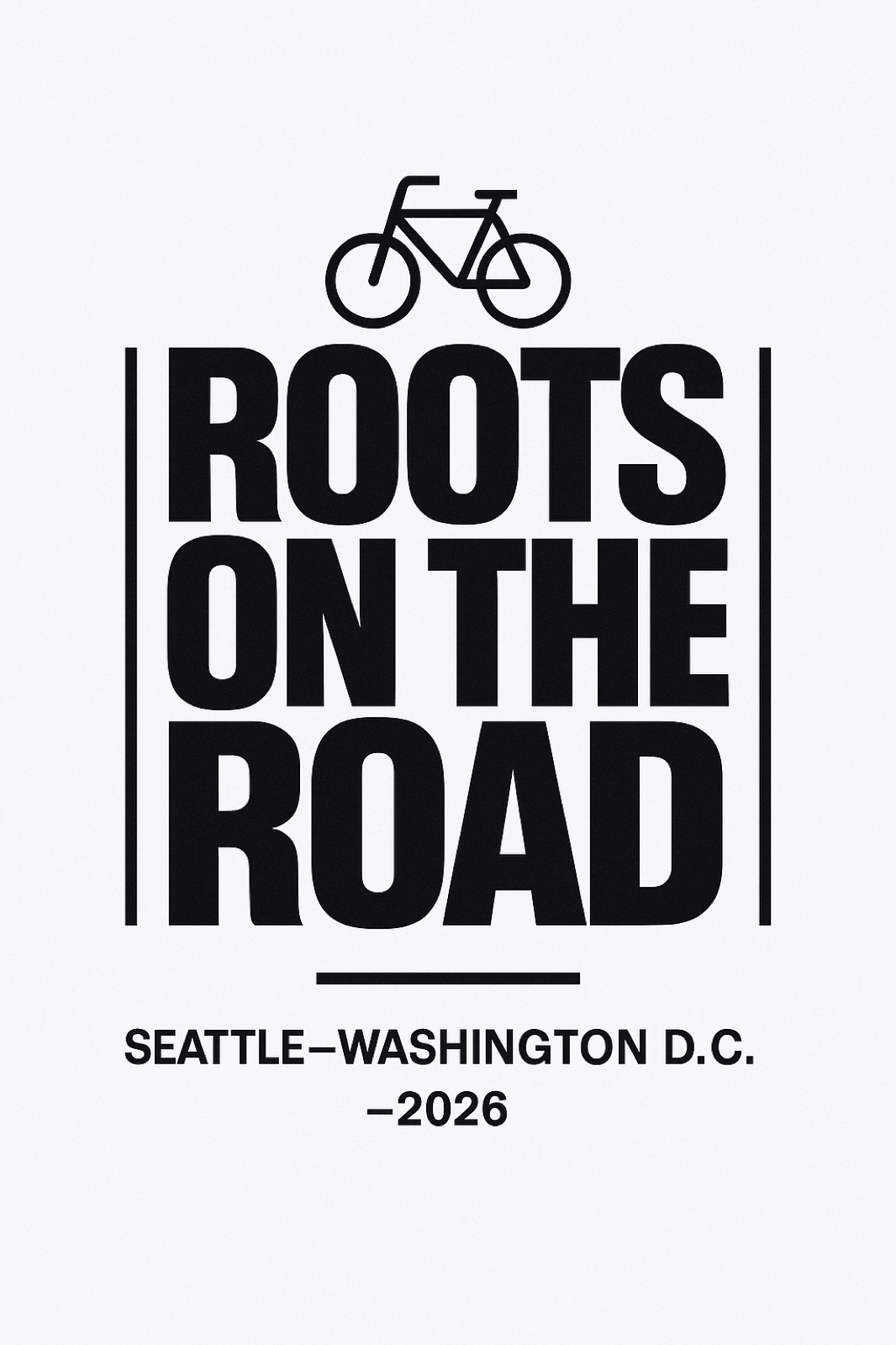
Vignelli Stack

Vignelli Stack on black
ON BLACK
Vignelli Stack on white
ON WHITE
PROMPT
A single iconic brutalist-modernist typographic stack, centered on a solid pure black background. Square composition. The mark fills roughly 70% of the canvas, generously surrounded by black negative space.

Subject: a tight, monumental Massimo-Vignelli-style typographic stack, rendered entirely in flat solid white vector shapes, evoking the visual language of Vignelli's American Airlines, Bloomingdale's Big Brown Bag, the original Knoll catalogs, and Unimark transit signage.

Composition: the words "ROOTS / ON THE / ROAD" set in three perfectly-stacked centered lines of HEAVY condensed Helvetica-style sans-serif caps. Each line tightly leaded against the next so the stack reads as one solid block of type. Letter-spacing is set very tight. The block is roughly square in proportion. All three lines share the same point size and weight — uniformity is the point.

To the LEFT of the type stack, vertically aligned to the type's full height, a single thin white vertical rule. To the RIGHT of the type stack, mirrored, another single thin white vertical rule. The two rules frame the type like quotation marks or a goal-post structure.

Beneath the type block, with one line of generous space, a single tiny horizontal white rule centered, and below that, in very small letterspaced caps: "SEATTLE—WASHINGTON D.C. — 2026"

Above the type block, with one line of space, a single small white pictogram: an extremely minimal bicycle silhouette reduced to two circles connected by a single triangular frame, scale roughly 30% of one line of type.

Typography: Helvetica Bold or Akzidenz-Grotesk Bold, set extremely tight and condensed. Weight uniform. Mathematical. Monumental.

Strict design constraints: pure flat solid white vector shapes on solid pure black background. NO outlines that aren't filled, NO gradients, NO color, NO photographic elements, NO drop shadows, NO decoration beyond the specified rules and pictogram. Aesthetic references: Massimo Vignelli's complete body of work, the Unimark NYC Subway signage, Wim Crouwel's grid systems, Müller-Brockmann's Swiss posters, contemporary brutalist typography (Karim Rashid's harder work, the Balenciaga wordmark). Monumental. Disciplined. Ascetic.
A single iconic brutalist-modernist typographic stack, centered on a solid pure black background. Square composition. The mark fills roughly 70% of the canvas, generously surrounded by black negative space.
26

Lauren Wordmark v2

Lauren Wordmark v2 on black
ON BLACK
Lauren Wordmark v2 on white
ON WHITE
PROMPT
A single iconic typographic wordmark, centered on a solid pure black background. Square-ish portrait composition. The wordmark fills roughly 75% of the canvas, generously surrounded by black negative space.
Subject: a refined typographic logo, three lines of solid white type, all caps, in a confident chunky modernist sans-serif (think Cooper Black-meets-Futura — soft and friendly but disciplined).

Line 1 (largest, top): "ROOTS" — but the two O's are replaced with COMPLETE bicycles viewed dead-on. Each bicycle is rendered in clean solid white vector style and shows the WHOLE bike, not just the wheels:
  - Two perfect-circle wheels (these occupy the visual position of the O's, sitting on the baseline at the same cap-height as the R, T, S)
  - A clean triangulated frame above and between the wheels
  - A small seat post and seat
  - Curved drop handlebars rising up from the front
  - Pedals and chainring visible at the bottom center
  - Each wheel has thin clean spokes radiating from a small white hub, and from two of the spokes on each wheel, tiny stylized leaves emerge (one upper-right, one lower-left)
  - The bicycles' handlebars and frames rise ABOVE the cap-height of the surrounding R, T, S letters — that's correct and intentional. The bikes are full bikes, not just wheels.

Line 2 (smaller, middle): "ON THE" — set centered.

Line 3 (large, bottom): "ROAD" — set centered, matching the size and weight of "ROOTS."

Strict design constraints: pure flat solid white vector shapes on solid pure black background. NO outlines that aren't filled, NO gradients, NO color, NO photographic elements, NO additional decoration, NO drop shadows, NO additional text. The two complete bicycles + the letters are the entire mark. Aesthetic references: Paul Rand's Cummins logo, Herb Lubalin's typographic plays, contemporary independent farm and brewery branding done by Pentagram or Hoodzpah. Reductive. Witty. Each O is unmistakably a complete little bicycle, leafy and ready to ride.
A single iconic typographic wordmark, centered on a solid pure black background. Square-ish portrait composition. The wordmark fills roughly 75% of the canvas, generously surrounded by black negative space.
12 Back — Full Design

01

Transect

Transect on black
ON BLACK
Transect on white
ON WHITE
PROMPT
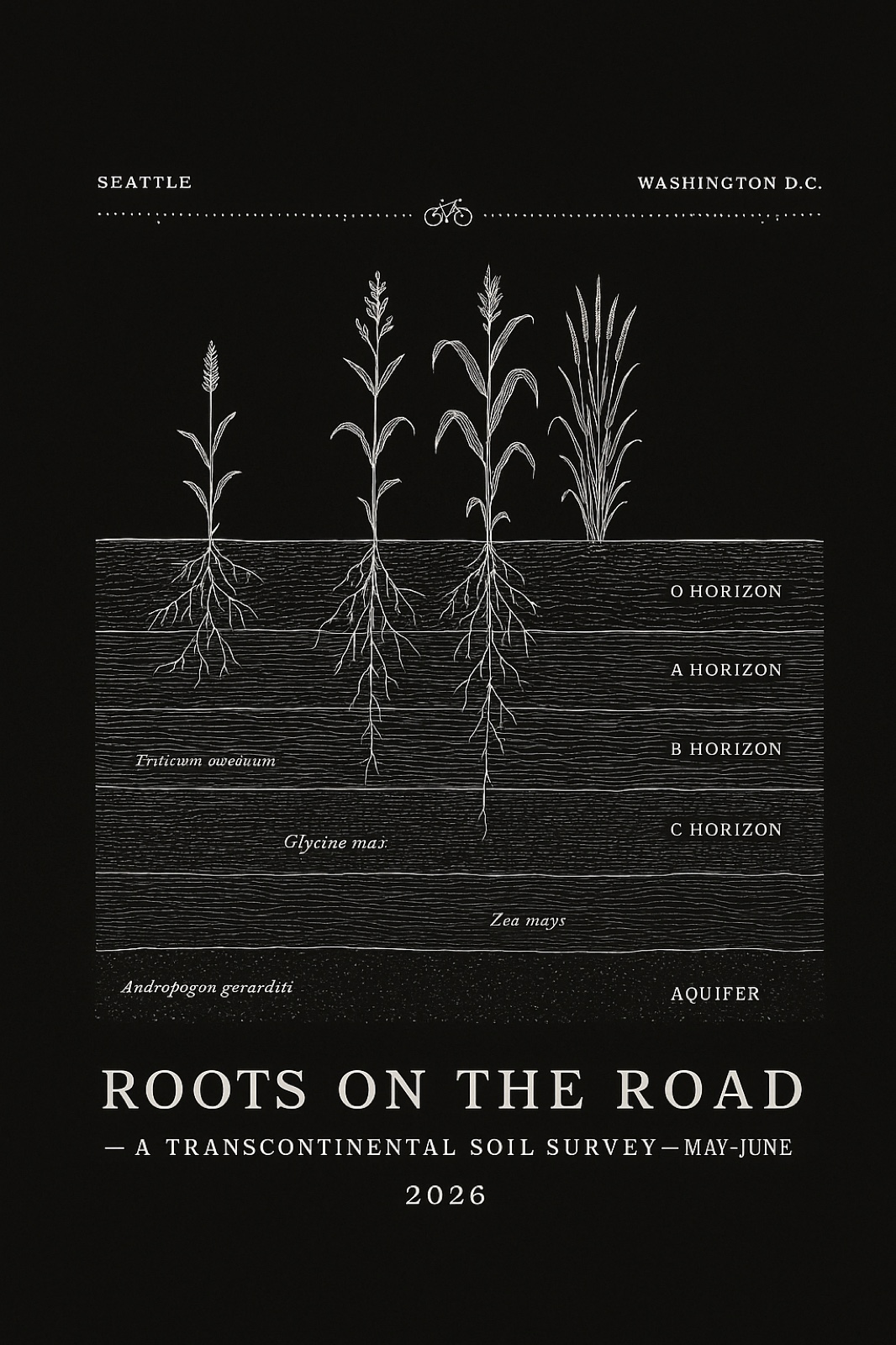
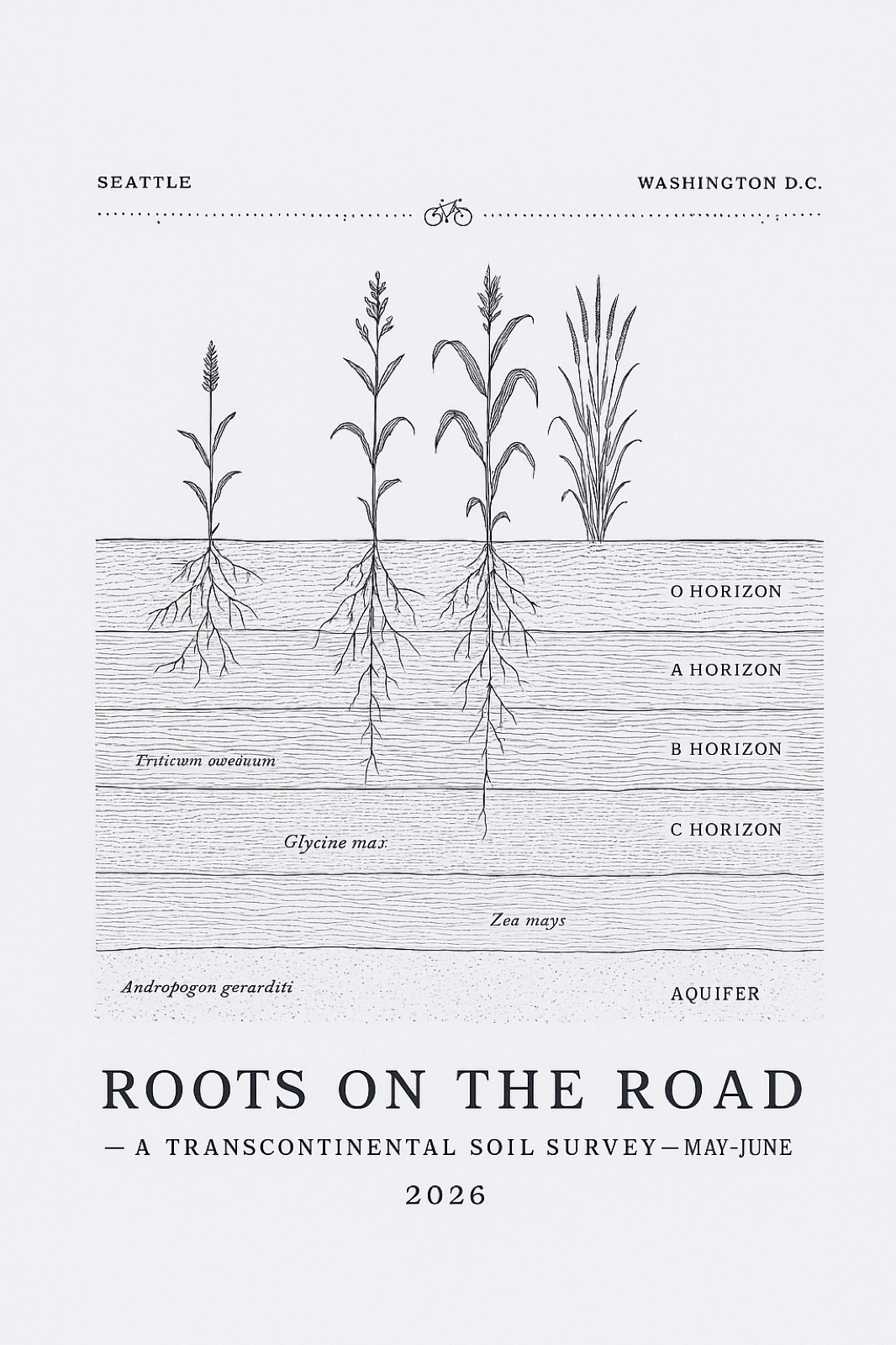
Single-color white line art on a solid black background, designed as a one-color screen-print graphic for the back of a t-shirt. Vertical composition.

Subject: a horizontal cross-section diagram in the style of a vintage USGS soil survey crossed with an Edward Tufte information graphic.

Across the upper third: a thin dotted bicycle route line spanning the full width, labeled "SEATTLE" at the far left and "WASHINGTON D.C." at the far right in tiny monospaced uppercase. A single small bicycle silhouette sits on the route line, scale-correct so it almost disappears into the line. Tiny mile markers and a few city tick marks along the route.

Below the route line, occupying the central two-thirds: a continuous horizontal earth cross-section. Show stratified soil horizons as parallel hairline bands, each labeled in tiny mono caps: "O HORIZON," "A HORIZON," "B HORIZON," "C HORIZON," "BEDROCK." Descending from the surface down through the layers: scientifically accurate root systems of wheat, soy, corn, and tallgrass prairie, drawn at correct relative depths as fine engraved lines. Each plant gets a small italic Latin binomial label with a hairline pointer ("Triticum aestivum," "Glycine max," "Zea mays," "Andropogon gerardii"). Subtle dotted indication of an aquifer near the bottom labeled "OGALLALA AQUIFER."

Bottom edge: thin caption rule with the text "ROOTS ON THE ROAD — A TRANSCONTINENTAL SOIL SURVEY — MAY-JUNE 2026" in mono caps.

Strict constraints: pure white strokes only, all uniform thin line weight, NO fills, NO shading, NO gradients, NO color, NO photographic elements. Looks like an etched scientific plate. Aesthetic references: USGS publications 1940-1960, Edward Tufte's "The Visual Display of Quantitative Information," Aesop product diagrams, technical engineering drawings.
Single-color white line art on a solid black background, designed as a one-color screen-print graphic for the back of a t-shirt. Vertical composition.
06

Transect with People

Transect with People on black
ON BLACK
Transect with People on white
ON WHITE
PROMPT
Single-color white line art on a solid black background, designed as a one-color screen-print graphic for the back of a t-shirt. Vertical composition.

Subject: a horizontal cross-section diagram in the style of a vintage USGS soil survey crossed with an Edward Tufte information graphic — but the "specimens" are people, not just plants.

Across the upper third: a thin horizontal line representing the Great American Rail Trail, labeled "SEATTLE, WA" at the far left and "WASHINGTON, D.C." at the far right in tiny monospaced uppercase. Standing on the trail line, evenly spaced across the width, are seven tiny human figures drawn in fine line, each captioned beneath in mono caps with their role: "FARMER," "CHEF," "TRUCK DRIVER," "EDUCATOR," "EATER," "ELDER," "CHILD." A single small bicycle silhouette is also on the trail line, scale-correct so it nearly disappears.

Below the trail line, occupying the central two-thirds: a continuous horizontal earth cross-section. Show stratified soil horizons as parallel hairline bands, each labeled in tiny mono caps along the right margin: "O HORIZON," "A HORIZON," "B HORIZON," "C HORIZON," "BEDROCK." Descending from the surface down through the layers: scientifically accurate root systems of wheat, soy, corn, and tallgrass prairie at correct relative depths, drawn as fine engraved lines. Each plant gets a small italic Latin binomial label with a hairline pointer ("Triticum aestivum," "Glycine max," "Zea mays," "Andropogon gerardii"). Subtle dotted indication of an aquifer near the bottom labeled "OGALLALA AQUIFER."

Bottom edge: thin caption rule, then "ROOTS ON THE ROAD" in elegant small caps, then below in smaller mono caps: "A NATIONAL FOOD-SYSTEM TRANSECT · 3,700 MILES · MAY–JUNE 2026."

Strict constraints: pure white strokes only, all uniform thin line weight, NO fills, NO shading, NO gradients, NO color, NO photographic elements. Reads as an etched scientific plate. Aesthetic references: USGS publications 1940-1960, Edward Tufte's information graphics, Aesop product diagrams, technical engineering drawings. The seven human figures are essential and must be clearly visible.
Single-color white line art on a solid black background, designed as a one-color screen-print graphic for the back of a t-shirt. Vertical composition.
11

Rail Trail Map

Rail Trail Map on black
ON BLACK
Rail Trail Map on white
ON WHITE
PROMPT
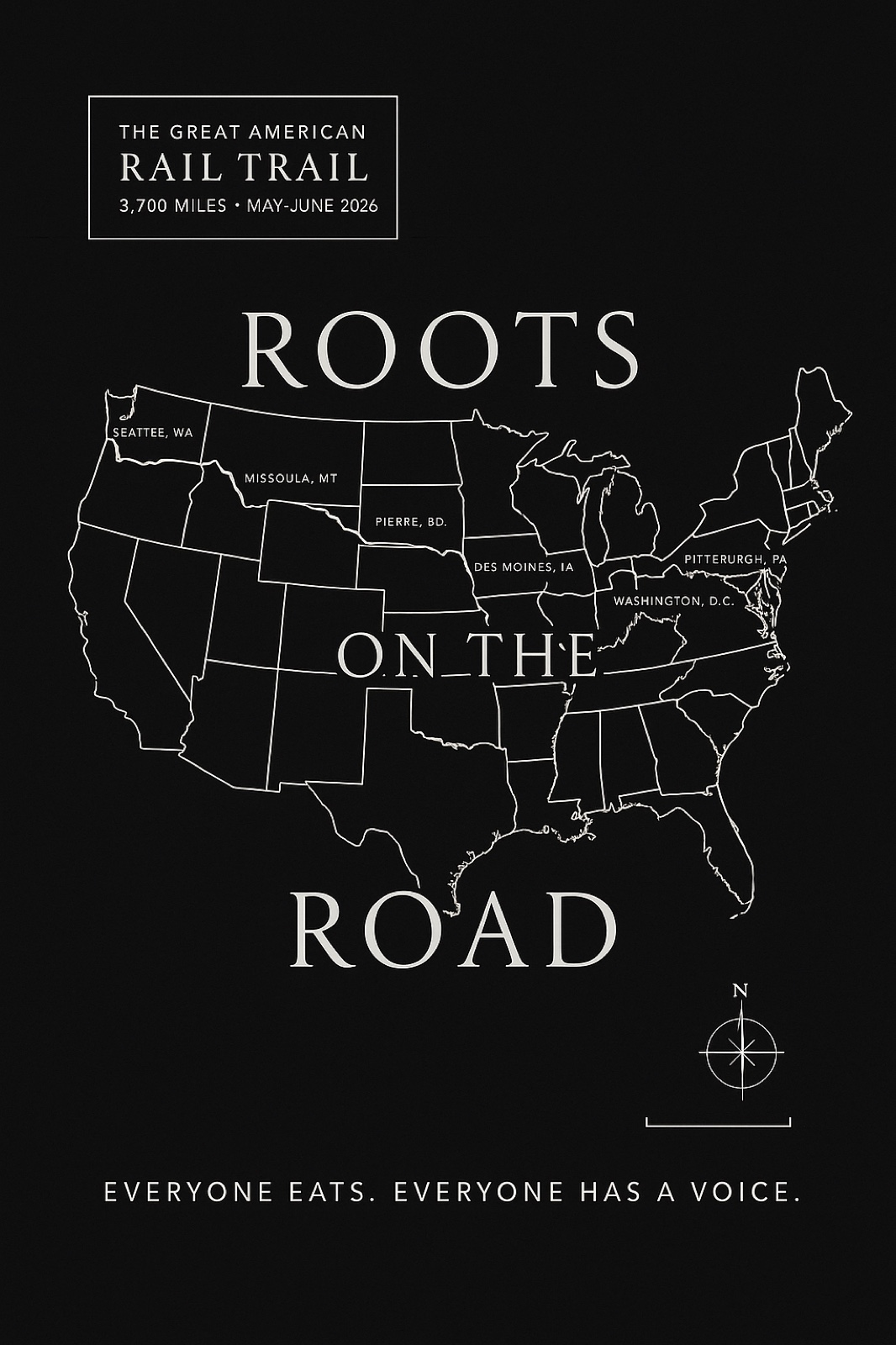
Single-color white line art on a solid black background, designed as a one-color screen-print graphic for the back of a t-shirt. Vertical composition.

Subject: a refined, minimal map showing the actual route of the Great American Rail Trail from Washington State to Washington, D.C.

Composition: a clean outline of the contiguous United States drawn in a single hairline weight, rendered in a slightly stylized way (not slavishly accurate — gently simplified). Across the country, traced as a slightly thicker but still elegant white line, the actual approximate path of the Great American Rail Trail: starting on the Pacific coast of Washington State, passing through Idaho, Montana, Wyoming (or northern route equivalent), South Dakota, Iowa, Illinois, Indiana, Ohio, Pennsylvania, Maryland, ending at Washington, D.C. The trail line should curve naturally and feel hand-drawn-but-precise, like a Stanford map.

Set ALONG the trail line itself, following its curves, the words "ROOTS ON THE ROAD" rendered in an elegant small-caps serif (think Trajan or contemporary Trajan-inspired faces) — the type bends along the path of the trail like signage along a road. Where the type runs out, the trail line continues unbroken to its end.

Small tick marks along the trail at key cities, each labeled in tiny mono caps: "SEATTLE, WA" at the start, "MISSOULA, MT," "PIERRE, SD," "DES MOINES, IA," "PITTSBURGH, PA," "WASHINGTON, D.C." at the end.

In the upper-left corner, a small modest cartouche in thin hairline rule containing: "THE GREAT AMERICAN RAIL TRAIL · 3,700 MILES · MAY–JUNE 2026" in small mono caps stacked.

In the lower-right corner, a small compass rose in fine line and a tiny scale bar.

Bottom margin, centered: "EVERYONE EATS. EVERYONE HAS A VOICE." in small mono caps.

The map should feel like something from a serious cartographic publisher — National Geographic, Stanford's London, USGS — adapted to a t-shirt. Calm, confident, geographically truthful.

Strict constraints: pure white linework on solid black only, hairline weights for the country outline, slightly thicker for the trail itself, all type precisely set, NO color, NO gradients, NO solid fills, NO photographic detail, NO illustration other than the map and the small compass. Aesthetic references: National Geographic atlas plates, Stanford's London cartography, Edward Tufte map work, contemporary minimal cartographic poster design from House Industries or Pop Chart Lab.
Single-color white line art on a solid black background, designed as a one-color screen-print graphic for the back of a t-shirt. Vertical composition.
12

Wheel of Roots

Wheel of Roots on black
ON BLACK
Wheel of Roots on white
ON WHITE
PROMPT
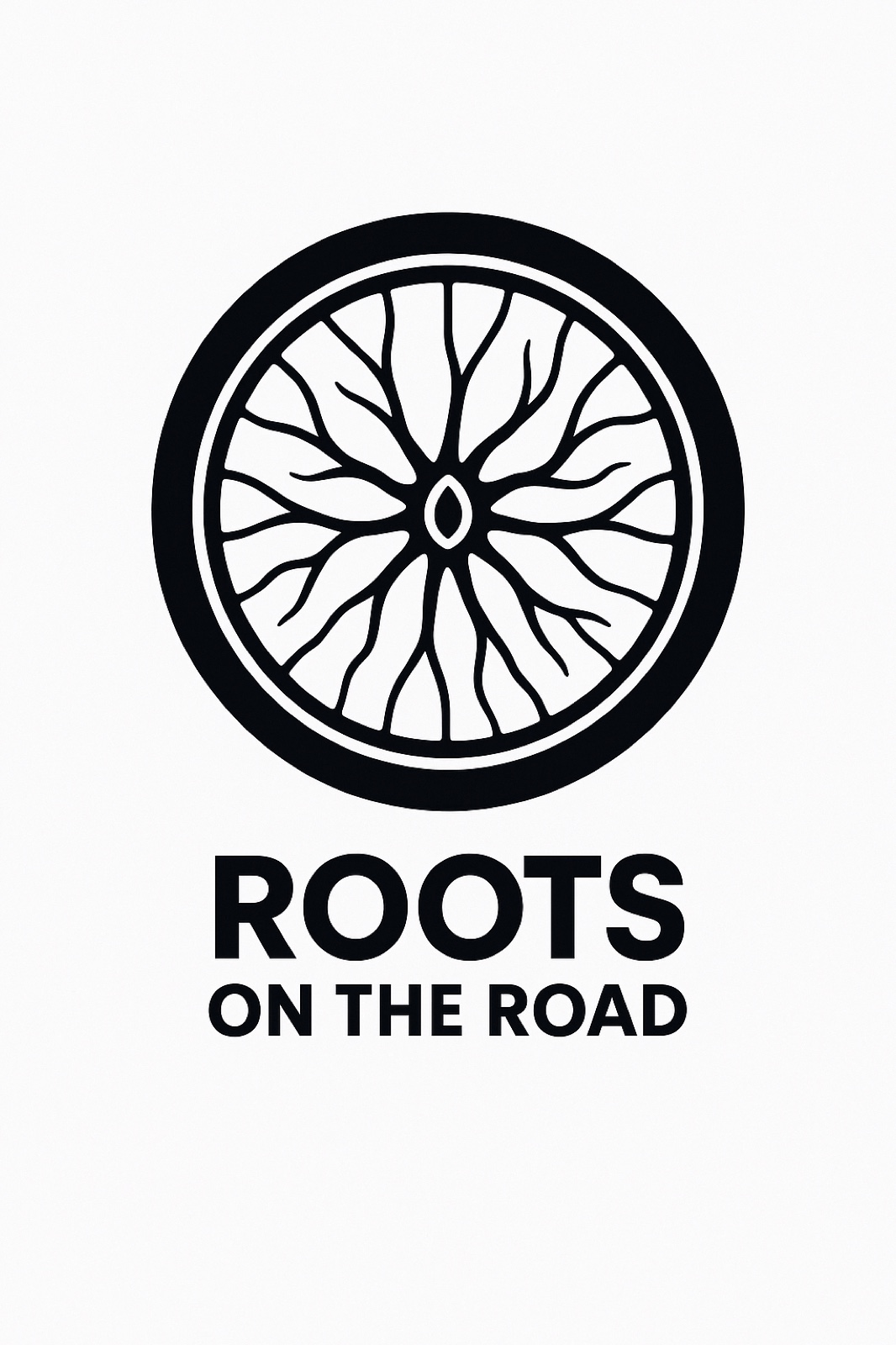
A single iconic vector mark, centered on a solid pure black background. Square or near-square composition. The mark fills roughly 70% of the canvas, generously surrounded by black negative space.
Subject: a stylized bicycle wheel viewed dead-on (perfectly circular, head-on perspective), rendered as a flat solid white vector icon. Where the spokes of the wheel would be, draw delicate root tendrils radiating outward from the central hub to the inner edge of the tire. The hub at the very center is a small solid white seed shape (almond-form). The tire itself is a thick clean white ring. The roots are organic but disciplined — uneven natural curves, but consistent stroke weight, like a Massimo Vignelli reinterpretation of a William Morris ornament.

The whole mark reads in one second: a bicycle wheel, but its spokes are roots growing from a seed.

Beneath the icon, with generous space above it, a single tight wordmark in a confident geometric sans-serif (think Futura Bold, Akzidenz-Grotesk, or Helvetica Black), all caps, set in two stacked centered lines: "ROOTS" / "ON THE ROAD." That's the only type on the entire image.

Strict design constraints: pure flat solid white vector shapes on solid pure black background. NO outlines that aren't filled, NO gradients, NO color, NO photographic elements, NO additional text, NO hatching, NO line shading, NO drop shadows. Every shape is a clean filled silhouette. The whole thing must be reproducible as a 1-color screen print on a green t-shirt. Aesthetic references: Paul Rand's IBM and Westinghouse marks, Saul Bass film posters, Massimo Vignelli's American Airlines work, contemporary Pentagram identity systems. Iconic. Reductive. Witty. Confident.
A single iconic vector mark, centered on a solid pure black background. Square or near-square composition. The mark fills roughly 70% of the canvas, generously surrounded by black negative space.
27

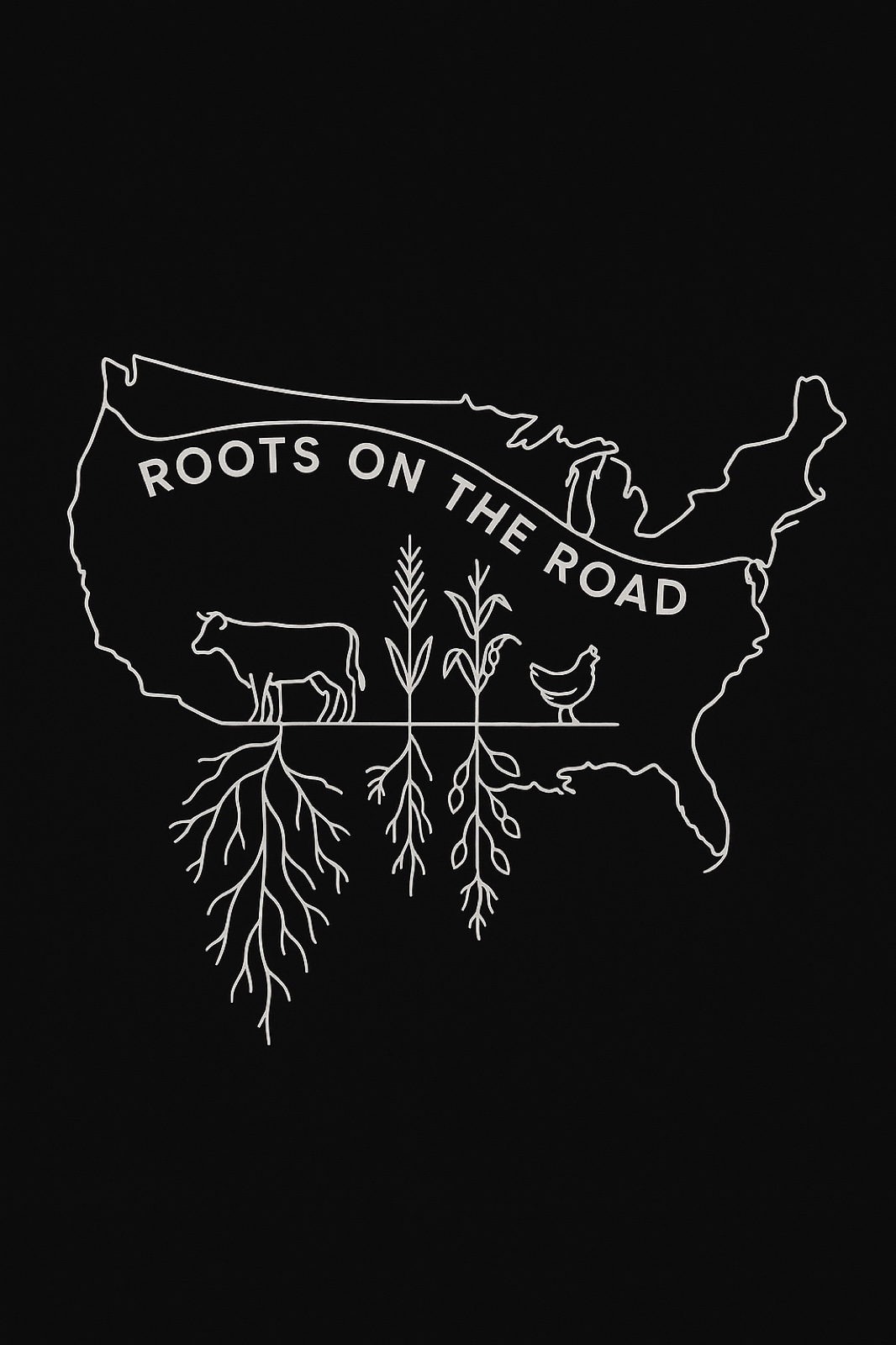
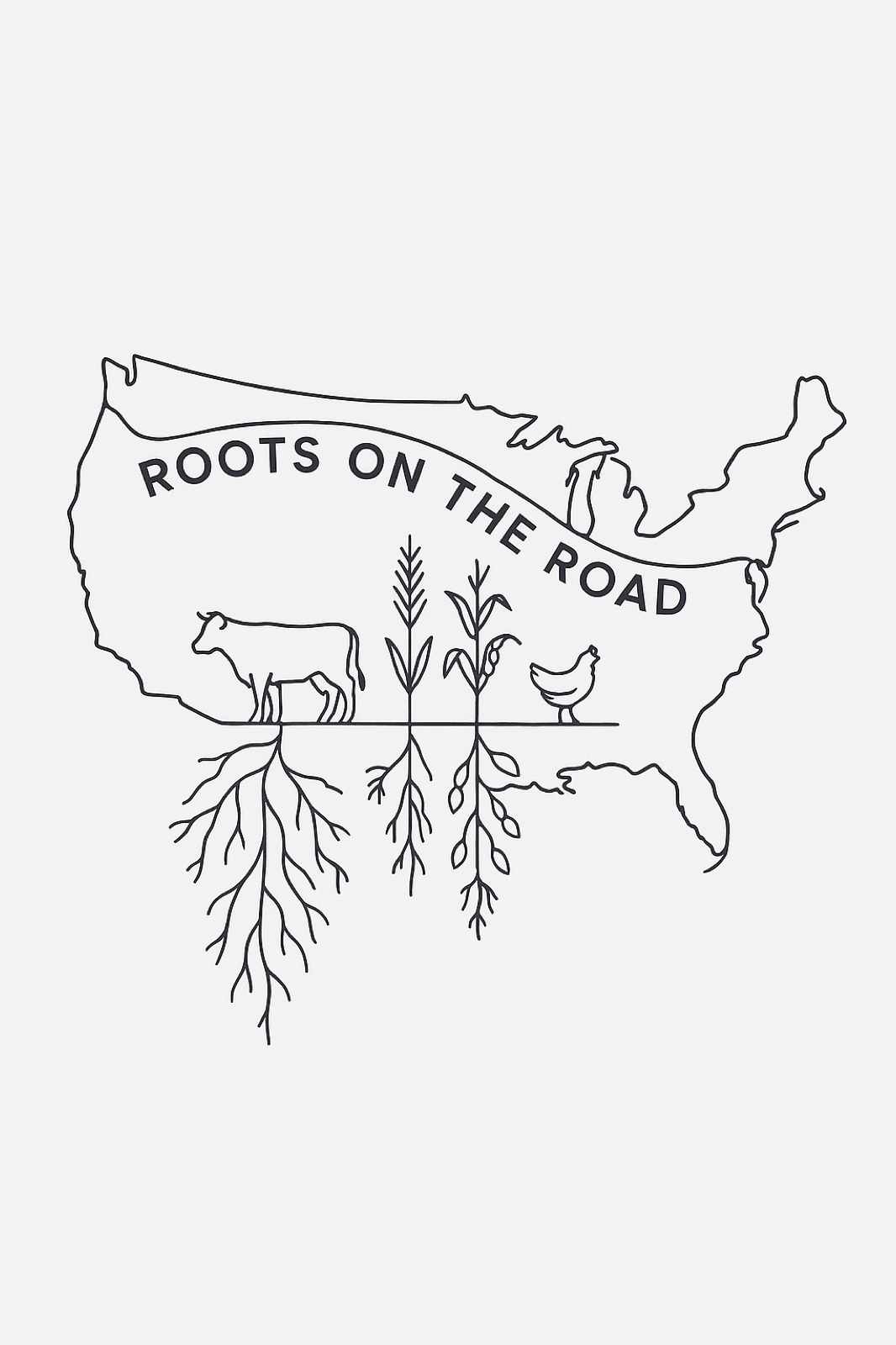
Back — Continuous Line

Back — Continuous Line on black
ON BLACK
Back — Continuous Line on white
ON WHITE
PROMPT
A single iconic t-shirt back illustration, centered on a solid pure black background. Tall portrait composition. The illustration fills roughly 90% of the canvas, generously surrounded by black margin.

Subject: an outline map of the contiguous United States, drawn entirely in confident single-weight white linework (think continuous-line drawing, monoline vector, no fills, no shading — just clean white lines on black). The map is the hero of the composition.

The northern border of the US: a single curving white line (the cycling route) sweeps from the Pacific Northwest (Seattle area, upper-left) eastward across the northern plains and Great Lakes region, ending at Washington D.C. (mid-Atlantic, upper-right). ALONG this curving route line, the words "ROOTS ON THE ROAD" are set in confident geometric sans-serif caps, each letter following the curve precisely, the route line passing through the baseline of the type. The route is the type's baseline.

The southern border of the US morphs west-to-east through THREE distinct zones:

ZONE 1 (WEST — California/Arizona/New Mexico section): the border line dissolves DOWNWARD into a network of organic root tendrils, descending below the map into the black space below. The roots branch and taper like a real root system, drawn in the same single-weight white line.

ZONE 2 (MIDDLE — Texas/Louisiana/Mississippi/Alabama section): the border becomes a horizon line from which three farm plants grow UPWARD into the body of the map: a sheaf of wheat (left), a corn stalk with ears (center), and a soybean plant with pods (right). The ROOTS of each plant descend BELOW the border line down into the black space, mirroring the foliage above. Standing ON the border line between the plants: one small cow silhouette and one small chicken silhouette, both in the same clean linework style.

ZONE 3 (EAST — Florida/Georgia coast): the border returns to a normal clean map outline. The Florida peninsula is intact and unmodified. The transition from plants back to normal border is graceful.

Strict design constraints: pure single-weight white linework on solid pure black background. NO fills, NO shading, NO color, NO gradients, NO photographic elements, NO state borders inside the US shape, NO drop shadows. Single uniform line weight throughout. Aesthetic references: Saul Steinberg's continuous-line drawings, Picasso's single-line animal sketches, contemporary monoline tattoo illustration, Quentin Blake's economy of line. The illustration should feel drawn in one breath.
A single iconic t-shirt back illustration, centered on a solid pure black background. Tall portrait composition. The illustration fills roughly 90% of the canvas, generously surrounded by black margin.
28

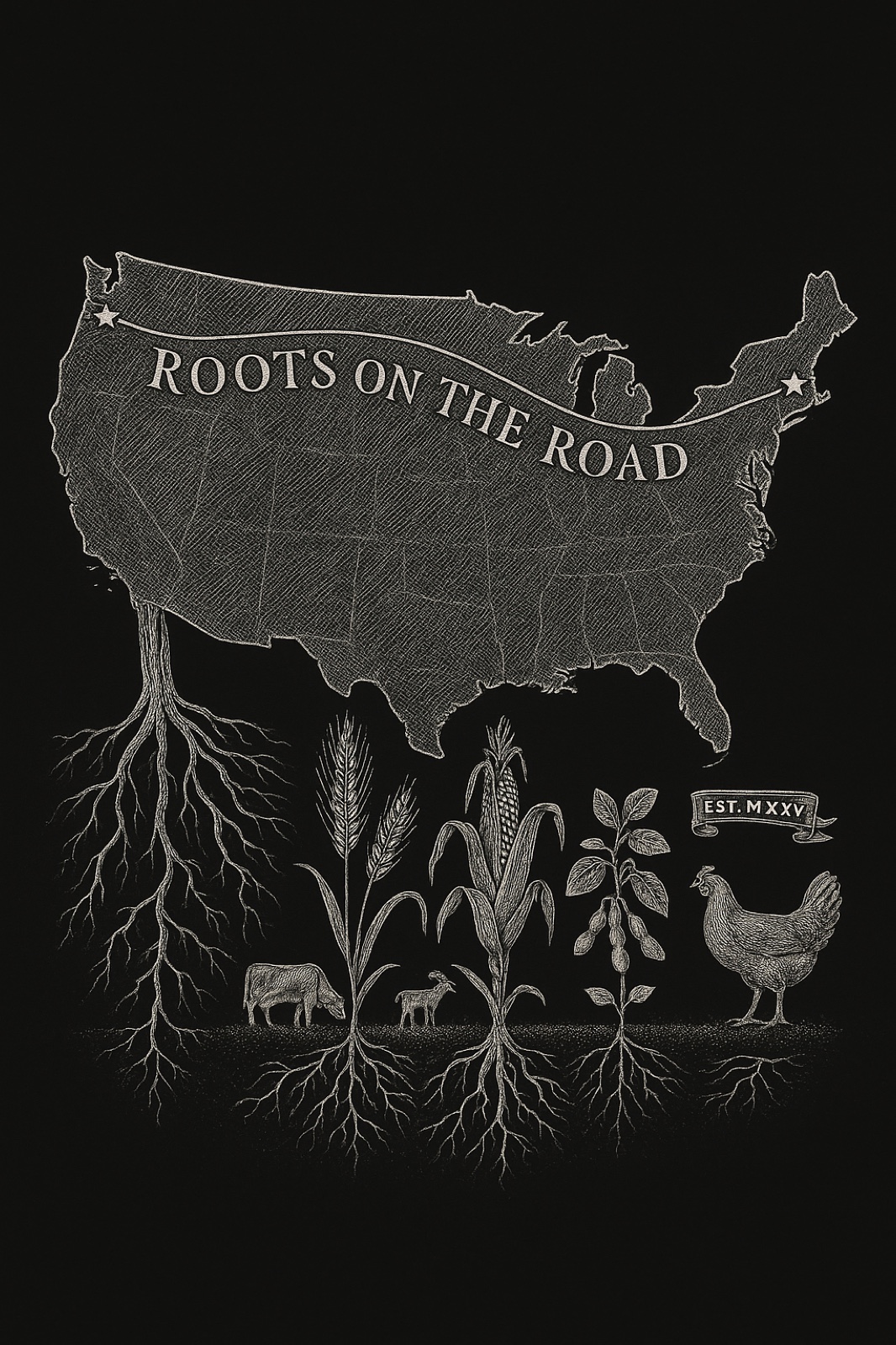
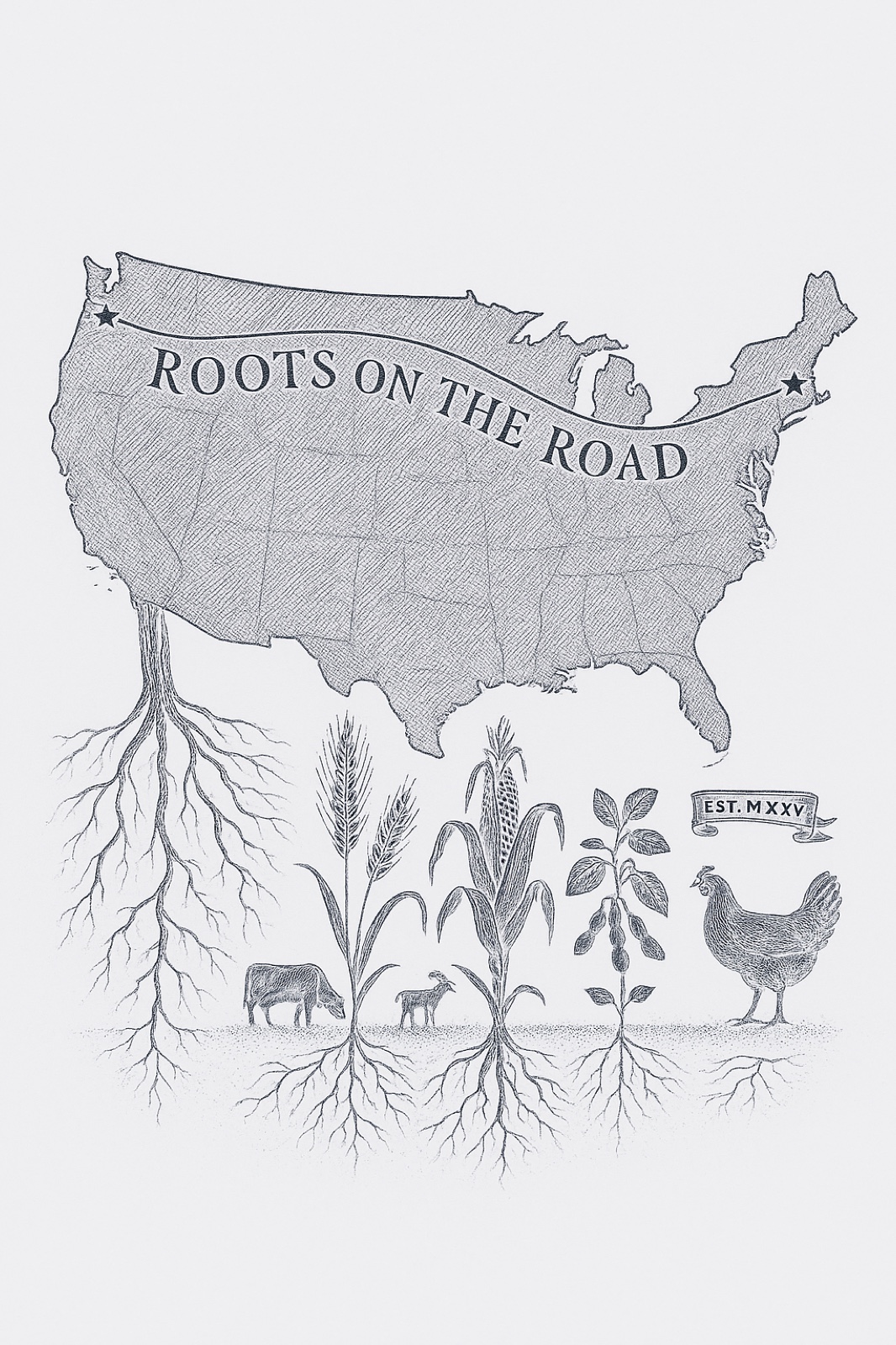
Back — Botanical Plate

Back — Botanical Plate on black
ON BLACK
Back — Botanical Plate on white
ON WHITE
PROMPT
A single iconic t-shirt back illustration, centered on a solid pure black background. Tall portrait composition. The illustration fills roughly 90% of the canvas, generously surrounded by black margin.

Subject: an outline map of the contiguous United States rendered in the style of a 19th-century botanical plate or scientific illustration, drawn entirely in delicate, technical white linework with crosshatching and stippling — like an Audubon engraving or a Curtis's Botanical Magazine plate, but executed in pure white line on black.

The northern border of the US: a graceful curving line representing the cycling route from Seattle (upper-left, marked with a tiny white star) eastward across the northern tier to Washington D.C. (upper-right, marked with a tiny white star). Along this route, the words "Roots on the Road" are set in elegant hand-lettered serif italic caps that follow the curve, each letter rotating to sit on the route line.

The southern border of the US morphs west-to-east through THREE distinct zones:

ZONE 1 (WEST): the southern border dissolves into an exquisite root system, drawn with the fine-line precision of a botanical illustration — primary taproot, secondary lateral roots, fine root hairs — descending into the black space below the map with stippled detail showing the soil texture.

ZONE 2 (MIDDLE): the border becomes a soil line from which three exemplar farm plants rise, each rendered with botanical-plate accuracy: a wheat sheaf with detailed grain heads and bearded awns, a corn stalk with detailed husks and silk, and a soybean plant with detailed trifoliate leaves and pods. The ROOTS of each plant descend below the border into the black space, drawn with the same scientific precision. Beside the plants, two small farm-animal vignettes in the style of a livestock encyclopedia: a cow standing in profile (left) and a chicken in profile (right), both finely line-detailed.

ZONE 3 (EAST): the border returns to a clean botanical-plate map outline, with Florida intact. A small banner-scroll near the east coast contains tiny caps: "EST. MMXXVI."

Strict design constraints: pure white linework on solid pure black background, with white crosshatching and stippling for tonal detail. NO fills (no solid white shapes filling the map), NO color, NO gradients, NO photographic elements, NO state borders inside the US shape. Aesthetic references: John James Audubon's Birds of America, Pierre-Joseph Redouté's botanical plates, Ernst Haeckel's Kunstformen der Natur, contemporary scientific-illustration revival work. Refined. Detailed. Educational-poetic.
A single iconic t-shirt back illustration, centered on a solid pure black background. Tall portrait composition. The illustration fills roughly 90% of the canvas, generously surrounded by black margin.
29

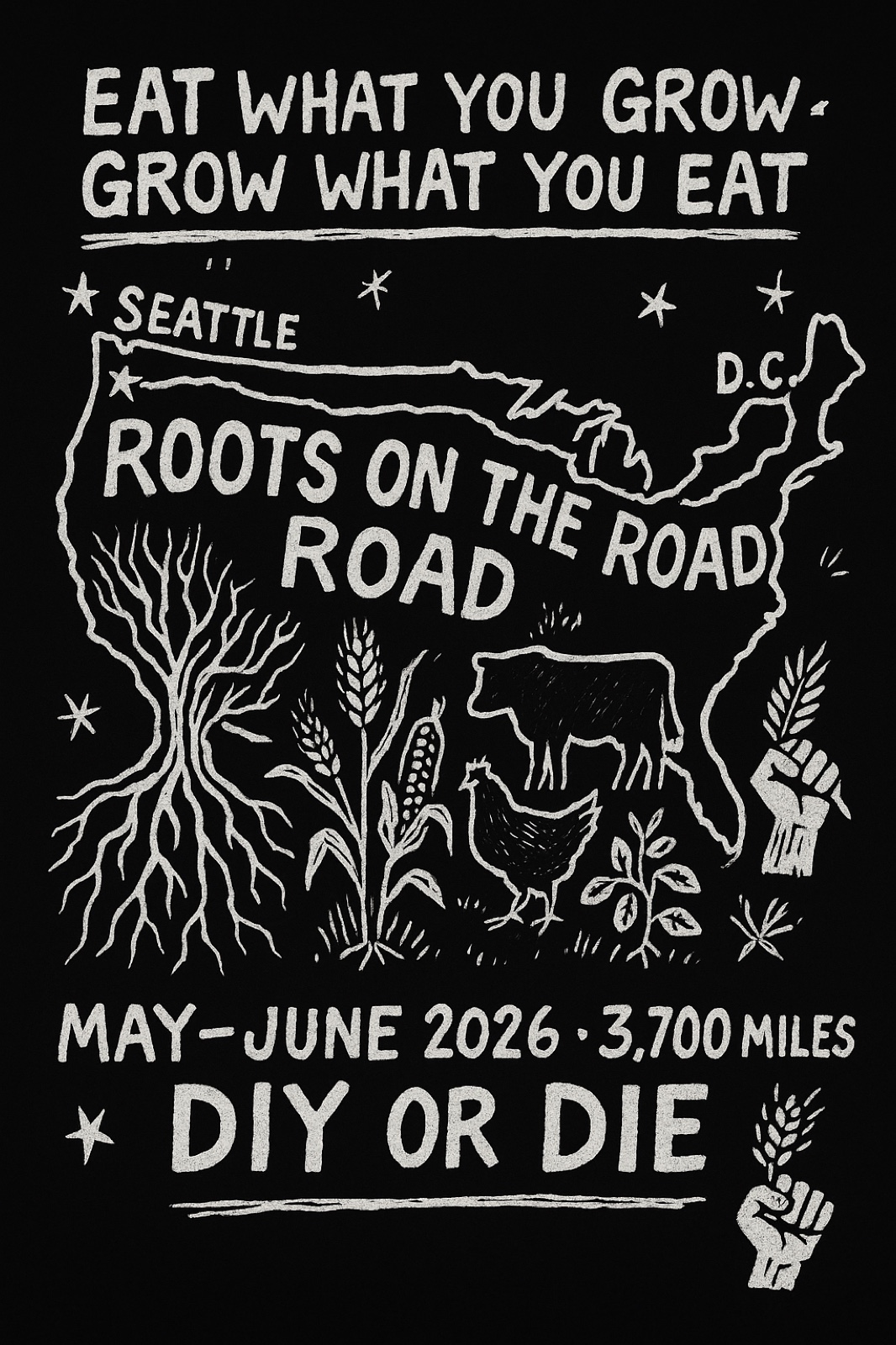
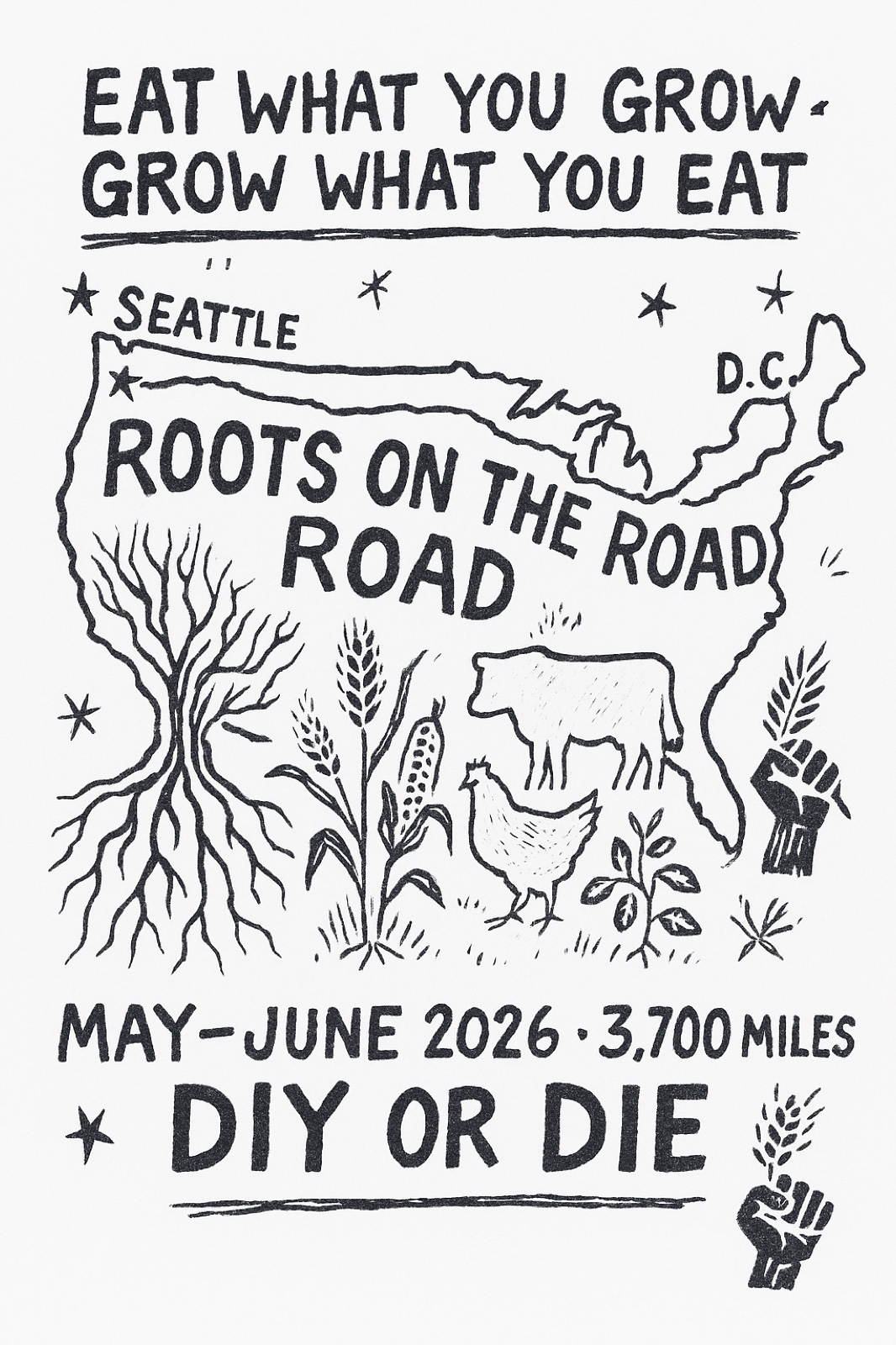
Back — Punk Zine

Back — Punk Zine on black
ON BLACK
Back — Punk Zine on white
ON WHITE
PROMPT
A single iconic t-shirt back illustration, centered on a solid pure black background. Tall portrait composition. The illustration fills roughly 95% of the canvas with raw DIY energy.

Subject: an outline map of the contiguous United States, drawn entirely in raw, hand-drawn, slightly wobbly thick white marker linework — like a high-contrast photocopied punk zine from 1985, a Crass record sleeve, or a Riot Grrrl flyer xeroxed at the campus copy shop. Every line should feel hand-drawn, urgent, and imperfect. NO clean vector — this should look like it was drawn fast with a Sharpie.

The northern border of the US: a hand-drawn jagged route line sweeping from the Pacific Northwest (upper-left, with a hand-drawn star and the word "SEATTLE" in raw block caps) eastward across the northern tier to Washington D.C. (upper-right, hand-drawn star and "D.C." in raw caps). Along this route, the words "ROOTS ON THE ROAD" are set in chunky hand-drawn caps that follow the curve, slightly uneven in size and angle — clearly drawn by hand. Some letters touch the route line, some float just above.

The southern border of the US morphs west-to-east through THREE zones:

ZONE 1 (WEST): the border explodes into a tangle of bold thick-marker roots descending wildly into the black space below — knotted, branching, urgent.

ZONE 2 (MIDDLE): the border becomes a ground line from which farm plants erupt — a wheat sheaf scribbled with hatch-mark grain heads, a corn stalk with chunky cobs, a soybean plant with bold round pods. Each plant has thick scribbled roots descending below. Standing among them: a chunky hand-drawn cow silhouette and a feisty hand-drawn chicken, both with high-contrast scribble shading.

ZONE 3 (EAST): the border returns to a hand-drawn normal map outline, with Florida present.

Across the very top of the canvas, ABOVE the map, additional zine-style hand-lettered text in raw white block caps: "EAT WHAT YOU GROW · GROW WHAT YOU EAT" with ragged underline. At the bottom, hand-lettered: "MAY-JUNE 2026 · 3,700 MILES · DIY OR DIE."

Add small zine-style decorations: a few hand-drawn stars, asterisks, and a small hand-drawn fist clutching a wheat stalk in one corner.

Strict design constraints: pure white hand-drawn linework on solid pure black background. Thick uneven marker-quality lines. Crosshatching and scribble-shading allowed. NO clean digital vectors, NO gradients, NO color, NO photographic elements, NO drop shadows. Aesthetic references: Crass record sleeves, Raymond Pettibon Black Flag art, Jamie Reid Sex Pistols flyers, 1990s Riot Grrrl zines, Cometbus, the original Maximum RockNRoll layouts. Raw. Urgent. Hand-touched. Photocopied-feeling.
A single iconic t-shirt back illustration, centered on a solid pure black background. Tall portrait composition. The illustration fills roughly 95% of the canvas with raw DIY energy.
30

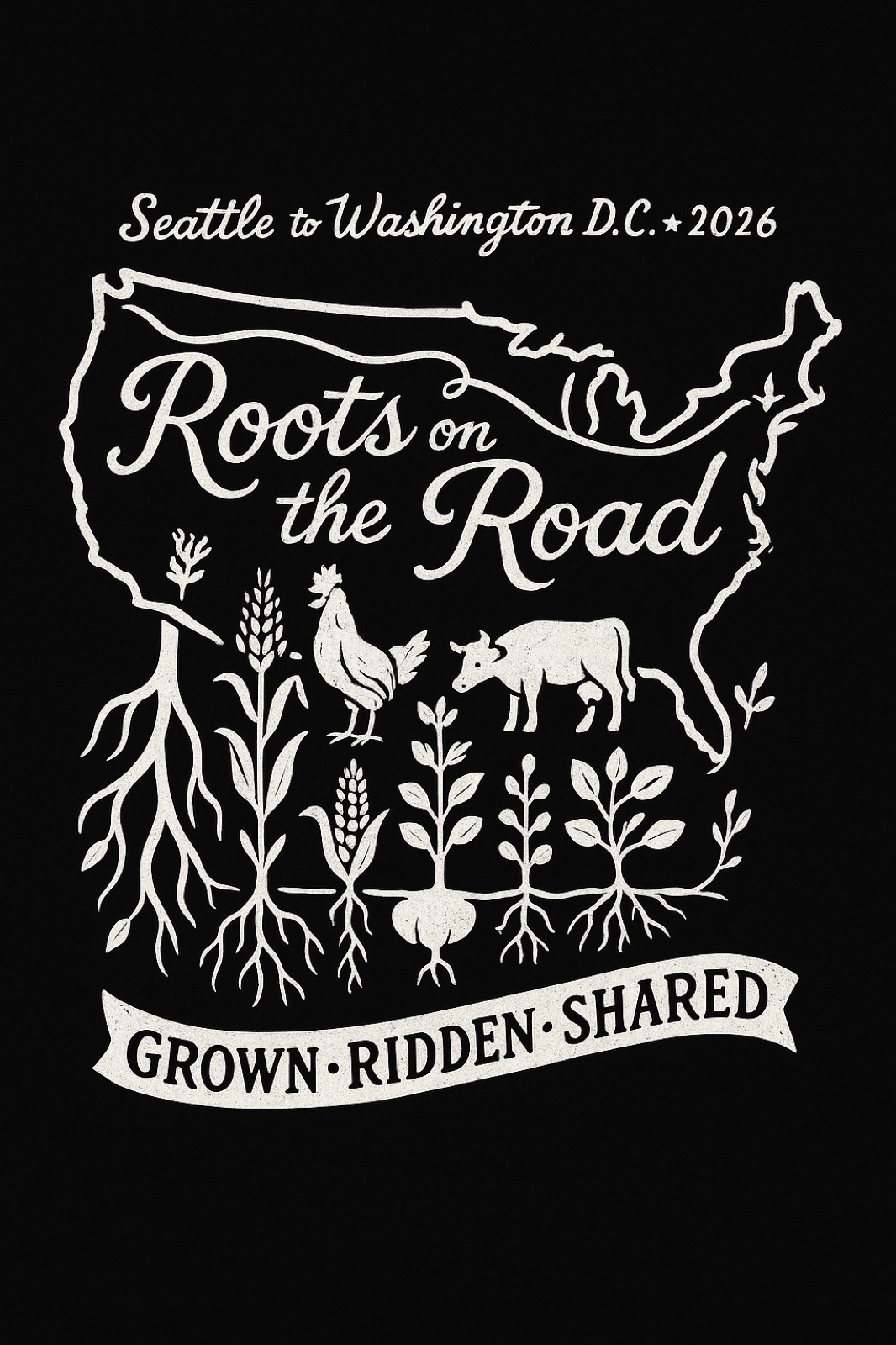
Back — Folk Script

Back — Folk Script on black
ON BLACK
Back — Folk Script on white
ON WHITE
PROMPT
A single iconic t-shirt back illustration, centered on a solid pure black background. Tall portrait composition. The illustration fills roughly 90% of the canvas, generously surrounded by black margin.

Subject: an outline map of the contiguous United States rendered in the style of a hand-painted folk-art farm sign or barn-quilt, drawn in confident sign-painter's brush linework, all in solid white on black.

The northern border of the US: a flowing curving white line representing the cycling route from Seattle (upper-left) eastward across the northern tier to Washington D.C. (upper-right). Along this route, the words "Roots on the Road" are set in beautiful hand-lettered Spencerian-meets-sign-painter SCRIPT — flowing, expressive, slightly imperfect, with confident brush variation in stroke weight. The script follows the curve of the route, ascending and descending slightly with the line. The "R" of Roots and the "R" of Road have small flourishes that end in tiny leaves or tendrils.

The southern border of the US morphs west-to-east through THREE distinct zones:

ZONE 1 (WEST): the border line transforms into expressive folk-art roots — confident brush-stroke tendrils descending into the black space below, with rounded organic curves. Each root tip ends in a small leaf or sprout.

ZONE 2 (MIDDLE): the border becomes a soil line from which folk-rendered farm plants grow upward: a wheat sheaf bound with a folk-style ribbon, a corn stalk with stylized husks and tassels, a soybean plant with rounded leaves. The ROOTS of each plant descend below the border into the black space in matching folk style. Standing on the border between them: a stylized folk-art cow (rounded, friendly, painted-sign-quality) and a folk-art chicken with a curling tail feather.

ZONE 3 (EAST): the border returns to a normal hand-painted outline, with Florida intact and a small folk-art flourish (a tiny leaf or sprout) marking the southern tip.

Below the map, with generous space, a hand-lettered ribbon-banner curves across the canvas containing the words "GROWN · RIDDEN · SHARED" in matching sign-painter caps. Above the map, in a smaller folk-script line: "Seattle to Washington D.C. ★ 2026."

Strict design constraints: pure white sign-painter brushwork on solid pure black background. The white should feel painted, with confident slight variations in stroke weight. NO digital-perfect vector, NO gradients, NO color, NO photographic elements, NO drop shadows. Aesthetic references: hand-painted barn quilts of the rural Midwest, the original Ben & Jerry's hand-lettering, Whole Earth Catalog interior illustrations, traditional New England farm-stand signage, the work of contemporary sign painter Ira Coyne. Earnest. Hand-touched. Folk-warm.
A single iconic t-shirt back illustration, centered on a solid pure black background. Tall portrait composition. The illustration fills roughly 90% of the canvas, generously surrounded by black margin.
31

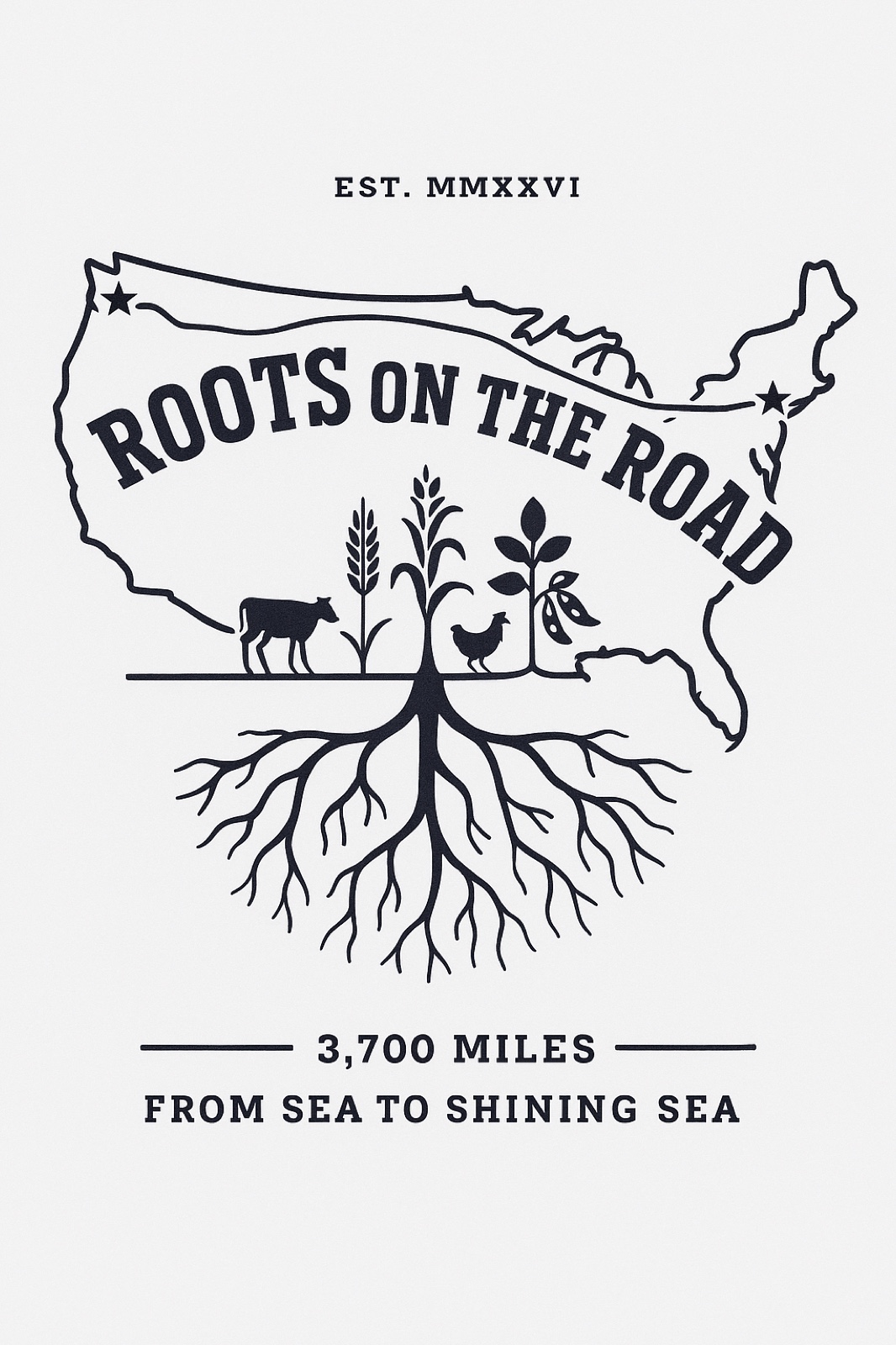
Back — Athletic Slab

Back — Athletic Slab on black
ON BLACK
Back — Athletic Slab on white
ON WHITE
PROMPT
A single iconic t-shirt back illustration, centered on a solid pure black background. Tall portrait composition. The illustration fills roughly 90% of the canvas, generously surrounded by black margin.

Subject: an outline map of the contiguous United States rendered in clean, confident, slightly chunky white linework with a vintage collegiate-athletic sensibility — like the back of a Rapha cycling jersey or a varsity cycling team shirt from a small American liberal arts college.

The northern border of the US: a clean curving route line from Seattle (upper-left, marked with a small white star) eastward across the northern tier to Washington D.C. (upper-right, marked with a small white star). Along this route, the words "ROOTS ON THE ROAD" are set in heavy slab-serif athletic caps (Rockwell Bold or Clarendon Black style) that follow the curve precisely, each letter sitting on the route line as its baseline. The type is bold, confident, varsity-jersey-quality.

The southern border of the US morphs west-to-east through THREE distinct zones:

ZONE 1 (WEST): the border line becomes a clean designed root system descending into the black space below — strong primary taproot with secondary roots branching off in a balanced symmetrical composition. Drawn in the same confident vector linework as the rest of the map.

ZONE 2 (MIDDLE): the border becomes a clean ground line from which three exemplar farm plants rise in clean designed silhouette: a wheat sheaf (left), a corn stalk with two ears (center), a soybean plant with three trifoliate leaves and pods (right). The ROOTS of each plant descend below the border in matching clean linework. Standing on the border between the plants, two small clean farm-animal silhouettes: a cow (left of corn) and a chicken (right of corn).

ZONE 3 (EAST): the border returns to a clean map outline with Florida intact.

Above the map, with generous space, a horizontal white rule, and above it set in smaller slab-serif caps: "EST. MMXXVI." Below the map, another horizontal white rule, and below it: "★ 3,700 MILES ★ FROM SEA TO SHINING SEA ★" in smaller slab-serif caps.

Strict design constraints: clean confident white linework with consistent line weight on solid pure black background. NO fills, NO shading, NO color, NO gradients, NO photographic elements, NO state borders inside the US shape, NO drop shadows. Aesthetic references: Rapha cycling jersey graphics, Brooks England saddle branding, Pendleton wool labels, vintage American baseball script, the United States Bicycle Route System wordmark. Athletic. Classic. Confident. Varsity.
A single iconic t-shirt back illustration, centered on a solid pure black background. Tall portrait composition. The illustration fills roughly 90% of the canvas, generously surrounded by black margin.
32

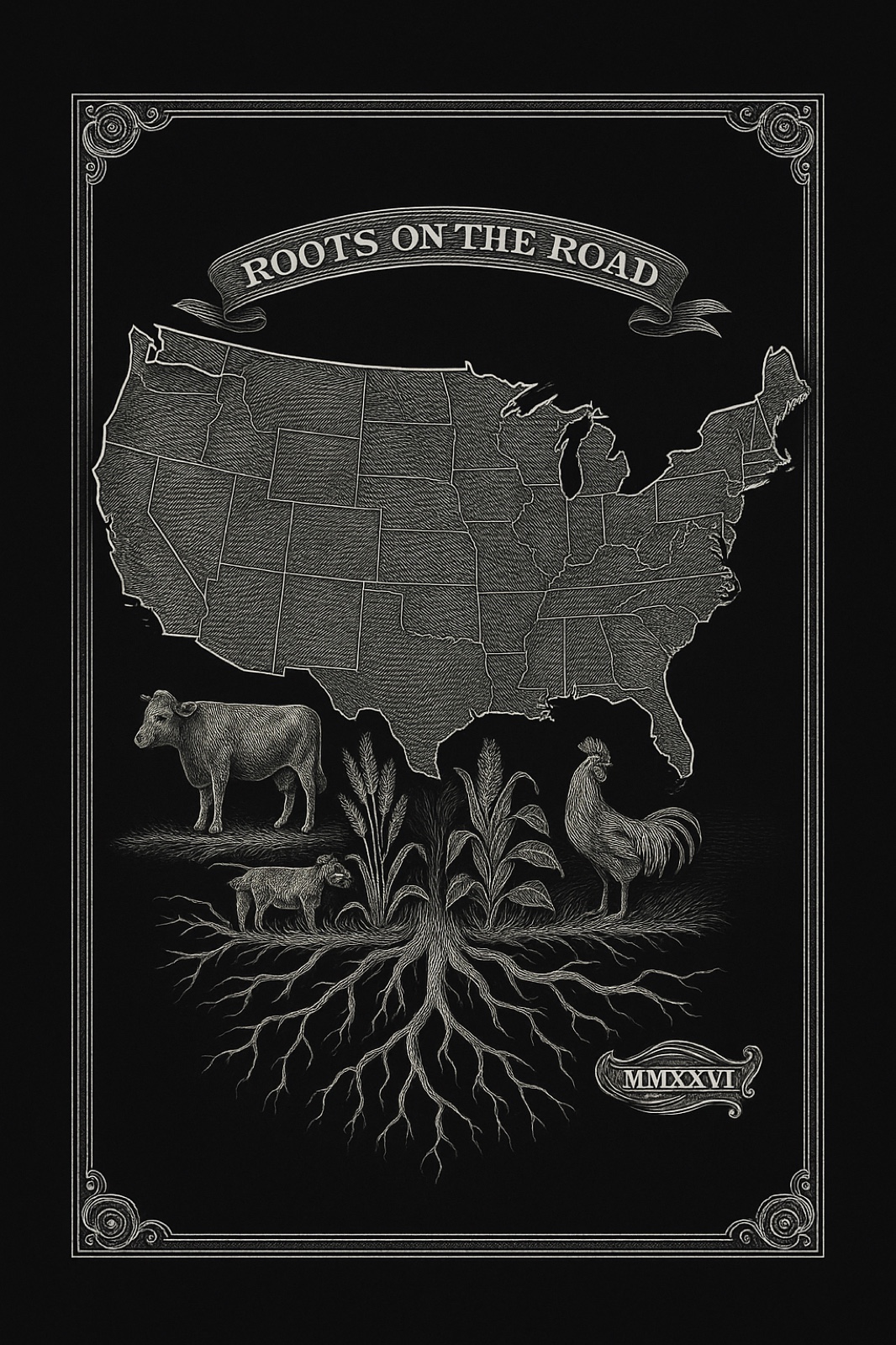
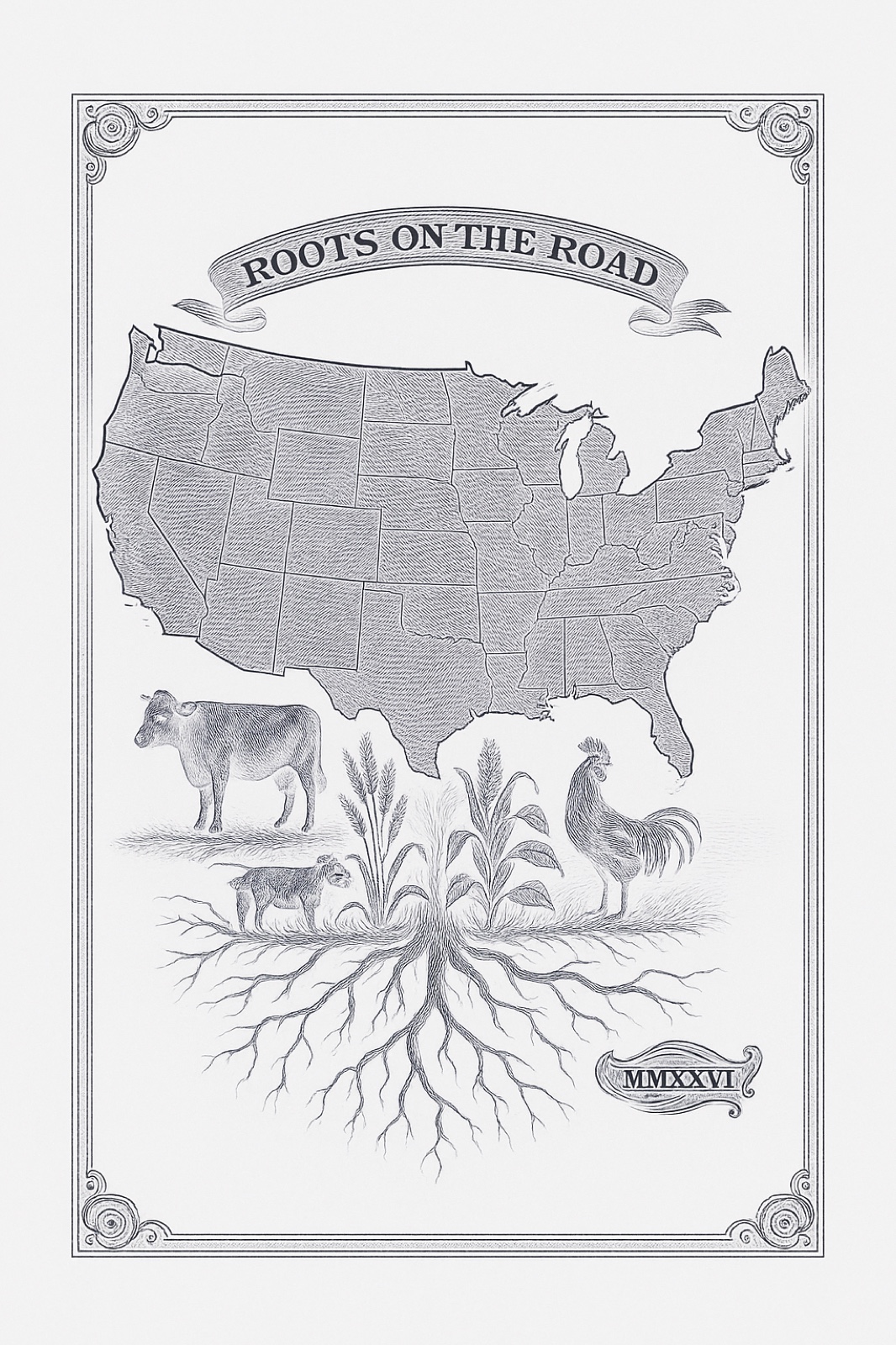
Back — Engraved

Back — Engraved on black
ON BLACK
Back — Engraved on white
ON WHITE
PROMPT
A single iconic t-shirt back illustration, centered on a solid pure black background. Tall portrait composition. The illustration fills roughly 90% of the canvas, generously surrounded by black margin.

Subject: an outline map of the contiguous United States rendered in the style of a U.S. currency engraving or a 19th-century steel-plate illustration — extremely fine white linework with elegant guilloché flourishes, parallel-line shading, and decorative cartouches. Like the back of a dollar bill or a Treasury bond, but in pure white on black.

The northern border of the US: an elegant decorative route ribbon from Seattle (upper-left) eastward across the northern tier to Washington D.C. (upper-right). The route is rendered as a slender engraved ribbon with subtle parallel-line shading. ON this ribbon, the words "ROOTS ON THE ROAD" are set in fine engraved serif caps — small, refined, like the lettering on a banknote — following the ribbon's curve.

The southern border of the US morphs west-to-east through THREE distinct zones:

ZONE 1 (WEST): the border dissolves into a delicate engraved root system descending into the black space below, with the fine parallel-line shading characteristic of steel-plate engraving — each root rendered with light-and-shadow definition through dense linework. Roots branch and taper with anatomical precision.

ZONE 2 (MIDDLE): the border becomes a horizon ground-line from which engraved farm plants rise: a wheat sheaf with each grain head etched in fine detail with bearded awns, a corn stalk with detailed husks and ears showing engraved kernels, a soybean plant with trifoliate leaves and pods rendered in fine parallel hatching. Roots descend below the border in matching engraved style. Standing on the border, finely engraved farm-animal vignettes worthy of a Treasury allegorical scene: a cow in dignified profile (left) and a rooster in proud profile (right), both with full engraving-style shading.

ZONE 3 (EAST): the border returns to a finely-engraved clean map outline, with Florida intact. Near the east coast, a small engraved cartouche-banner contains "MMXXVI" in fine serif caps.

Around the entire composition, optional thin decorative engraved borders — guilloché flourishes in the corners, like a banknote frame.

Strict design constraints: pure fine white linework on solid pure black background, with parallel-line and crosshatch shading for tonal definition. NO solid fills, NO color, NO gradients, NO photographic elements, NO state borders inside the US shape. Aesthetic references: U.S. paper currency engravings (the back of a $1 bill, $20 bill), Bureau of Engraving and Printing portrait work, 19th-century steel-plate book illustrations, certificates of merit from the Industrial Revolution era. Refined. Authoritative. Elegantly American.
A single iconic t-shirt back illustration, centered on a solid pure black background. Tall portrait composition. The illustration fills roughly 90% of the canvas, generously surrounded by black margin.
33

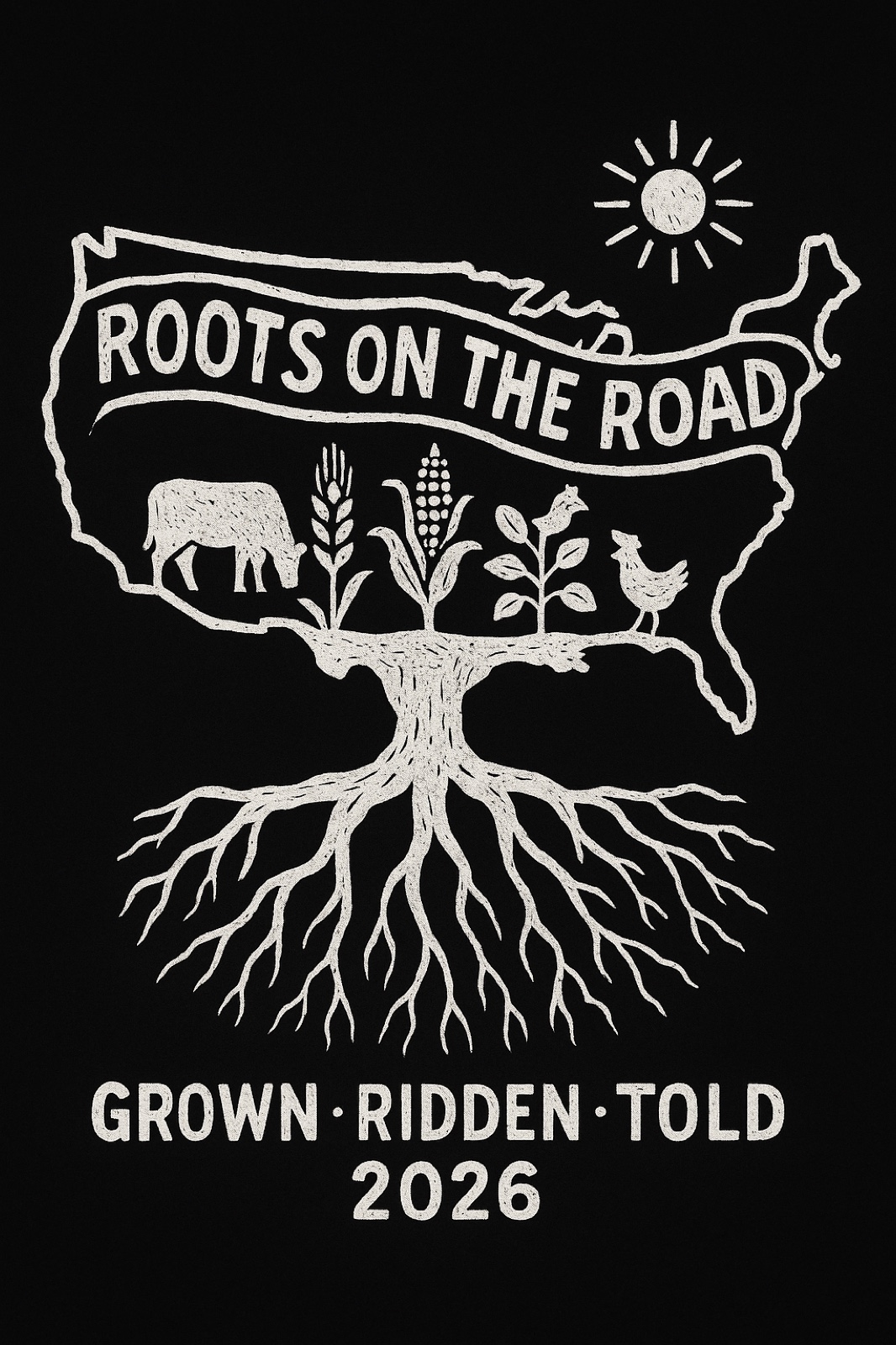
Back — Block Print

Back — Block Print on black
ON BLACK
Back — Block Print on white
ON WHITE
PROMPT
A single iconic t-shirt back illustration, centered on a solid pure black background. Tall portrait composition. The illustration fills roughly 90% of the canvas, generously surrounded by black margin.

Subject: an outline map of the contiguous United States rendered in the style of a hand-cut linocut or woodblock print — bold confident white shapes and lines on black, with the characteristic chiseled marks of a print made from a carved block. Like a Sister Corita Kent print, a Grateful Dead block-print poster, or a Wendell Berry book illustration, but executed in pure white-on-black.

The northern border of the US: a confident carved curving route line from Seattle (upper-left) eastward across the northern tier to Washington D.C. (upper-right). Along this route, the words "ROOTS ON THE ROAD" are set in chunky carved block-letter caps (slightly imperfect, with the visible edges of a wood-carved tool) following the curve, each letter sitting on the route as its baseline.

The southern border of the US morphs west-to-east through THREE distinct zones:

ZONE 1 (WEST): the border becomes a bold, chunky, carved root system descending into the black space below. The roots have the characteristic taper and slight imperfection of a tool-carved line — strong primary taproot, branching secondary roots, with small parallel-gouge marks suggesting bark texture.

ZONE 2 (MIDDLE): the border becomes a carved ground line from which three farm plants rise as bold block-print silhouettes: a wheat sheaf with thick carved grain heads, a corn stalk with carved husks and ears, a soybean plant with rounded carved leaves and pods. The ROOTS of each plant descend below the border in matching block-print style. Standing on the border, a chunky carved cow silhouette and a chunky carved chicken silhouette — both rendered as bold positive/negative block-print shapes with simple carved interior detail (an eye, a hint of a tail).

ZONE 3 (EAST): the border returns to a carved clean map outline, with Florida intact.

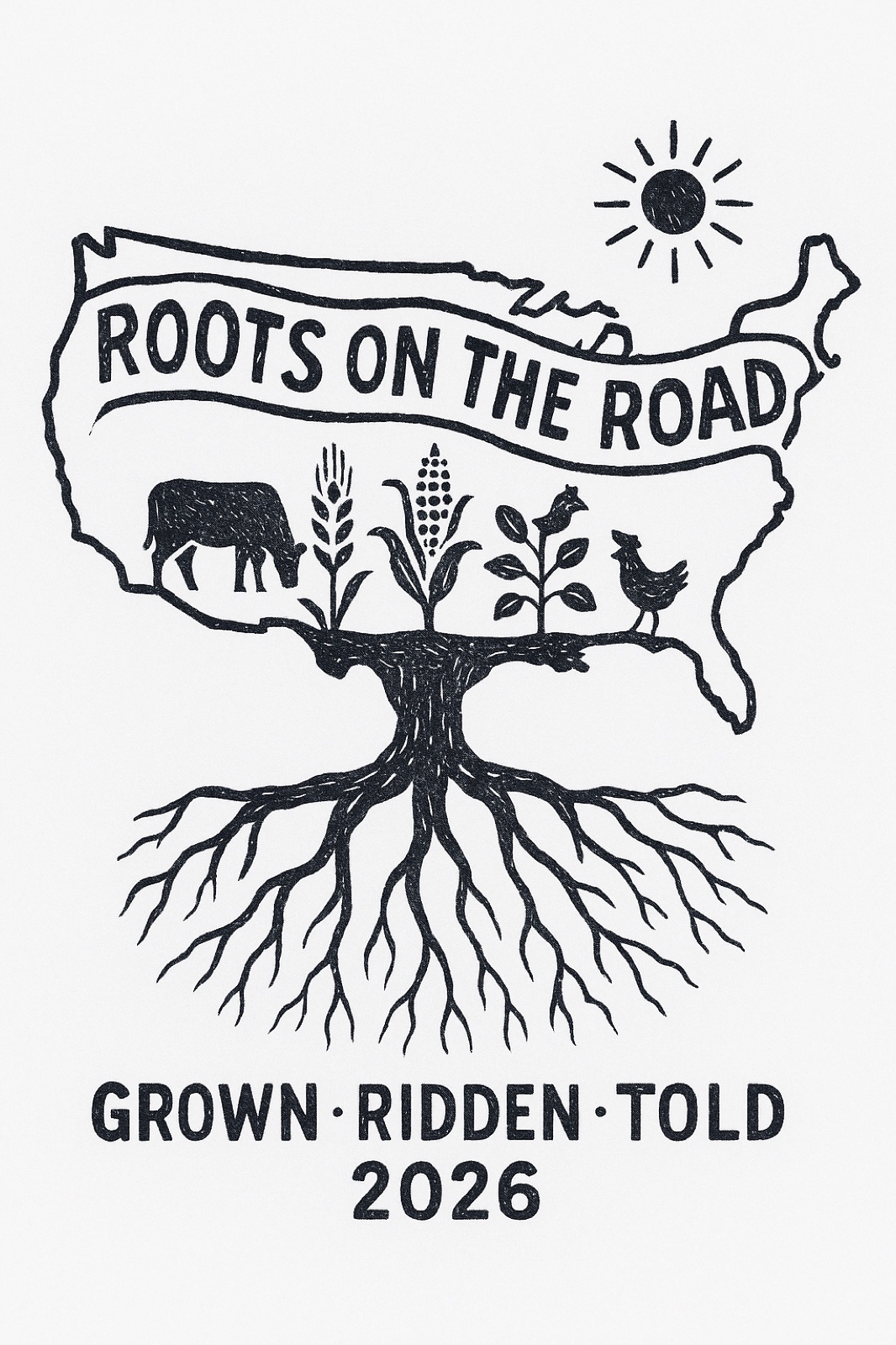
Below the map, set in carved block-letter caps: "GROWN · RIDDEN · TOLD · 2026." Above the map, a small block-print sun or sunburst motif.

Strict design constraints: pure white block-print marks on solid pure black background. The white should feel CARVED — with slight imperfections, visible tool marks, the occasional small white speckle suggesting block-print artifact. Bold contrast between solid white shapes and pure black negative space. NO smooth digital vectors, NO gradients, NO color, NO photographic elements, NO drop shadows. Aesthetic references: Sister Corita Kent serigraphs, Wendell Berry's book illustrations by Wesley Bates, Grateful Dead poster art, traditional Mexican linocut work, the WPA-era block prints of rural America. Bold. Hand-cut. Earthy. Crafted.
A single iconic t-shirt back illustration, centered on a solid pure black background. Tall portrait composition. The illustration fills roughly 90% of the canvas, generously surrounded by black margin.
34

Back — WPA Poster

Back — WPA Poster on black
ON BLACK
Back — WPA Poster on white
ON WHITE
PROMPT
A single iconic t-shirt back illustration, centered on a solid pure black background. Tall portrait composition. The illustration fills roughly 90% of the canvas, generously surrounded by black margin.

Subject: an outline map of the contiguous United States rendered in the bold, confident, geometric style of a 1930s WPA poster — flat shapes, strong silhouettes, art-deco-influenced line work. Like a Civilian Conservation Corps national parks poster, a Federal Art Project agricultural poster, or a Rural Electrification Administration print — but executed in pure white linework on black.

The northern border of the US: a bold confident route line from Seattle (upper-left) eastward across the northern tier to Washington D.C. (upper-right). Above the route, set in bold WPA-era geometric sans-serif caps with art-deco proportions (think the "SEE AMERICA" poster lettering): "ROOTS ON THE ROAD" — following the curve of the route, the type confident and large.

The southern border of the US morphs west-to-east through THREE distinct zones:

ZONE 1 (WEST): the border becomes a bold geometric root system — stylized in the deco-WPA manner, with strong tapering taproots and branching secondaries descending into the black space below. The roots have the geometric confidence of a 1930s industrial poster.

ZONE 2 (MIDDLE): the border becomes a strong horizon ground-line from which three monumental farm plants rise in WPA-poster style: a wheat sheaf rendered as a bold geometric bundle, a corn stalk rendered as a strong vertical column with stylized husks, a soybean plant rendered with confident geometric leaves. The ROOTS descend below the border in matching style. Standing among them in WPA-poster silhouette: a strong proud cow (left) and a strong proud rooster (right), both rendered as bold confident silhouettes worthy of a "GROW YOUR OWN" agricultural poster.

ZONE 3 (EAST): the border returns to a bold WPA-style map outline, Florida intact and confident.

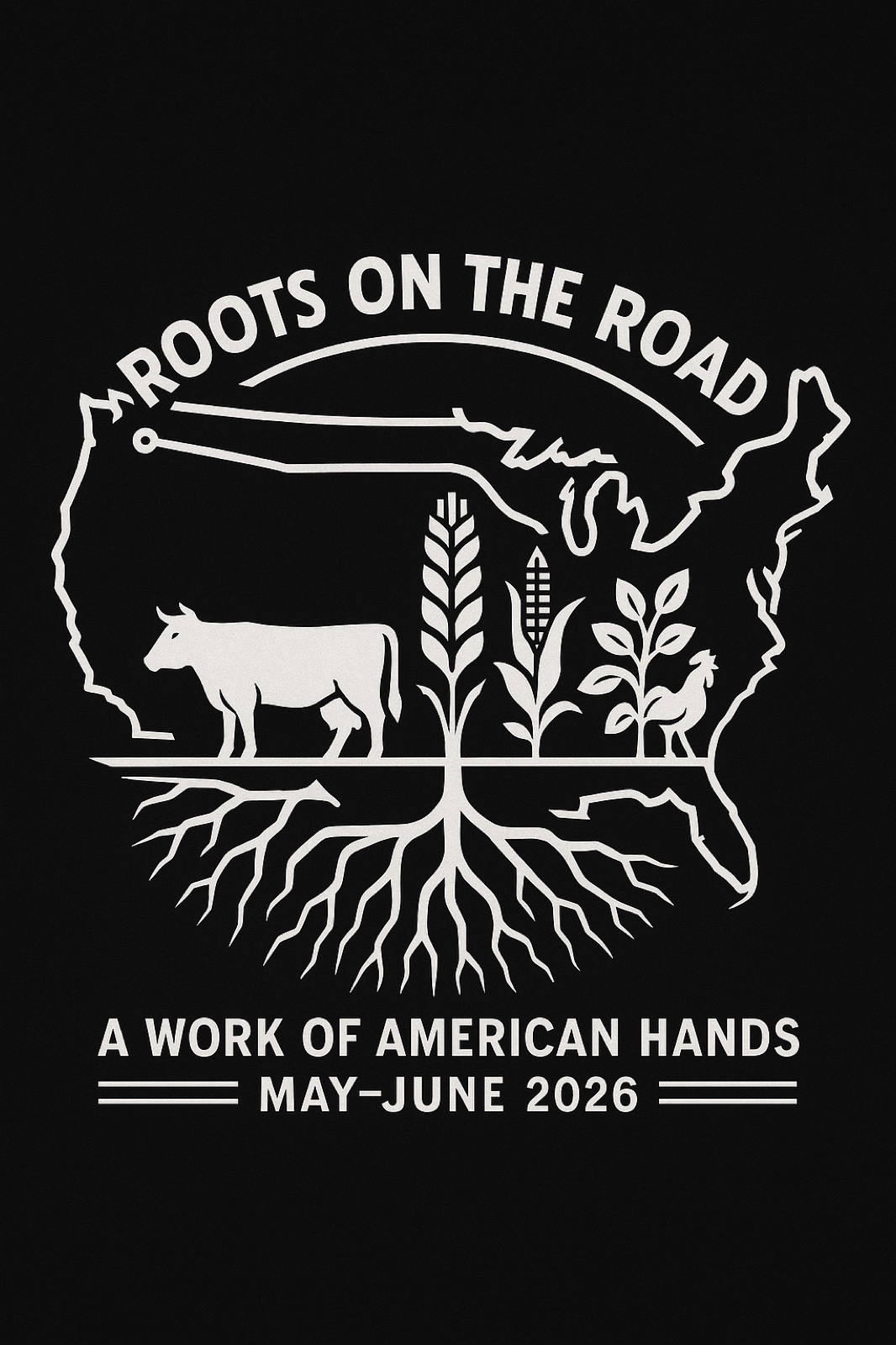
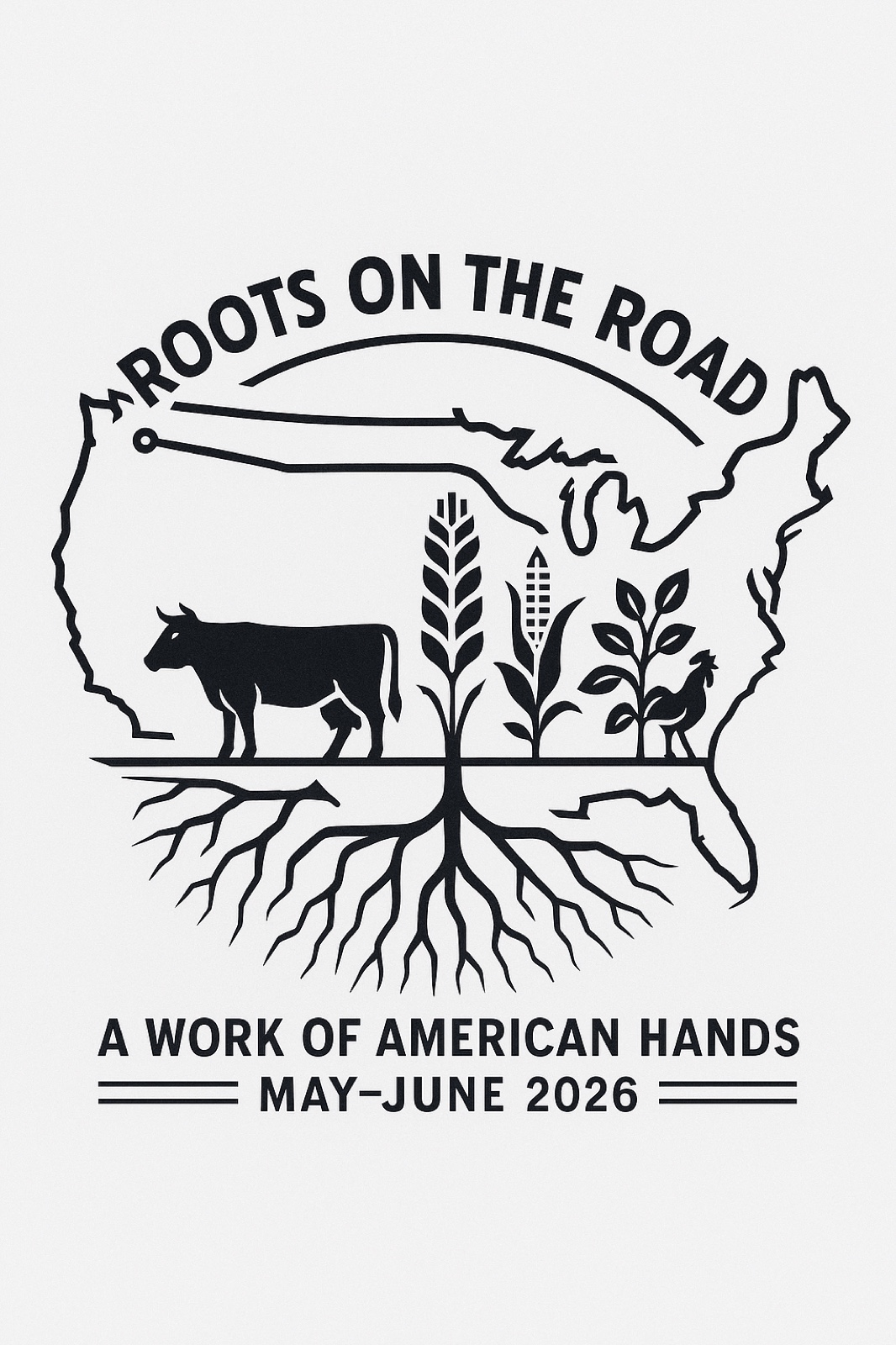
Below the map, set in WPA-poster caps with strong horizontal rules above and below: "A WORK OF AMERICAN HANDS · MAY-JUNE 2026."

Strict design constraints: pure white linework with bold confident weight on solid pure black background, with white solid silhouette fills allowed for the farm animals and plants where appropriate. NO color, NO gradients, NO photographic elements, NO state borders inside the US shape, NO drop shadows. Aesthetic references: Federal Art Project posters of 1936-43, Civilian Conservation Corps national parks posters, the "SEE AMERICA" WPA series, Rural Electrification Administration prints, the agricultural posters of Stanley Mock and Anthony Velonis. Bold. Geometric. Confidently American. Public-spirited.
A single iconic t-shirt back illustration, centered on a solid pure black background. Tall portrait composition. The illustration fills roughly 90% of the canvas, generously surrounded by black margin.

12 Other Explorations

02

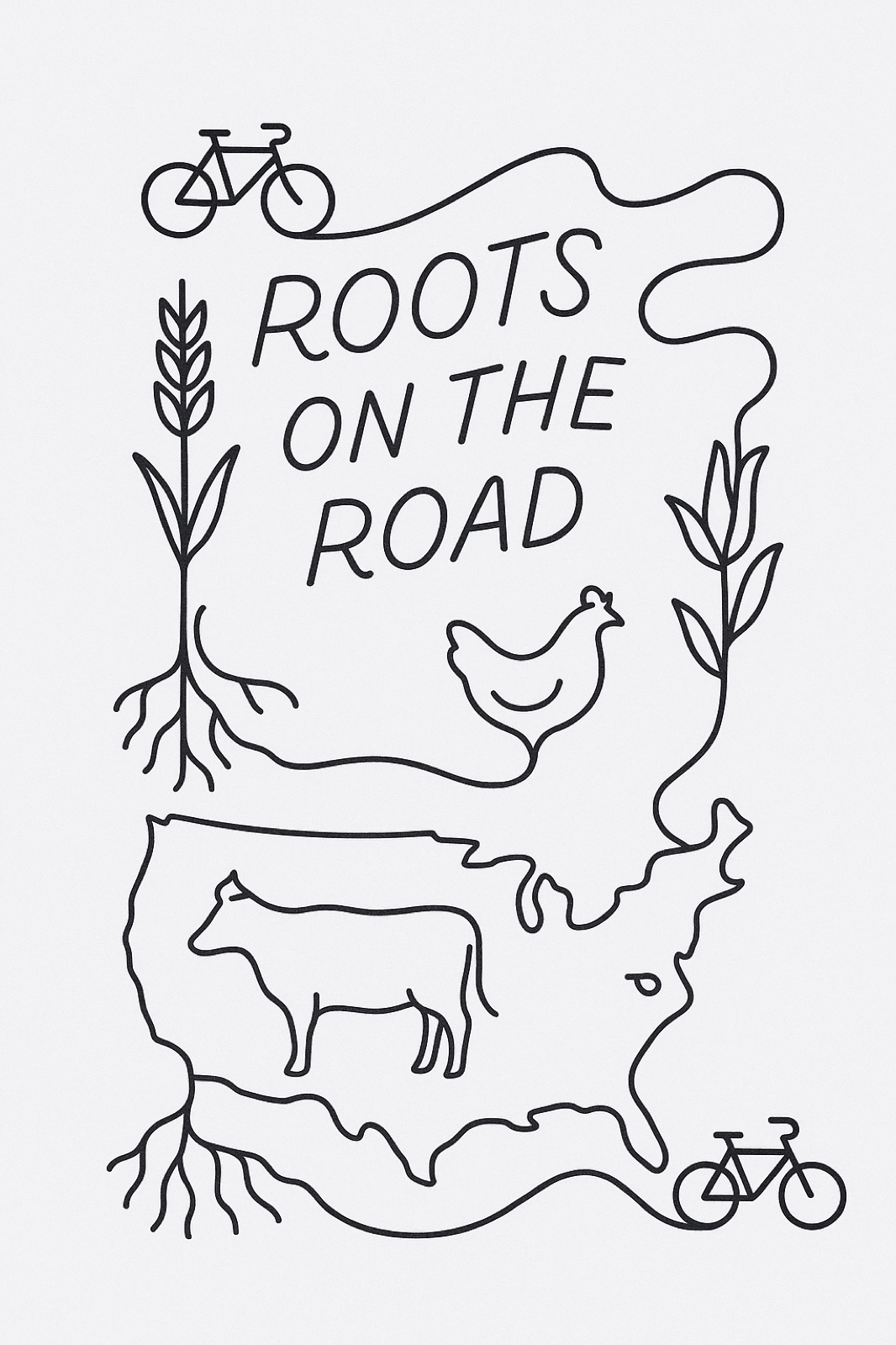
Continuous Line

Continuous Line on black
ON BLACK
Continuous Line on white
ON WHITE
PROMPT
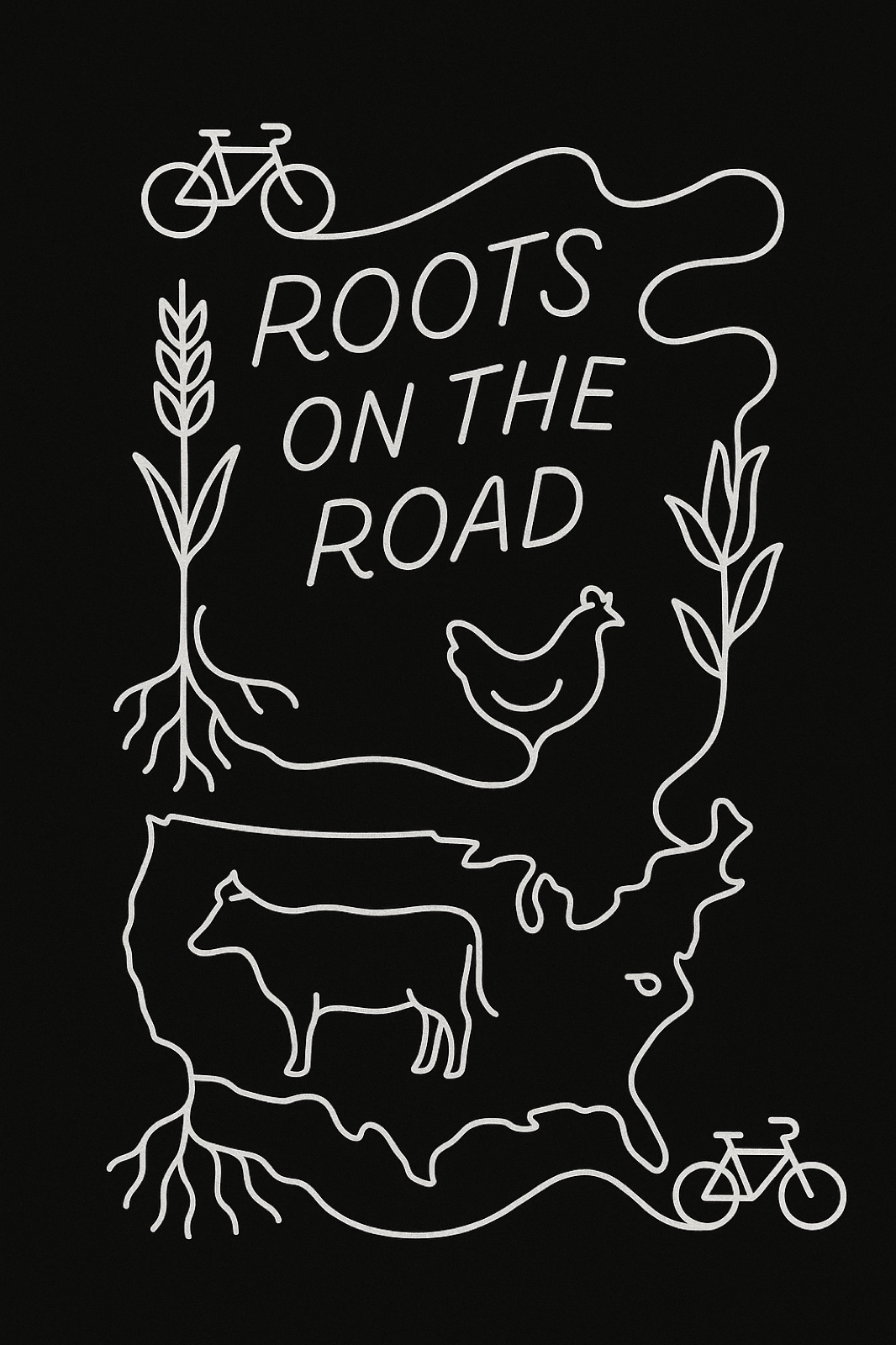
Single-color white continuous-line drawing on a solid black background, designed as a one-color screen-print graphic for the back of a t-shirt. Vertical composition.

The entire image is drawn as ONE unbroken white line of perfectly uniform stroke weight, never lifted from the page. The line begins at the top-left as a small bicycle, then unspools rightward across the upper portion of the image as a gracefully curving cross-country route. As it curves, the line forms the words "ROOTS ON THE ROAD" in flowing connected single-line script along its path.

The line then descends and transforms — without ever breaking — through the following sequence: into a wheat stalk with grain heads, down into a tangled root system, becoming the southern border outline of the United States stretching across the lower third of the image, climbing back up as a corn stalk with leaves, briefly forming the silhouette of a chicken, then a cow, returning to a bicycle route line, and ending as a small bicycle on the right side.

Aesthetic references: Pablo Picasso's single-line drawings, Saul Bass logos, Massimo Vignelli signage, Quentin Blake's tightest line work, contemporary one-line tattoo design.

Strict constraints: ONE single white line only, uniform stroke weight throughout, no fills, no shading, no hatching, no other elements, no second line, no decorative dots or stars, pure black background. The eye should be able to trace the entire image as a single continuous path from start to end.
Single-color white continuous-line drawing on a solid black background, designed as a one-color screen-print graphic for the back of a t-shirt. Vertical composition.
03

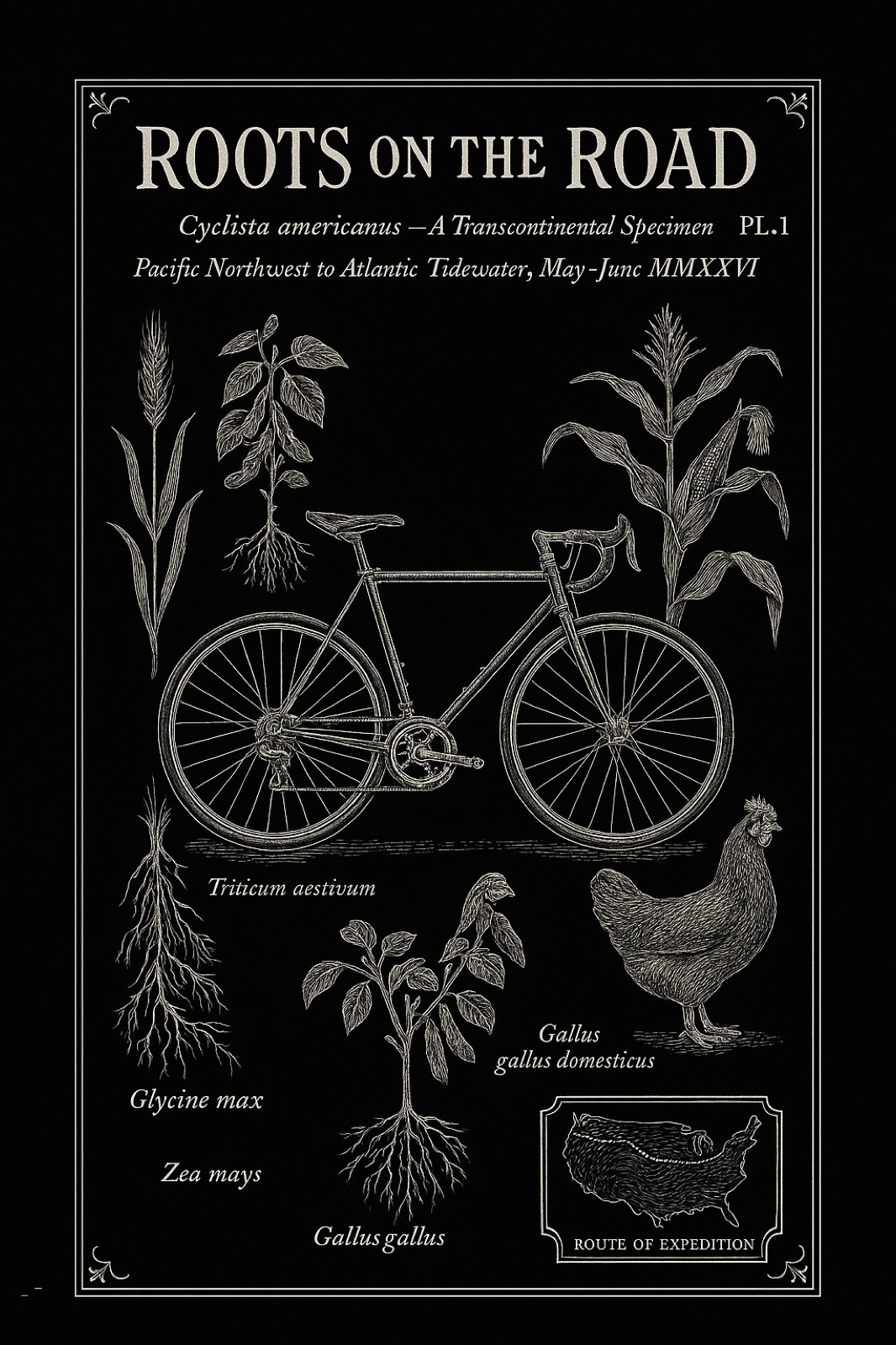
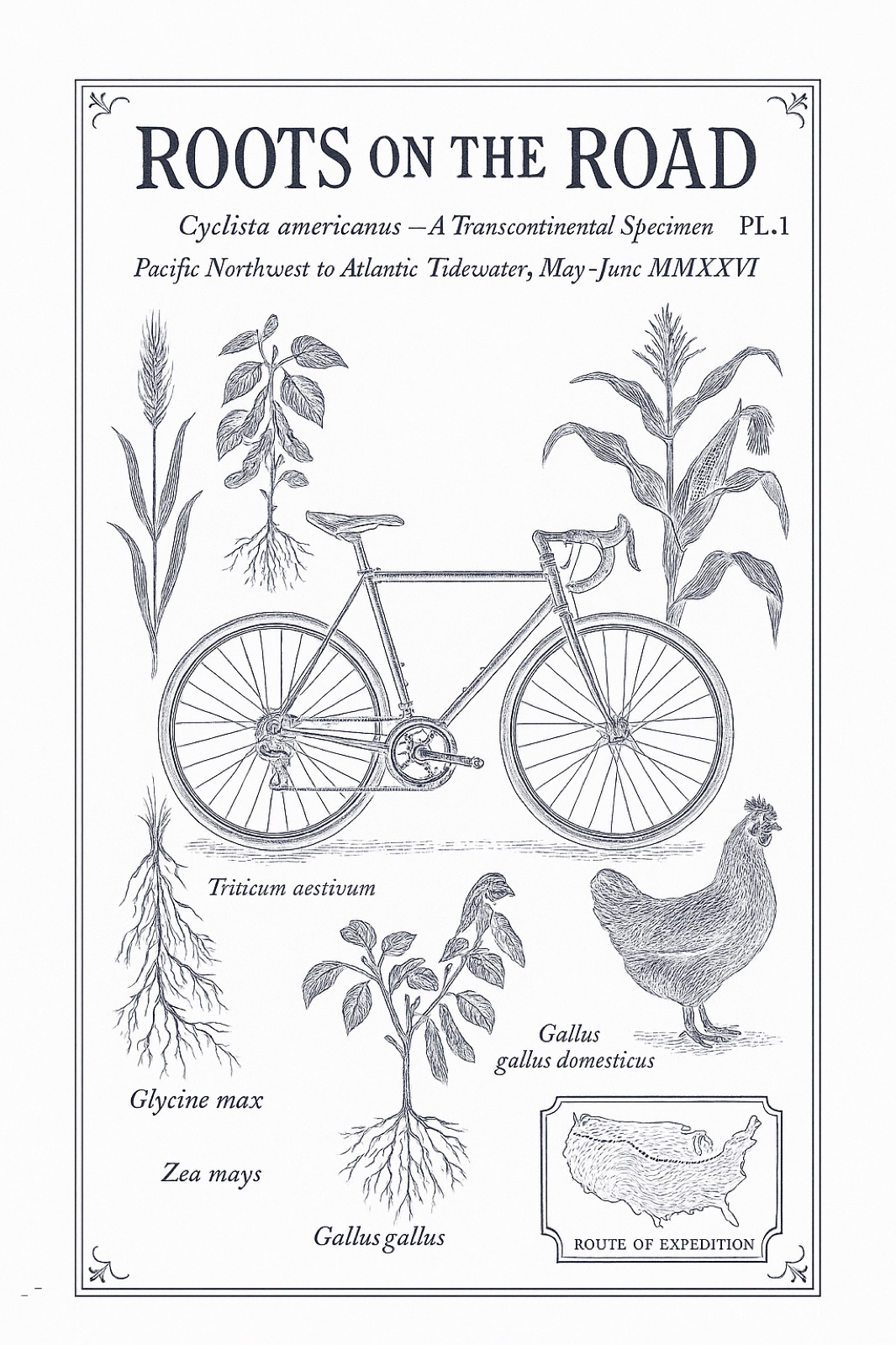
Botanical Plate

Botanical Plate on black
ON BLACK
Botanical Plate on white
ON WHITE
PROMPT
A 19th-century scientific botanical illustration plate, rendered as fine white line engraving on a solid black background, designed as a one-color screen-print graphic for the back of a t-shirt. Vertical composition.

Layout: an ornate engraved plate, framed by a thin double-rule border with small decorative corner flourishes. Plate number "PL. I" in the top-right corner inside the rule.

Top of the plate: ornate serif title "ROOTS ON THE ROAD" in a Didone or Caslon-style display serif, with a subtitle line below in italic: "Cyclista americanus — A Transcontinental Specimen." Below that in smaller italic: "Pacific Northwest to Atlantic Tidewater, May–June MMXXVI."

Center of the plate: a vintage road bicycle drawn in the style of an Audubon plate, as if it were a scientific specimen — viewed from the side, every spoke, cable, and component rendered in fine engraved lines with delicate cross-hatching for tonal shading. The bicycle is the "specimen."

Around the bicycle in a loose, naturalistic arrangement (not a rigid grid): detailed engraved illustrations of agricultural specimens — a wheat stalk with seed head, a soybean plant with pods, a corn stalk with ear and tassel, and a single hen. Each specimen has a hand-engraved label beneath it in italic Latin binomial: "Triticum aestivum," "Glycine max," "Zea mays," "Gallus gallus domesticus." Roots are visible on each plant, drawn with the same loving detail as the foliage.

Bottom of the plate: a small inset cartouche containing a hand-engraved fragment of the United States with a dotted route line from Seattle to Washington D.C., labeled "ROUTE OF EXPEDITION."

Aesthetic references: John James Audubon's "Birds of America" plates, USDA pomological watercolors converted to engraving, Sibley field guides, 1850-1890 scientific illustration, antique apothecary labels.

Strict constraints: pure white linework on pure black background only, fine cross-hatching for tonal effect is allowed, NO solid white fills, NO color, NO gradients, NO photographic elements. Every element looks hand-engraved.
A 19th-century scientific botanical illustration plate, rendered as fine white line engraving on a solid black background, designed as a one-color screen-print graphic for the back of a t-shirt. Vertical composition.
04

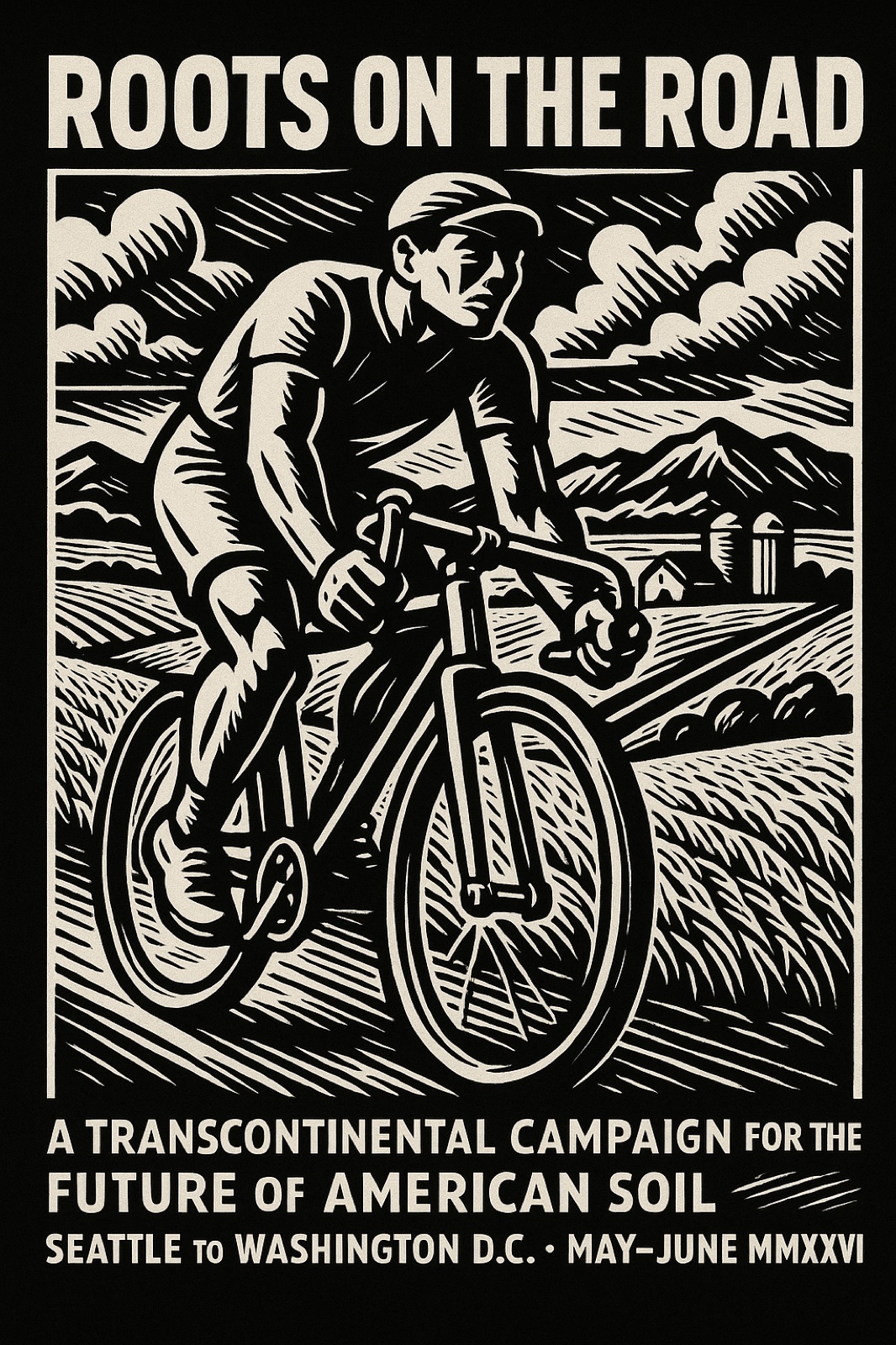
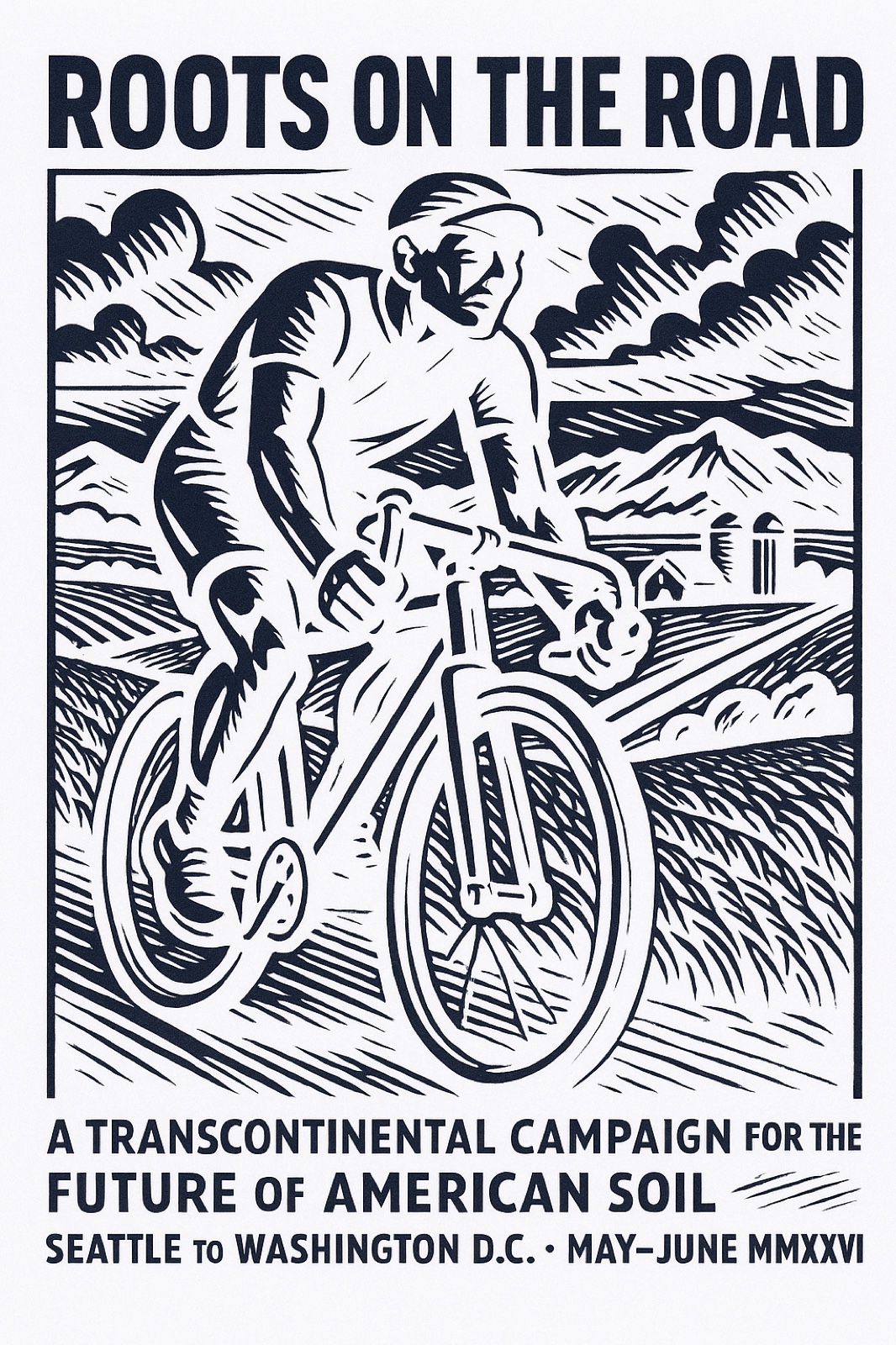
WPA Poster

WPA Poster on black
ON BLACK
WPA Poster on white
ON WHITE
PROMPT
A 1930s WPA-style propaganda poster aesthetic, rendered in bold white line and woodcut-style shapes on a solid black background, designed as a one-color screen-print graphic for the back of a t-shirt. Vertical poster composition.

Heroic central image: a stylized cyclist on a road bike, viewed from a low three-quarter angle so the rider looms heroically against the landscape. The cyclist is rendered in chunky simplified woodcut shapes with parallel-line shading on shadowed planes. The figure leans into the wind, determined, mid-pedal-stroke.

Behind and around the rider: a stylized American agricultural landscape rendered in flat geometric woodcut planes — rolling wheat fields with parallel-line shading suggesting wind across the grain, a distant grain silo and barn, a band of mountains on the horizon, dramatic stylized clouds with hard edges. A long road or rail line cuts diagonally through the composition behind the rider, suggesting the journey.

Top of the poster: "ROOTS ON THE ROAD" set in a heavy condensed sans-serif uppercase (Akzidenz Grotesk Bold Condensed or similar), tightly leaded across the full width.

Bottom banner spanning the width: "A TRANSCONTINENTAL CAMPAIGN FOR THE FUTURE OF AMERICAN SOIL · SEATTLE TO WASHINGTON D.C. · MAY–JUNE MMXXVI" in smaller condensed caps, set on a thin rule.

Aesthetic references: WPA Federal Art Project posters 1935-1942 (especially the National Park and soil conservation series), Rockwell Kent's woodcut illustrations, Ben Shahn, Joseph Binder travel posters, Soviet constructivist agricultural posters but warmer and more populist.

Strict constraints: only white linework and white solid shapes on pure black background, parallel-line hatching is allowed for shading, NO color, NO gradients, NO photographic elements, NO fine engraving detail — keep all shapes bold, blocky, and screen-print-friendly. The whole composition should read clearly from across a room.
A 1930s WPA-style propaganda poster aesthetic, rendered in bold white line and woodcut-style shapes on a solid black background, designed as a one-color screen-print graphic for the back of a t-shirt. Vertical poster composition.
05

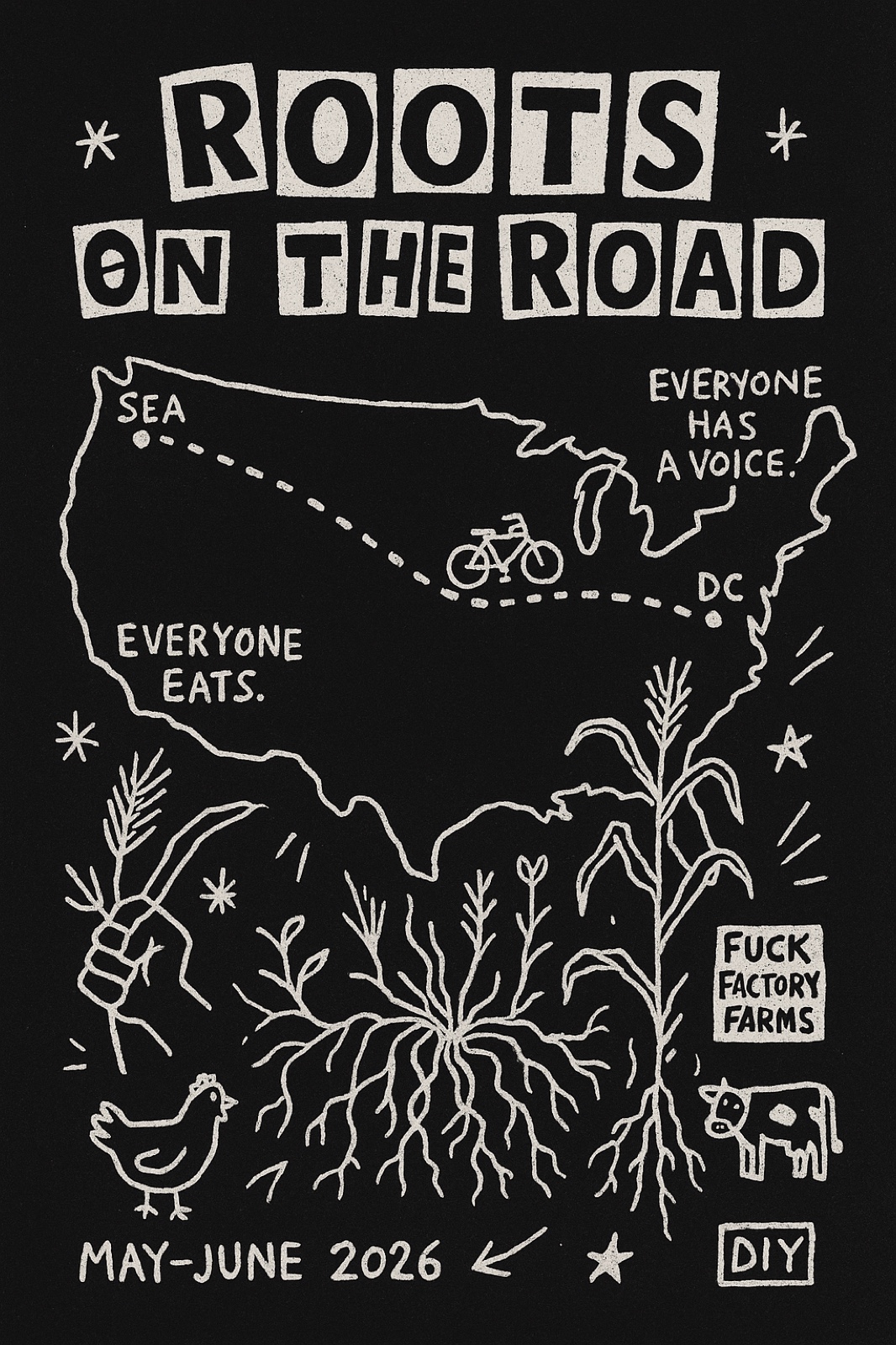
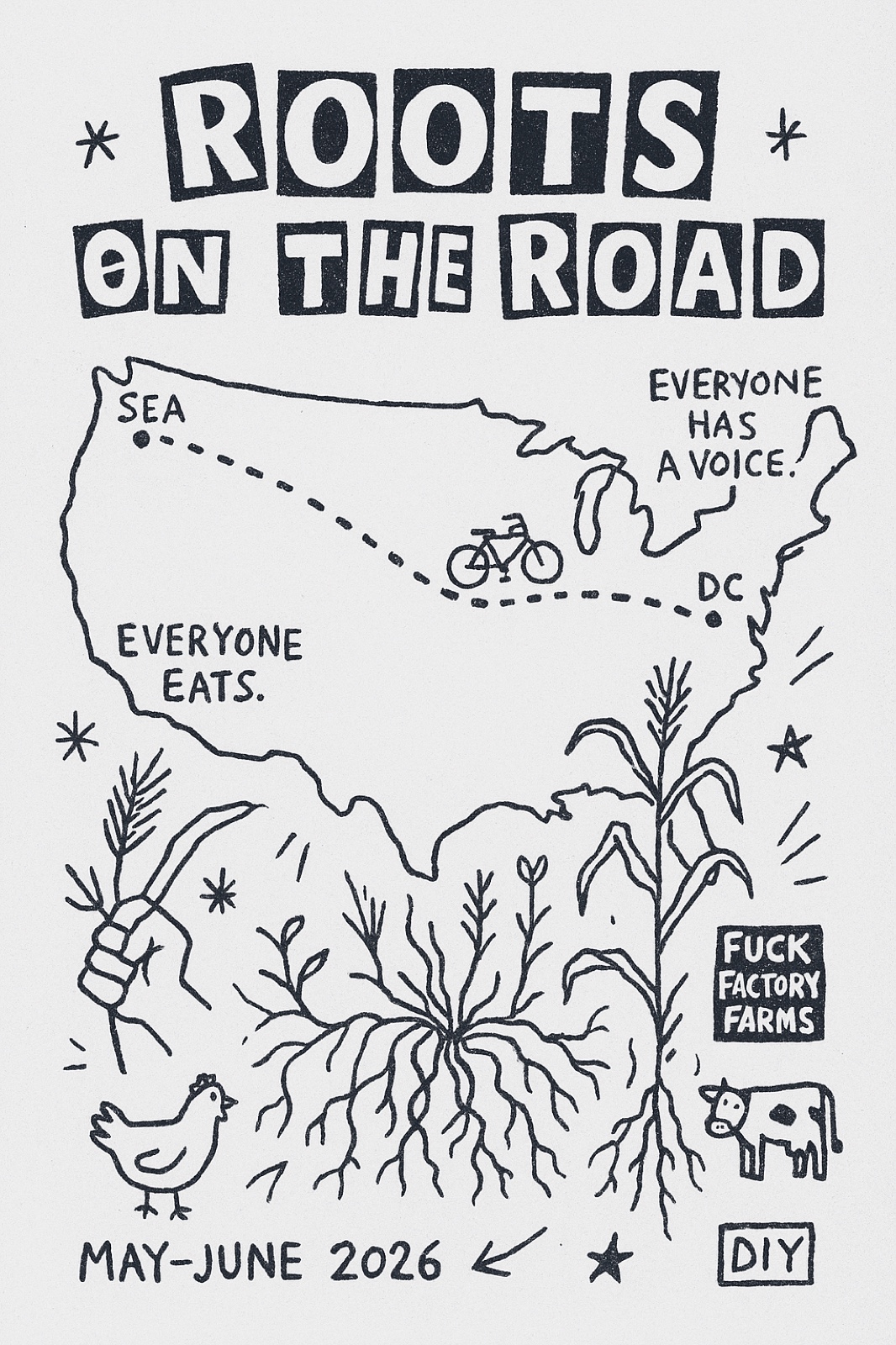
Punk Zine

Punk Zine on black
ON BLACK
Punk Zine on white
ON WHITE
PROMPT
A DIY punk zine / riso-print aesthetic, single white ink on solid black background, designed as a one-color screen-print graphic for the back of a t-shirt. Vertical composition with an intentionally chaotic but balanced collage feel.

Composition: a hand-drawn outline of the United States dominates the center, drawn with a slightly imperfect, jittery hand-marker line — clearly NOT done with a ruler. The southern border of the country morphs and dissolves into wild scribbled botanical roots, weeds, vines, a cornstalk, a wheat sheaf, a chicken doodle, and a small cow doodle, all hand-drawn in a loose punk-illustration style.

Across the top, in big "ransom-note" hand-cut letters of mixed sizes and slightly mismatched fonts: "ROOTS ON THE ROAD." Each letter looks like it was cut from a different magazine and pasted down crookedly.

Hand-drawn dotted bicycle route arcing across the country from Seattle (small "SEA" hand-lettered) to Washington D.C. (small "DC" hand-lettered), with a tiny scribbled bicycle riding along the route.

Marginalia scattered around the edges, hand-lettered in different sizes and angles like a punk flyer: "EVERYONE EATS." "EVERYONE HAS A VOICE." "MAY-JUNE 2026." Plus tiny hand-drawn stars, asterisks, scrawled arrows, a fist holding a wheat stalk in one corner, a small "DIY" stamp, a "FUCK FACTORY FARMS" hand-lettered patch (or similar earnest punk slogan), small zine-style dingbats.

Texture and feel: every line slightly imperfect, hand-drawn, with the slight registration imperfection and grainy texture of riso printing or a well-worn photocopy. Some elements look like halftone dot patterns on close inspection.

Aesthetic references: 1980s hardcore punk zines, Cometbus zine, Raymond Pettibon's Black Flag artwork, Patti Smith's notebooks, Mike Mills' early work, riso-printed farm-cooperative pamphlets, Crimethinc graphics.

Strict constraints: pure white "ink" on pure black background, no color, no gradients, all marks read as if hand-drawn or photocopied, embrace imperfection and asymmetry. NO clean vector shapes, NO computer-perfect type — everything should feel made by a human at 2am with a pen, scissors, and a copier.
A DIY punk zine / riso-print aesthetic, single white ink on solid black background, designed as a one-color screen-print graphic for the back of a t-shirt. Vertical composition with an intentionally chaotic but balanced collage feel.
07

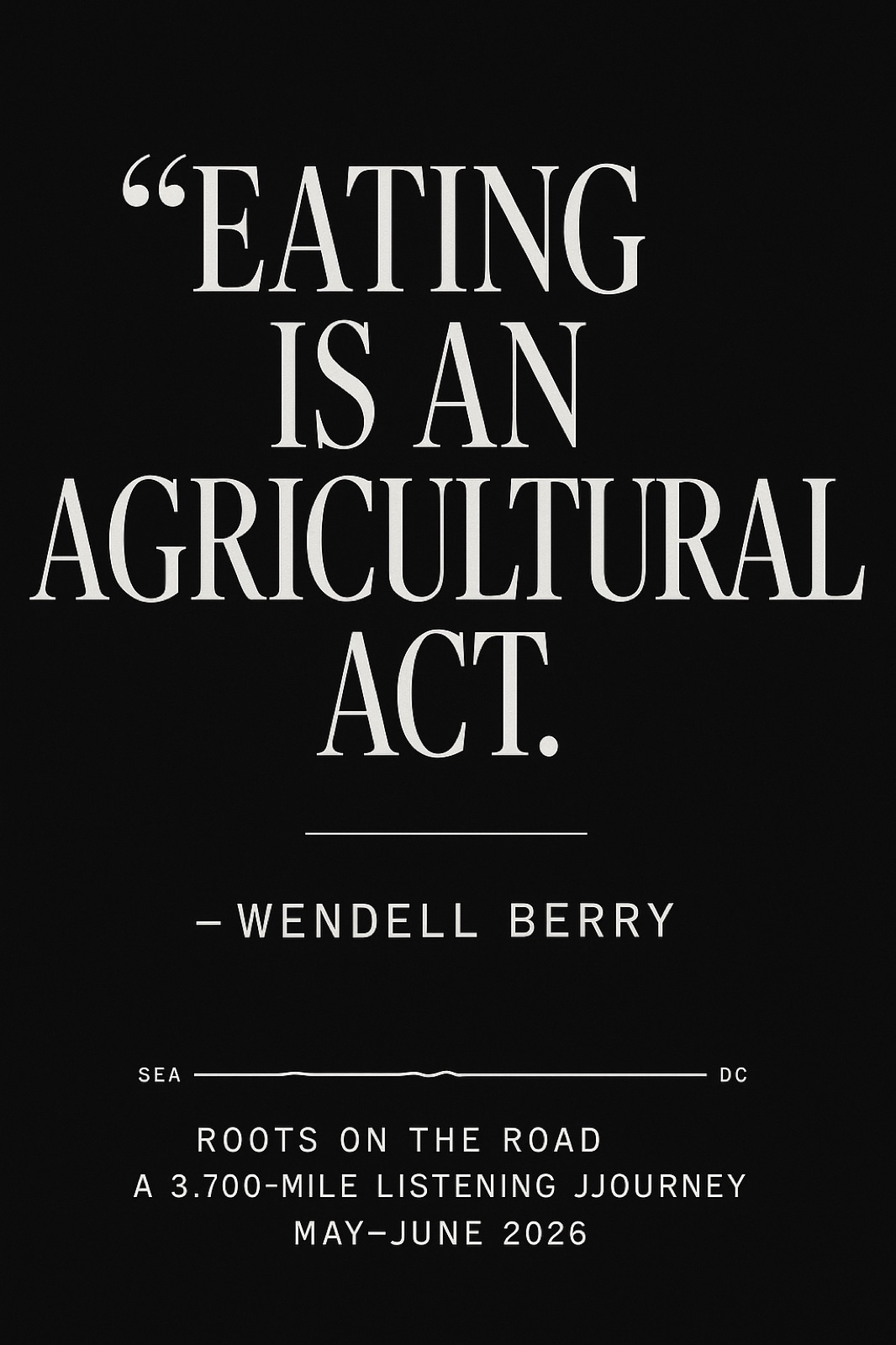
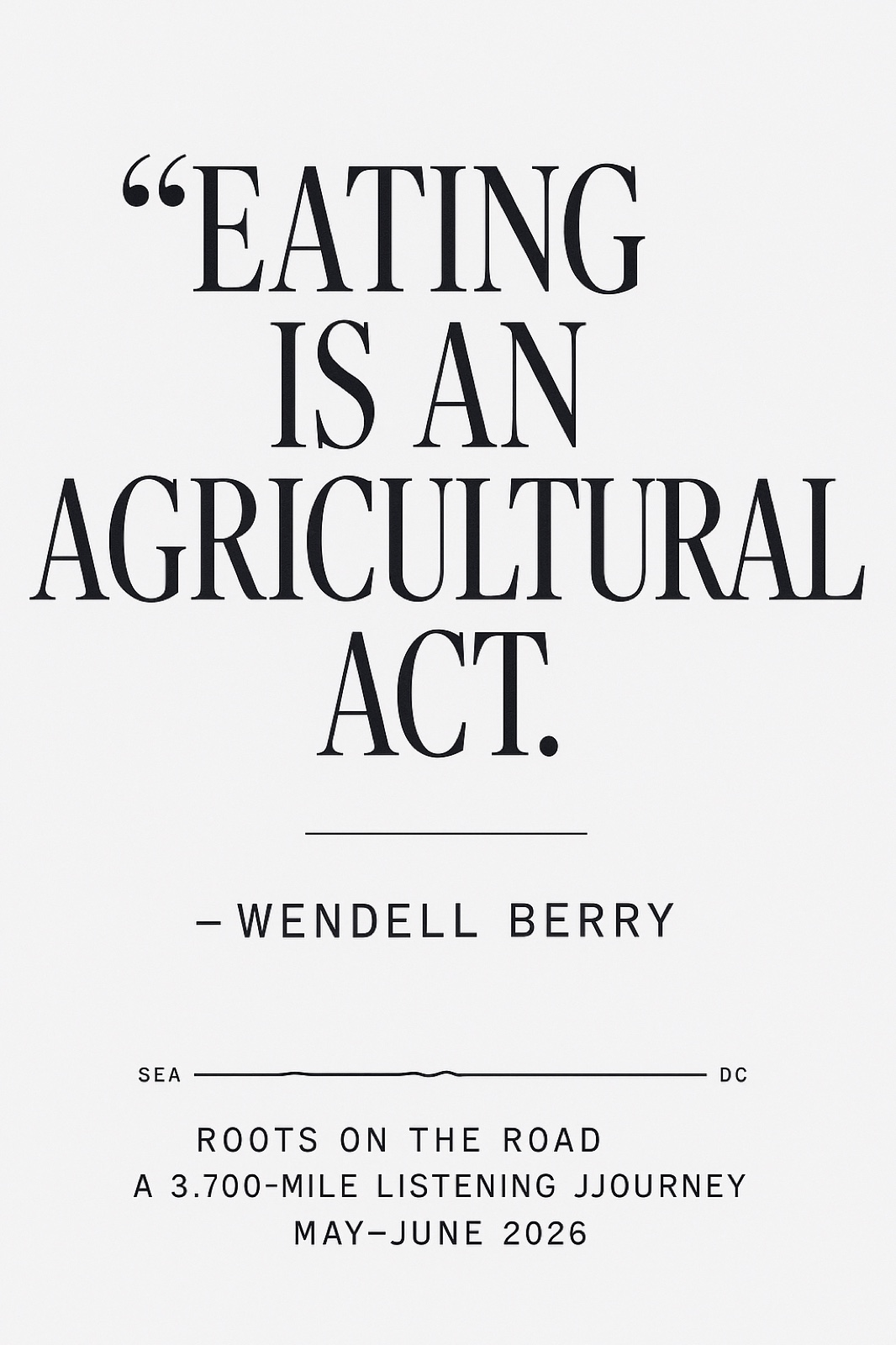
Berry Quote

Berry Quote on black
ON BLACK
Berry Quote on white
ON WHITE
PROMPT
Single-color white type-driven design on a solid black background, designed as a one-color screen-print graphic for the back of a t-shirt. Vertical composition.

The shirt back is dominated by an enormous quotation set in a refined editorial display serif (think Caslon, Didot, or Reckless Display): "EATING IS AN AGRICULTURAL ACT." The quote spans nearly the full width of the shirt, set in three lines, all uppercase, with generous leading and tight tracking. Quotation marks are large and elegant.

Beneath the quote, after a small space and a thin horizontal hairline rule, the attribution: "— WENDELL BERRY" in small monospaced caps, set centered.

Far below the attribution, near the bottom of the shirt, a small, modest credit lockup: a single thin horizontal line representing the Great American Rail Trail with tiny "SEA" tick mark on the left end and "DC" tick mark on the right end, and beneath it in small mono caps: "ROOTS ON THE ROAD · A 3,700-MILE LISTENING JOURNEY · MAY–JUNE 2026."

The composition should feel like the cover of a serious literary quarterly or a Wendell Berry essay collection — quiet, confident, all about the words. Lots of negative space (black) around the type. The type is the hero. The route line at the bottom is intentionally tiny and reverent.

Strict constraints: pure white type and line only on solid black, NO fills beyond the type itself, NO illustration other than the tiny route line at bottom, NO color, NO gradients, NO decorative ornament. Aesthetic references: cover design of n+1, The Paris Review, Aperture, Wendell Berry's Counterpoint Press editions, Aesop typography. Type must be perfectly legible and exquisitely set.
Single-color white type-driven design on a solid black background, designed as a one-color screen-print graphic for the back of a t-shirt. Vertical composition.
08

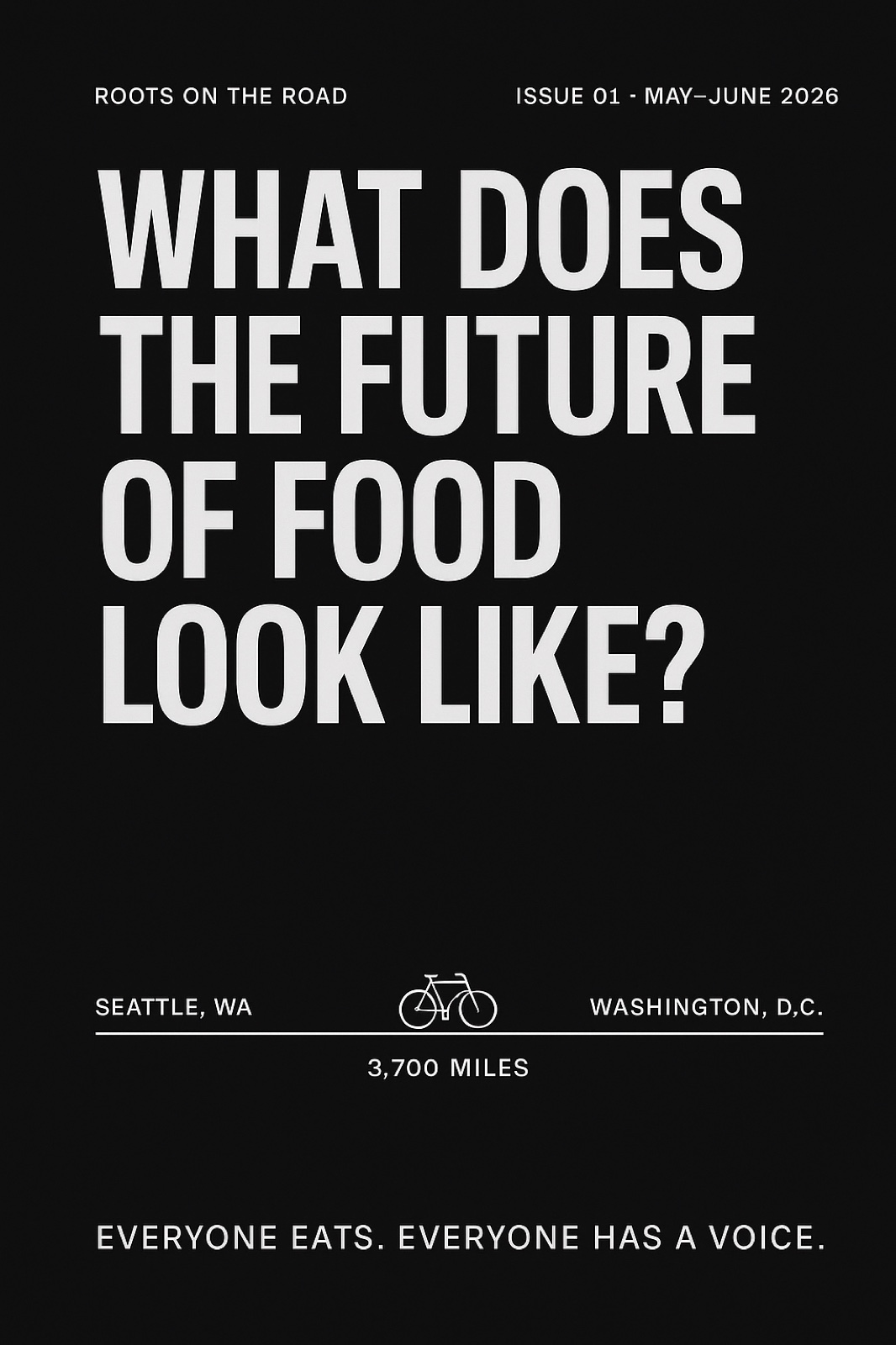
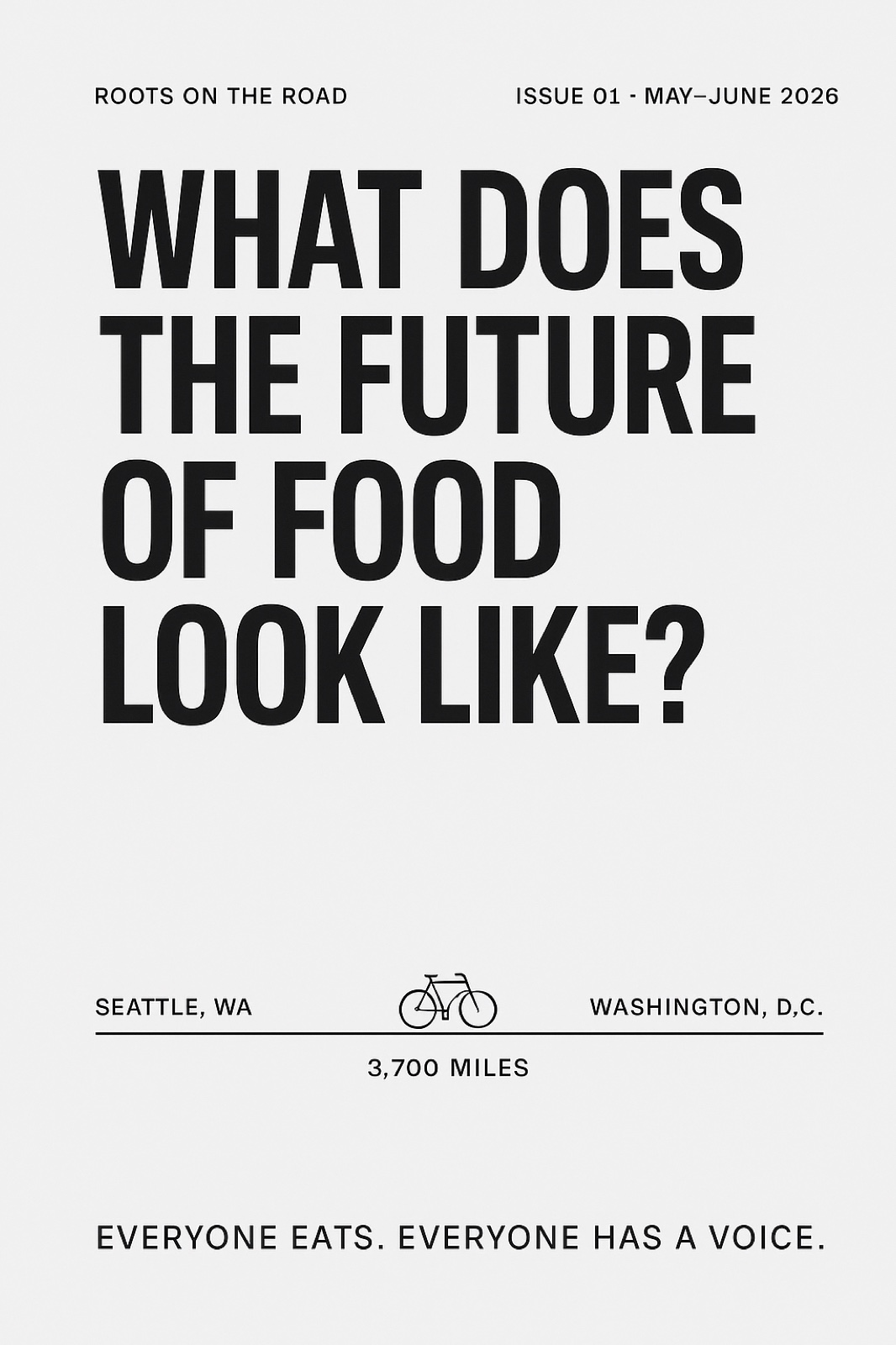
The Question

The Question on black
ON BLACK
The Question on white
ON WHITE
PROMPT
Single-color white type-driven design on a solid black background, designed as a one-color screen-print graphic for the back of a t-shirt. Vertical composition.

The shirt back is dominated by a single enormous magazine-cover-line question: "WHAT DOES THE FUTURE OF FOOD LOOK LIKE?" Set in a heavy, contemporary editorial sans-serif (think GT America Bold, Söhne Breit, or Inter Display Black), uppercase, in five lines, ranged left, with very tight leading so each line stacks closely on the one above. The question feels declarative and confrontational — like the cover of WIRED or The Atlantic.

In the upper-left or upper-right corner, a small "issue marker" in thin mono caps: "ROOTS ON THE ROAD · ISSUE 01 · MAY–JUNE 2026."

In the lower portion of the shirt, beneath the question, a thin horizontal hairline route line representing the Great American Rail Trail, with small mono caps labels: "SEATTLE, WA" at the left end, "WASHINGTON, D.C." at the right end, "3,700 MILES" beneath the center. A single small bicycle silhouette sits on the line at scale.

In the very bottom margin, a single line of small mono caps: "EVERYONE EATS. EVERYONE HAS A VOICE."

The composition should feel like the front cover of a serious culture magazine — the question is the headline, everything else is masthead and dateline. Lots of black negative space. Confident, quiet, journalistic, not preachy.

Strict constraints: pure white type and hairline only on solid black, NO illustration beyond the small bicycle and the route line, NO color, NO gradients, NO decorative ornament. Aesthetic references: editorial cover typography (The Atlantic redesigns, WIRED, Bloomberg Businessweek covers), Pentagram identity work, Aesop, Folio Society. Type must be flawlessly set and legible.
Single-color white type-driven design on a solid black background, designed as a one-color screen-print graphic for the back of a t-shirt. Vertical composition.
09

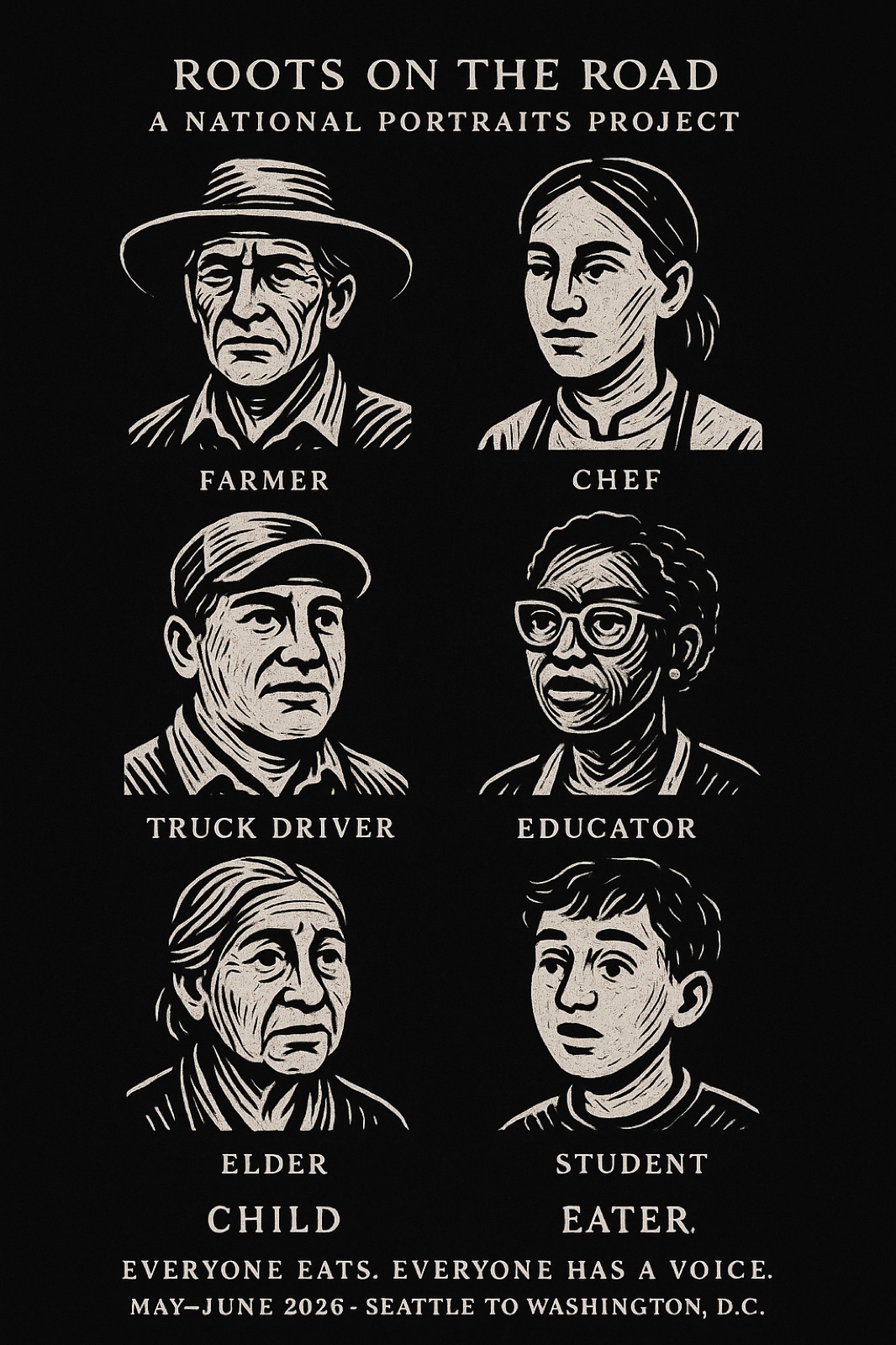
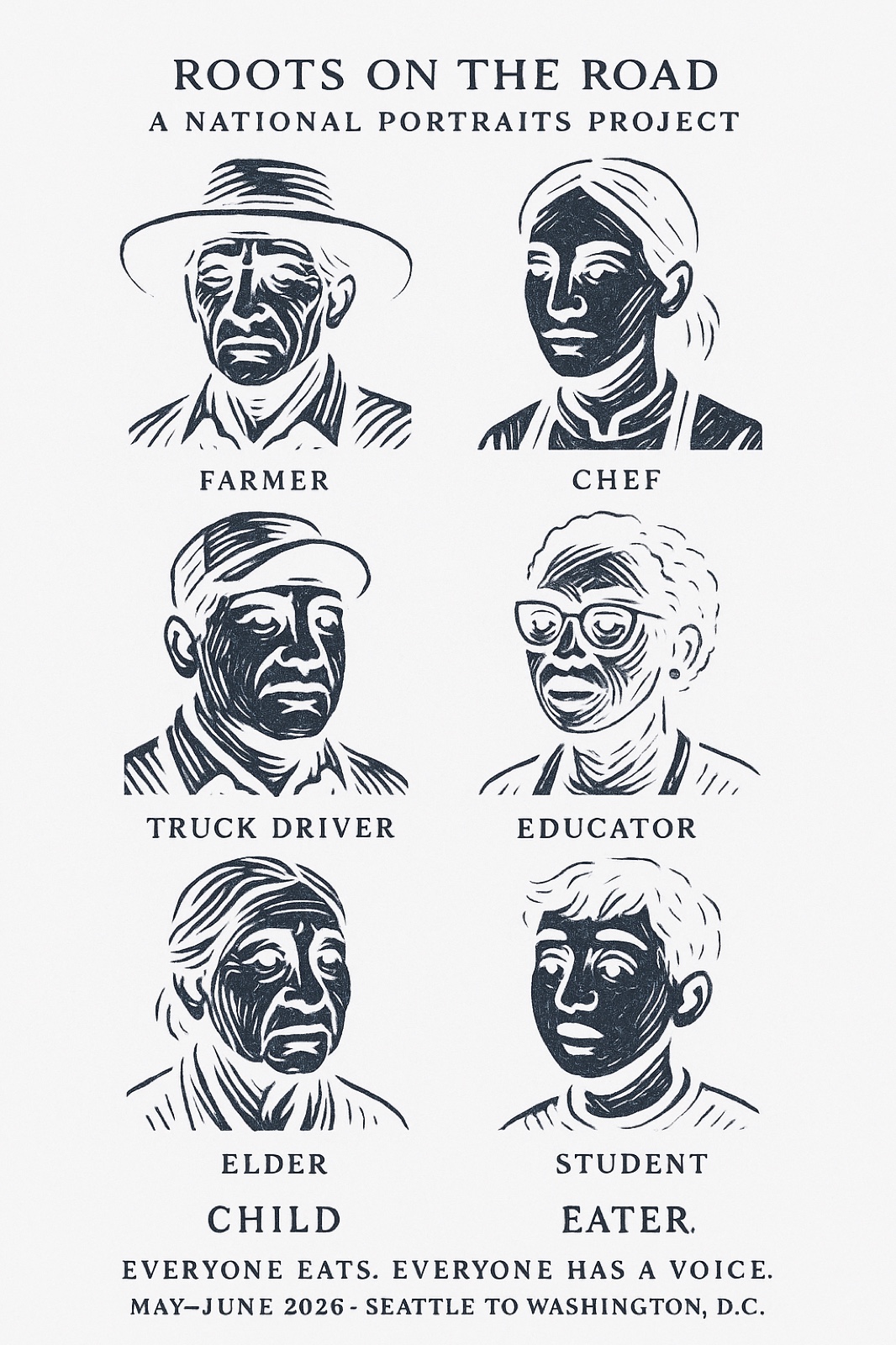
National Portraits

National Portraits on black
ON BLACK
National Portraits on white
ON WHITE
PROMPT
Single-color white woodcut/linocut-style portrait illustrations on a solid black background, designed as a one-color screen-print graphic for the back of a t-shirt. Vertical composition.

Layout: a 2-column by 4-row grid of eight small portrait illustrations of different people across the American food system. Each portrait is a tightly framed head-and-shoulders illustration in the style of a hand-cut linocut or a vintage WPA portrait — bold simplified shapes, parallel-line shading, expressive but not caricatured. Each portrait depicts a different role and a different age, gender, and background to convey real diversity:

Row 1: a weathered older FARMER in a wide-brim hat / a young female CHEF with hair tied back and an apron strap visible
Row 2: a middle-aged TRUCK DRIVER in a cap / a Black female EDUCATOR with glasses
Row 3: an elderly Latina ELDER / a young male FOOD-SCIENCE STUDENT with thoughtful expression
Row 4: a young CHILD with a curious open expression / a regular-looking middle-aged EATER (the everyday consumer)

Beneath each portrait, in tiny mono caps centered: "FARMER," "CHEF," "TRUCK DRIVER," "EDUCATOR," "ELDER," "STUDENT," "CHILD," "EATER." No personal names — they represent roles.

Above the grid, the title in elegant small caps: "ROOTS ON THE ROAD · A NATIONAL PORTRAITS PROJECT."

Below the grid, in tiny mono caps centered: "EVERYONE EATS. EVERYONE HAS A VOICE. · MAY–JUNE 2026 · SEATTLE TO WASHINGTON, D.C."

The portraits should feel humble, dignified, and documentary — these are the people the journey is honoring, not stereotypes. The style should feel like a contemporary illustrator's woodcut series for The New York Times opinion section.

Strict constraints: pure white strokes and white solid shapes on solid black background, parallel-line hatching is allowed for shading, NO color, NO gradients, NO photographic detail, all eight portraits should feel made by the same hand, screen-print friendly (no fine fiddly detail that will fill in). Aesthetic references: contemporary New York Times woodcut illustration, Eric Drooker, Frans Masereel, Lynd Ward, contemporary linocut artists like Andrea Lauren.
Single-color white woodcut/linocut-style portrait illustrations on a solid black background, designed as a one-color screen-print graphic for the back of a t-shirt. Vertical composition.
10

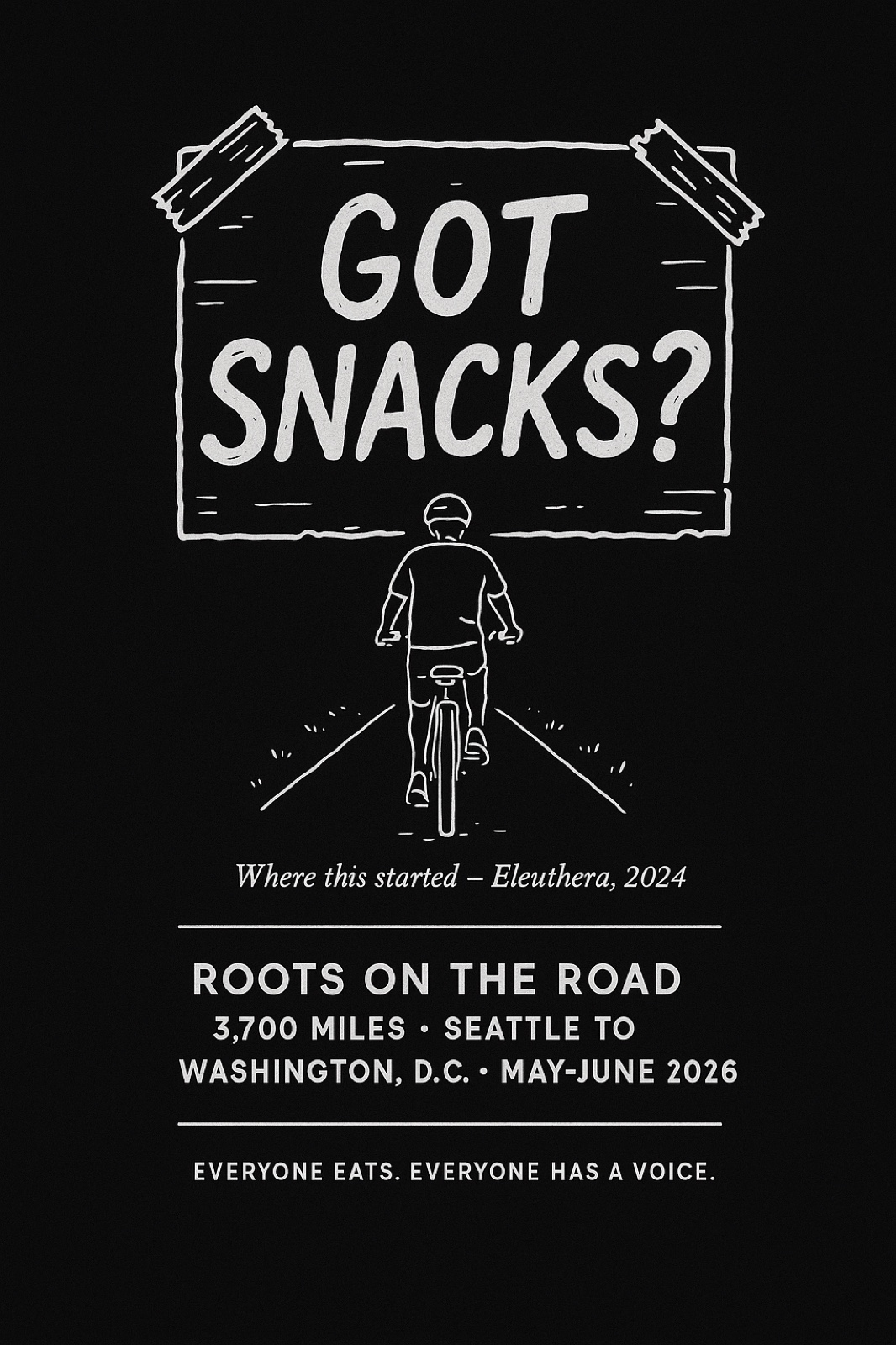
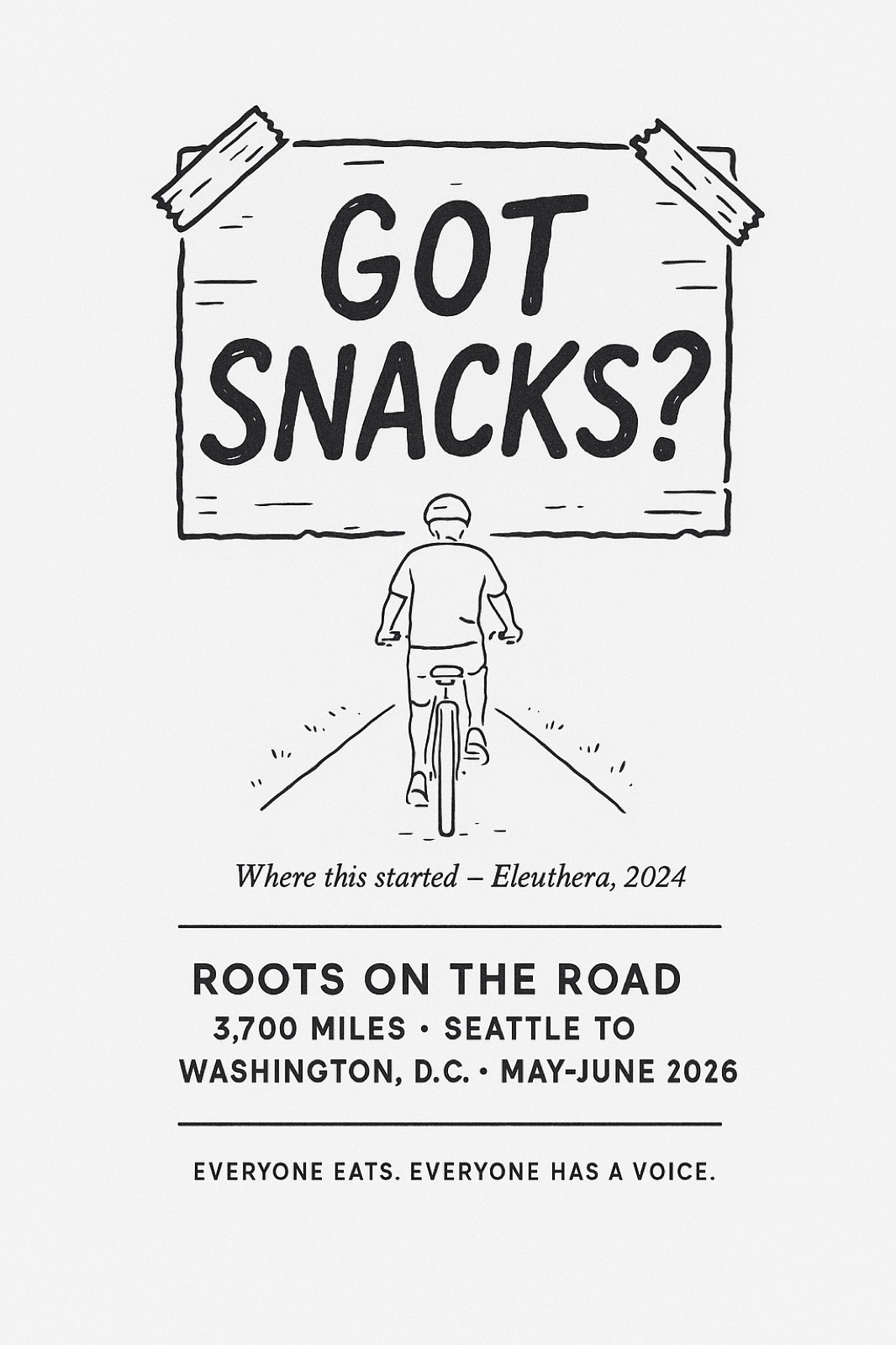
Got Snacks?

Got Snacks? on black
ON BLACK
Got Snacks? on white
ON WHITE
PROMPT
Single-color white line art on a solid black background, designed as a one-color screen-print graphic for the back of a t-shirt. Vertical composition.

Subject: an origin-story tee. The hero element is a hand-lettered cardboard sign reading "GOT SNACKS?" — exactly as it would have been written with a fat marker on a torn piece of cardboard, taped to the back of a cyclist riding a beach cruiser. The sign is the dominant element in the upper-center of the composition, drawn at large scale with imperfect tape strips at the corners and the slight crinkle of cardboard texture suggested in line.

Beneath the sign, a small line drawing of the back-view silhouette of a cyclist on a beach cruiser, viewed from behind — we see their back, the bike, the road stretching ahead. The cyclist is drawn small and intimate, almost like a memory.

Below the cyclist, a small italic caption in serif type: "Where this started — Eleuthera, 2024."

Then a thin horizontal hairline rule.

Then in mono caps: "ROOTS ON THE ROAD · 3,700 MILES · SEATTLE TO WASHINGTON, D.C. · MAY–JUNE 2026."

In the lower margin, much smaller: "EVERYONE EATS. EVERYONE HAS A VOICE."

The whole shirt should feel like an inside joke that becomes a manifesto — those who know the origin story will recognize the "GOT SNACKS?" sign immediately, and those who don't will be intrigued enough to ask. The hand-lettered sign should look genuinely hand-drawn (slightly imperfect strokes, real marker energy), in contrast to the more refined line work of the cyclist and the type below.

Strict constraints: pure white linework on solid black, the "GOT SNACKS?" hand lettering should look honestly hand-drawn (not a perfect font), the lower elements should be precisely set, NO color, NO gradients, NO solid fills beyond the marker strokes of the sign itself. Aesthetic references: Field Notes brand graphics, Topo Designs label work, Outerknown / Patagonia origin-story tees, Mast Brothers early packaging, contemporary indie outdoor brands.
Single-color white line art on a solid black background, designed as a one-color screen-print graphic for the back of a t-shirt. Vertical composition.
14

Sprouting Bike

Sprouting Bike on black
ON BLACK
Sprouting Bike on white
ON WHITE
PROMPT
A single iconic vector silhouette, centered on a solid pure black background. Square or near-square composition. The silhouette fills roughly 70% of the canvas, generously surrounded by black negative space.
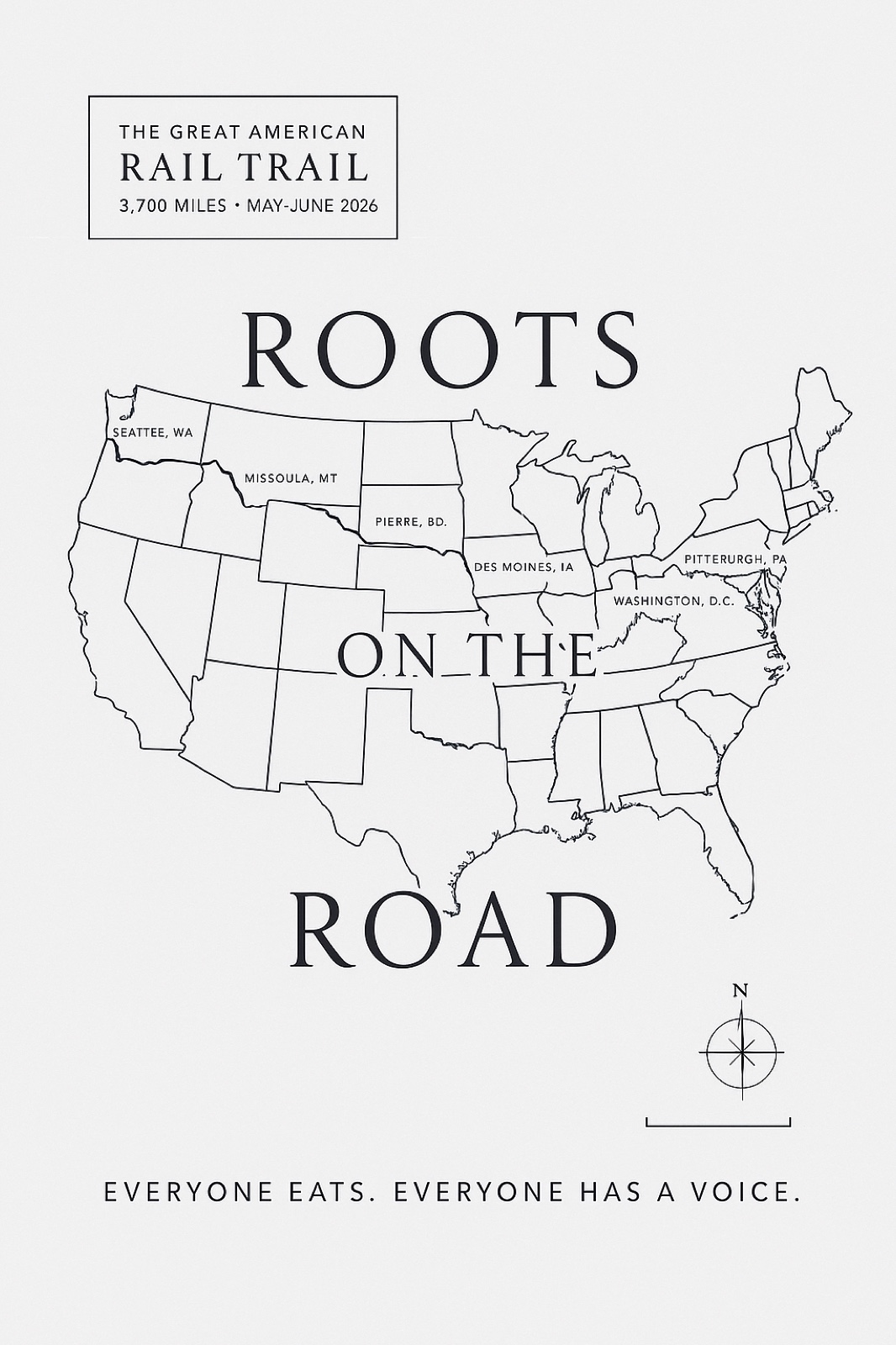
Subject: a side-view bicycle silhouette rendered as a single flat solid white shape, drawn in a confident modernist style — clean geometric circles for wheels, a triangulated frame, simple handlebars and seat. Stylized but unmistakable as a road bike or touring bike.

The visual pun: where the seat post would extend upward beyond the saddle, it transitions seamlessly into a single bold growing sprout — a stem with two simple leaves pushing upward toward the sky. The transition between mechanical bike and organic plant is seamless, the sprout flows out of the seat post like the bike is alive and growing. Both bike and sprout are the same continuous solid white shape.

Optional secondary element: small simple white root forms beneath the wheels — three or four short downward strokes — suggesting the bike has just been planted. These should be subtle and not compete with the bike's silhouette.

Beneath the icon, with generous space, a single tight wordmark in confident geometric sans-serif caps (Futura Bold or similar), set in two stacked centered lines: "ROOTS" / "ON THE ROAD." That is the only type.

Strict design constraints: pure flat solid white vector shapes on solid pure black background. NO outlines, NO gradients, NO color, NO photographic elements, NO additional text or decoration, NO hatching, NO drop shadows. Every shape is a clean filled silhouette. Aesthetic references: Paul Rand's UPS package logo, Saul Bass's AT&T globe and Bell System mark, the Citroën logo, Massimo Vignelli's transit signage, contemporary Pentagram and Base Design identity work. The bike-becomes-plant idea is the entire concept. Reductive. Witty. Iconic.
A single iconic vector silhouette, centered on a solid pure black background. Square or near-square composition. The silhouette fills roughly 70% of the canvas, generously surrounded by black negative space.
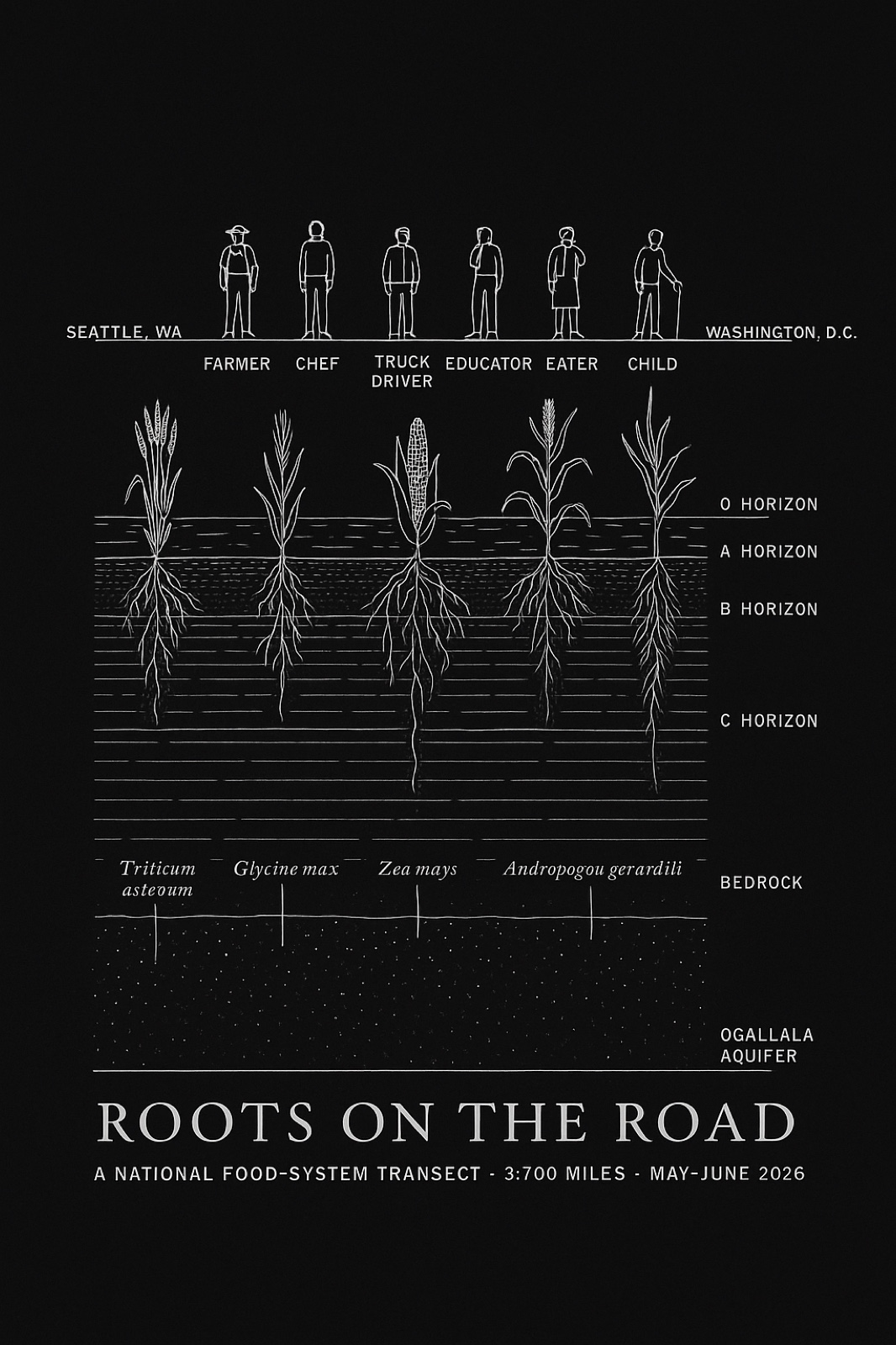
15

Us as Leaf

Us as Leaf on black
ON BLACK
Us as Leaf on white
ON WHITE
PROMPT
A single iconic vector mark, centered on a solid pure black background. Square or near-square composition. The mark fills roughly 70% of the canvas, generously surrounded by black negative space.
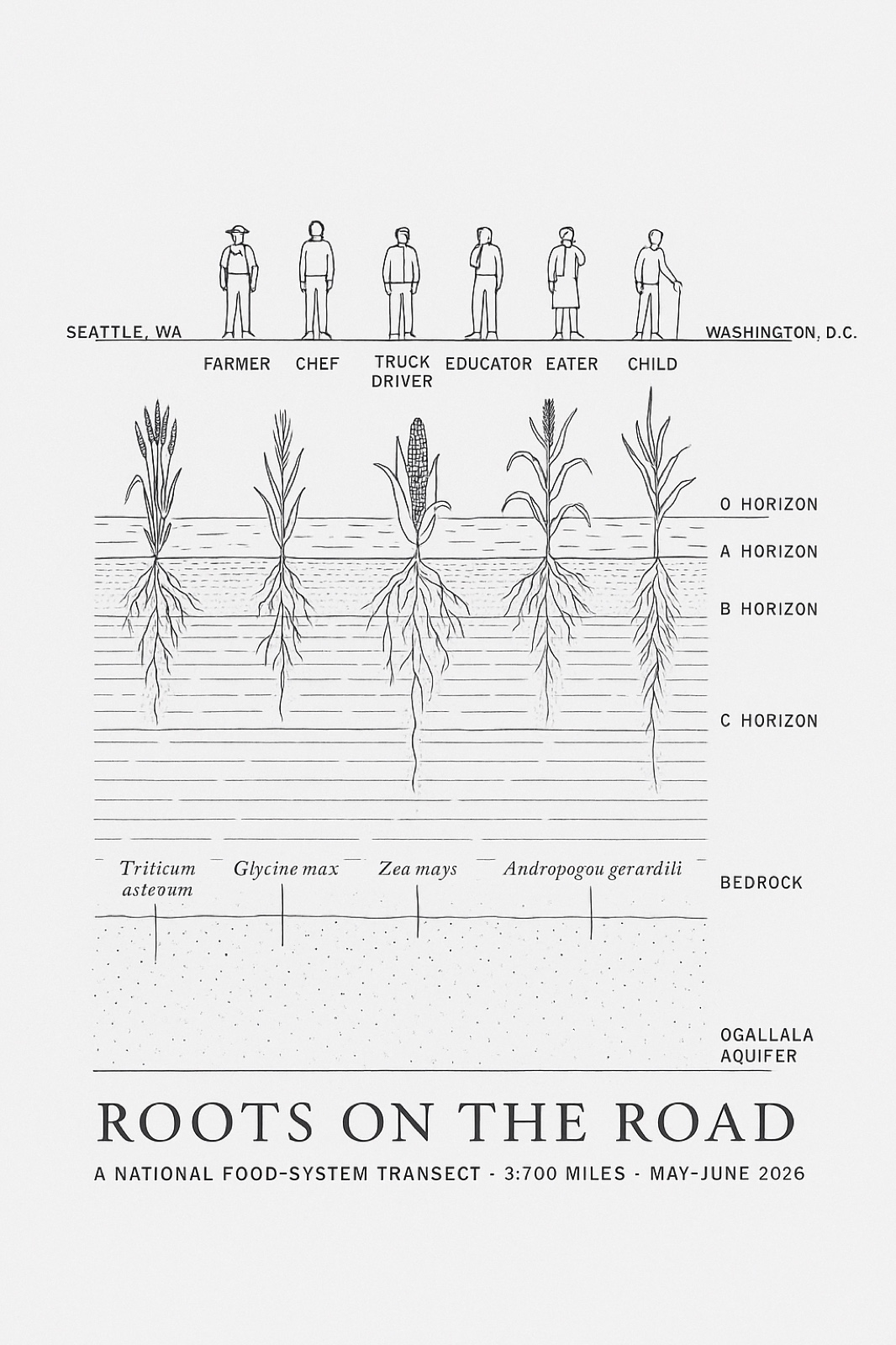
Subject: a stylized silhouette of the contiguous United States, rendered as a single flat solid white vector shape — but the country is unmistakably also a leaf. The continental outline is gently massaged so the overall form reads simultaneously as the US map AND as an organic leaf. The Pacific Northwest tip becomes the leaf's stem-end (a small stem extends from the Washington State coast). The Florida peninsula becomes the leaf's pointed tip. The general silhouette retains enough US-map character (recognizable Pacific coast, Gulf of Mexico, Florida, the Northeast) that the visual pun reads instantly: "the country is a leaf."

Across the leaf/country, draw delicate solid white leaf-vein lines: one strong central vein traveling from the Pacific Northwest stem all the way across to the East Coast (this vein is the Great American Rail Trail), and several finer secondary veins branching off it like ribs. The central vein is slightly thicker than the secondaries.

At the very start of the central vein (Seattle end), a tiny solid white dot marker. At the end (DC end), another tiny dot marker. Optional: a single tiny white bicycle silhouette positioned somewhere along the vein, scale-correct so it nearly disappears.

Beneath the icon, with generous space, a tight wordmark in confident geometric sans-serif caps (Futura Bold or similar), set in two stacked centered lines: "ROOTS" / "ON THE ROAD." That is the only type.

Strict design constraints: pure flat solid white vector shapes on solid pure black background. The country/leaf is one solid filled shape; the veins are clean white lines of consistent weight. NO outlines on the shapes, NO gradients, NO color, NO photographic elements, NO state borders, NO additional text or decoration, NO drop shadows. Aesthetic references: Paul Rand's Westinghouse and Cummins marks, Saul Bass's Bell System bell, Massimo Vignelli's National Park Service modernist proposals, the Sierra Club logo, contemporary Pentagram environmental identity work. The country-is-a-leaf visual pun is the entire concept. Reductive. Iconic.
A single iconic vector mark, centered on a solid pure black background. Square or near-square composition. The mark fills roughly 70% of the canvas, generously surrounded by black negative space.
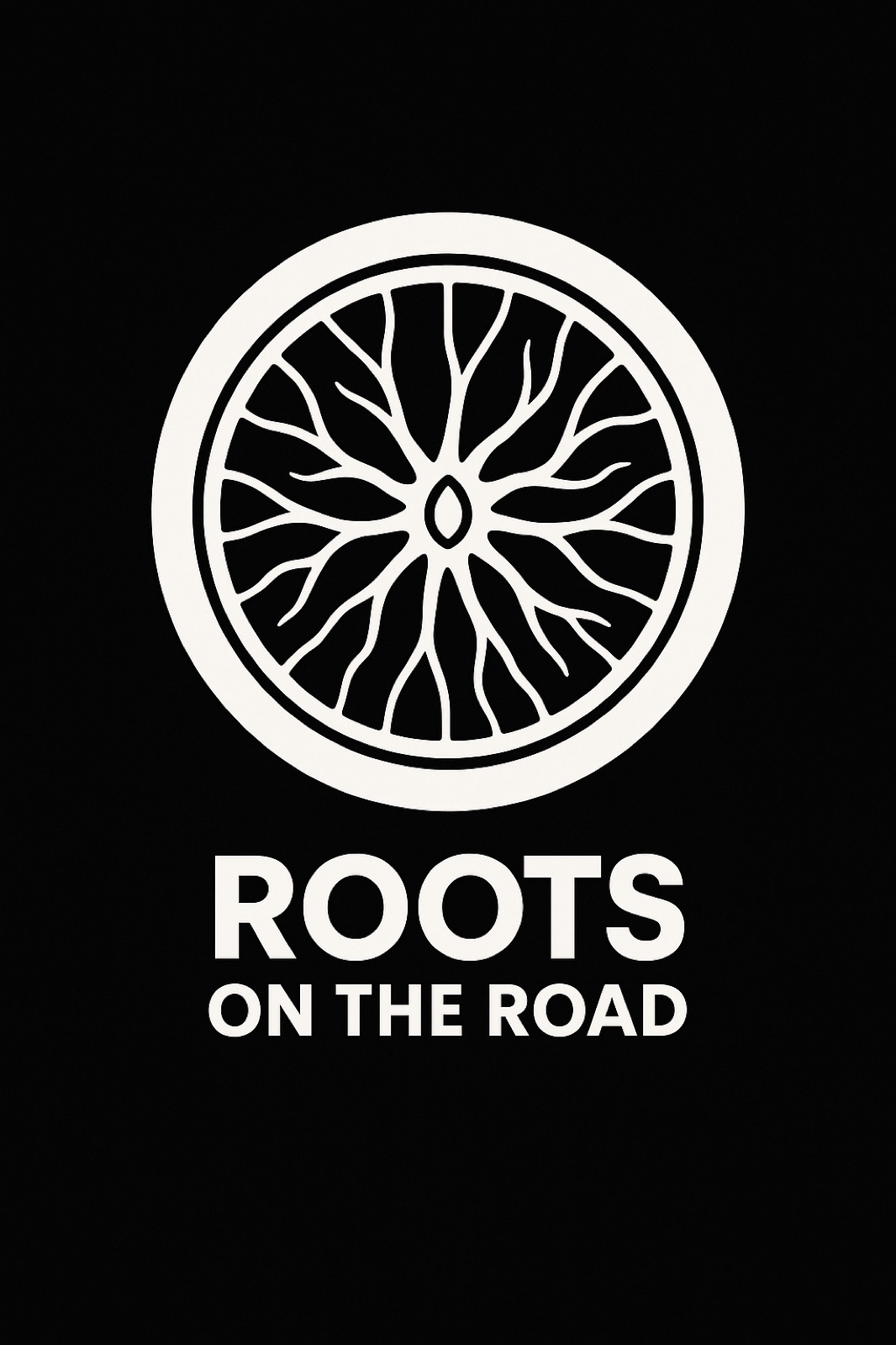
16

Trail as Gesture

Trail as Gesture on black
ON BLACK
Trail as Gesture on white
ON WHITE
PROMPT
A single iconic vector mark, centered on a solid pure black background. Horizontal-leaning composition, the mark spans roughly 80% of the canvas width, generously surrounded by black negative space above and below.

Subject: a single continuous gestural white form that traverses the canvas from left to right, telling a three-act story in one unbroken line: ROOT → ROAD → SPROUT.

Left third: the mark begins as a downward-growing root system emerging from a small horizontal "ground line" — a confident curving root with two or three smaller tendrils branching off, all in solid white shape.
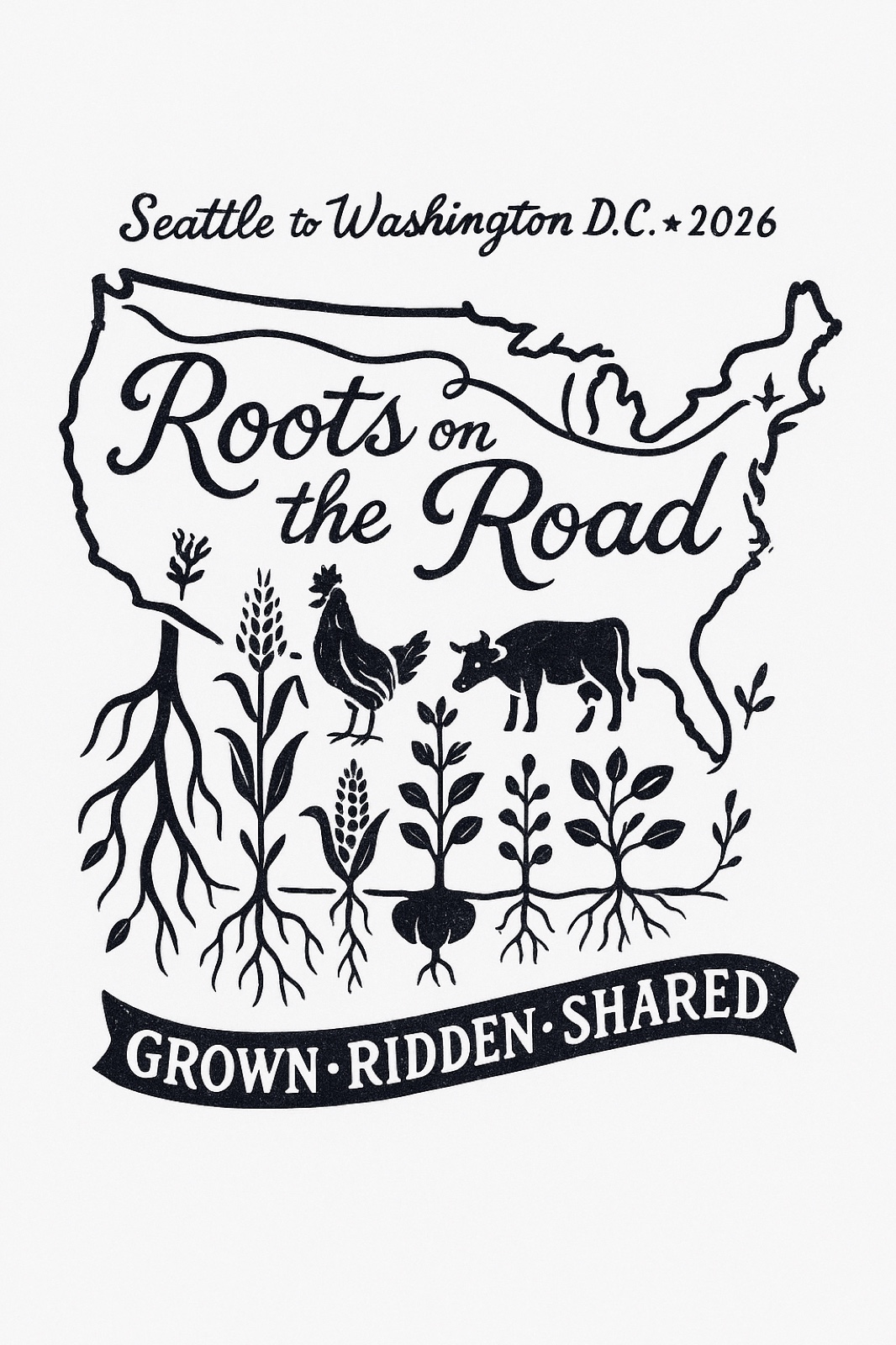
Middle third: the root rises up to ground level and continues as a single clean horizontal road — a flat white line of consistent thickness, with two or three short evenly-spaced perpendicular tick marks suggesting road dashes or fence posts. This is the journey.
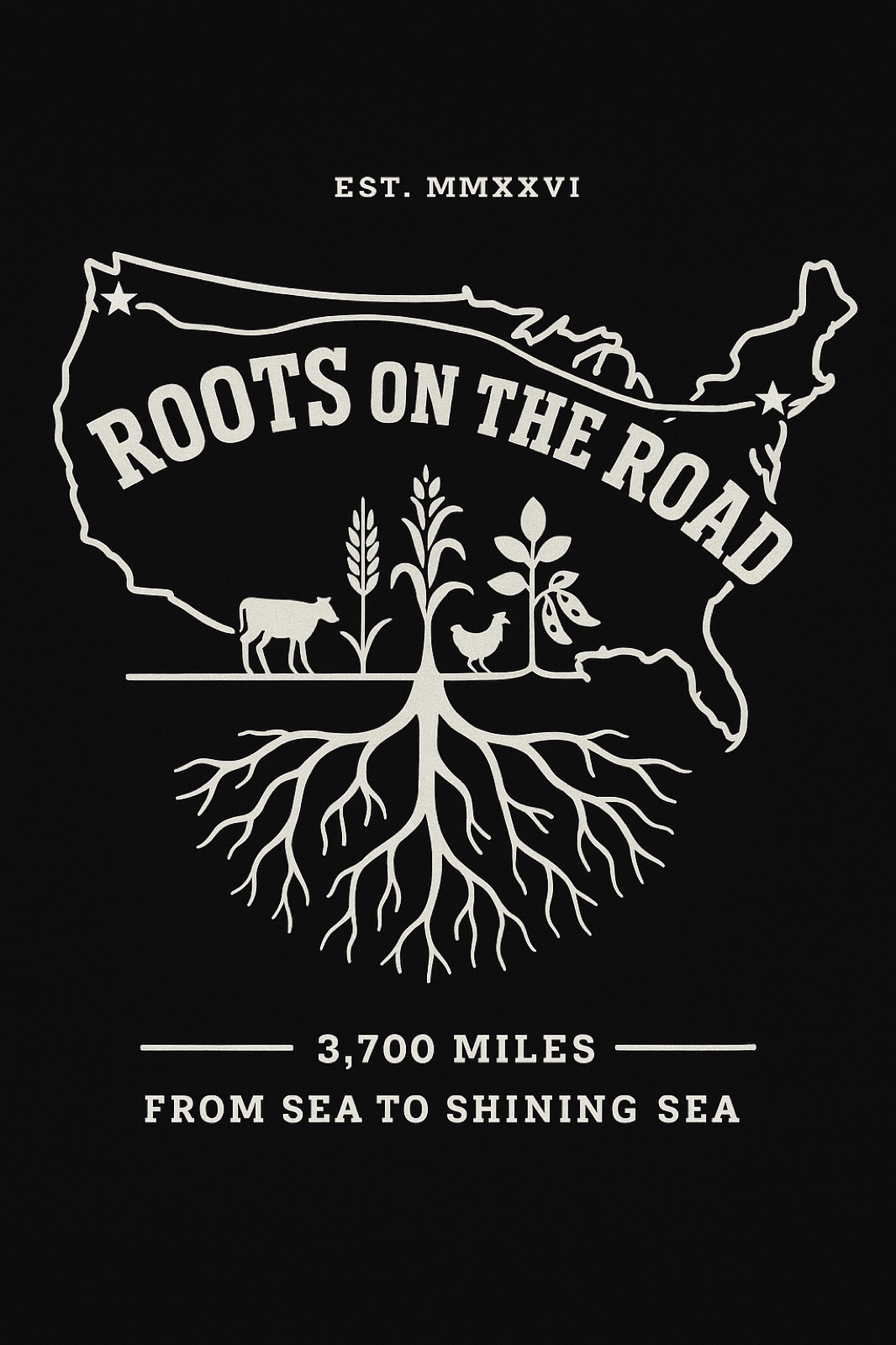
Right third: the road rises again and transitions into an upward-growing plant — a single confident stem with two stylized leaves opening outward, like a sprout reaching for sun. Solid white shape.

The entire form — root, road, and sprout — is one continuous unbroken white shape, drawn with the confidence of a single brushstroke or a single Paul Rand pen gesture. The transition from organic root to mechanical road to organic sprout should feel inevitable.

Optional: a single small white bicycle silhouette positioned on the road segment, scale-correct so it nearly disappears.

Beneath the gesture, with generous space, a tight wordmark in confident geometric sans-serif caps (Futura Bold or similar), set in two stacked centered lines: "ROOTS" / "ON THE ROAD." That is the only type.

Strict design constraints: pure flat solid white vector shapes on solid pure black background. The root-road-sprout form is ONE continuous solid shape. NO outlines, NO gradients, NO color, NO photographic elements, NO additional text, NO hatching, NO decorative ornament, NO drop shadows. Aesthetic references: Paul Rand's Cummins and ABC marks, Saul Bass's poster work for Anatomy of a Murder, Joan Miró's calligraphic forms, Picasso's single-line drawings, Massimo Vignelli's transit diagrams. The single-gesture-tells-a-story idea is the whole concept. Reductive. Confident. Iconic.
A single iconic vector mark, centered on a solid pure black background. Horizontal-leaning composition, the mark spans roughly 80% of the canvas width, generously surrounded by black negative space above and below.
35

Us as Leaf v2

Us as Leaf v2 on black
ON BLACK
Us as Leaf v2 on white
ON WHITE
PROMPT
A single iconic t-shirt back illustration, centered on a solid pure black background. Tall portrait composition. The illustration fills roughly 90% of the canvas, generously surrounded by black margin.

Subject: a refined visual conceit — the contiguous United States rendered as a single LEAF. The familiar US silhouette is unmistakably present (Pacific NW upper-left, Florida lower-right, Maine upper-right), but its internal structure is that of a botanical leaf: a strong central vein (midrib) running roughly along the Mississippi River from Minnesota down to the Gulf, and lateral veins branching outward from this central vein toward each coast like the venation of a leaf. All in clean confident white linework on solid pure black background.

The northern border of the US: along the upper edge of the leaf, the cycling route from Seattle (upper-left) eastward across the northern tier to Washington D.C. (upper-right) is rendered as a slightly thicker confident white curve. ON this route, the words "ROOTS ON THE ROAD" are set in clean geometric sans-serif caps following the curve, each letter sitting on the route as its baseline.

The southern border of the US morphs into the leaf's stem and root system through THREE zones:

ZONE 1 (WEST — California through Texas): the southern border dissolves DOWNWARD into the leaf's natural root system — the central midrib extends below the leaf as a primary taproot, with secondary roots branching out and tapering naturally into the black space below.

ZONE 2 (MIDDLE — Louisiana/Mississippi/Alabama section): integrated into the leaf-root structure, three small farm plants emerge from the soil-line of the southern border: a tiny wheat sheaf, a tiny corn stalk, a tiny soybean plant — each with its own root system descending below, drawn at a smaller scale so they read as plantings within the larger leaf-system. A small cow silhouette and a small chicken silhouette stand on the border line.

ZONE 3 (EAST — Florida): the leaf-edge returns to a clean map outline, with Florida intact and reading as the natural curling tip of the leaf.

The lateral veins of the leaf, branching from the central midrib out toward the east and west coasts, double as both botanical leaf-venation AND a subtle suggestion of major American river systems (Missouri, Ohio, Colorado, Columbia). Clean and confident.

Strict design constraints: pure clean white linework with consistent line weight on solid pure black background. The leaf-veins inside the US shape are the ONLY internal lines — NO state borders. NO fills, NO color, NO gradients, NO photographic elements, NO drop shadows. Aesthetic references: contemporary minimalist tattoo design, modern botanical-illustration revival work, the conceit of Saul Steinberg's "View of the World from 9th Avenue" applied to ecology, the elegance of a Pentagram identity mark. Singular conceit. Clean. Memorable.
A single iconic t-shirt back illustration, centered on a solid pure black background. Tall portrait composition. The illustration fills roughly 90% of the canvas, generously surrounded by black margin.